Smart Business: The importance of peer groups to my success
September 10th, 2024
Not long after, I attended a two-day industry seminar. It was long ago, the pre-internet era. The association that hosted the event sent a fax soliciting feedback. I excitedly filled it out, then put it back in the fax machine to return my answers. I suggested they include more networking events. Networking wasn’t a buzzword back then — I asked for more socializing opportunities. I wanted to meet people from our industry. Networking back then meant you had a big Rolodex.
Much to my shock, an hour later the fax spit out a flyer from our association looking for interested participants in a CEO peer networking group that was being formed. I was amazed at their speed of addressing my suggestion. I thought, I want to be part of any organization that can move this fast.
Turns out, coincidentally, the planning had been going on for over a year. It was an auspicious beginning to a group — my industry-specific peer networking group. The group has had a huge influence on our success. One thing I learned is that it did not matter how big each company was. We all had the same problems.
Over my career, I have been a member of numerous peer groups. Some are general business-oriented, and some are very specific to CEOs. Some are very specific to a tightly defined industry, i.e. metal forming. All have helped me a lot. As an example, I was in final negotiations to take over a competitor’s stamping operation. I described the project to a new member of our peer group. His advice was to get the equipment in our shop ASAP. We had not signed a contract yet. He strongly urged, since we were close, to act like it was a done deal and move the equipment. It was subtle yet important advice. We followed it, the rest of the negotiations went very smoothly. Twenty five years and billions of pieces later, they are still our largest customer. We enjoy a true partnering relationship.
We have even formed peer groups within our own company. They foster better communication and help build camaraderie among our colleagues. Educational opportunities come from all types of peer groups, be it co-workers, suppliers, customers, even competitors.
We have all been surrounded by peer groups our whole lives. PTA, sports teams, Cub Scouts, are all versions of peer groups built to facilitate learning. Education is as important as anything we do in life. Facilitating it and improving it is as noble as any endeavor. Success almost has to follow.
I am so enamored with the idea that I am forming one: Pepe’s Deal Community. Criteria for membership: Be a friend of mine and be involved in the “deal community,” which mostly means buying/selling companies. Stay tuned.
Steve Peplin is CEO of Talan Products.
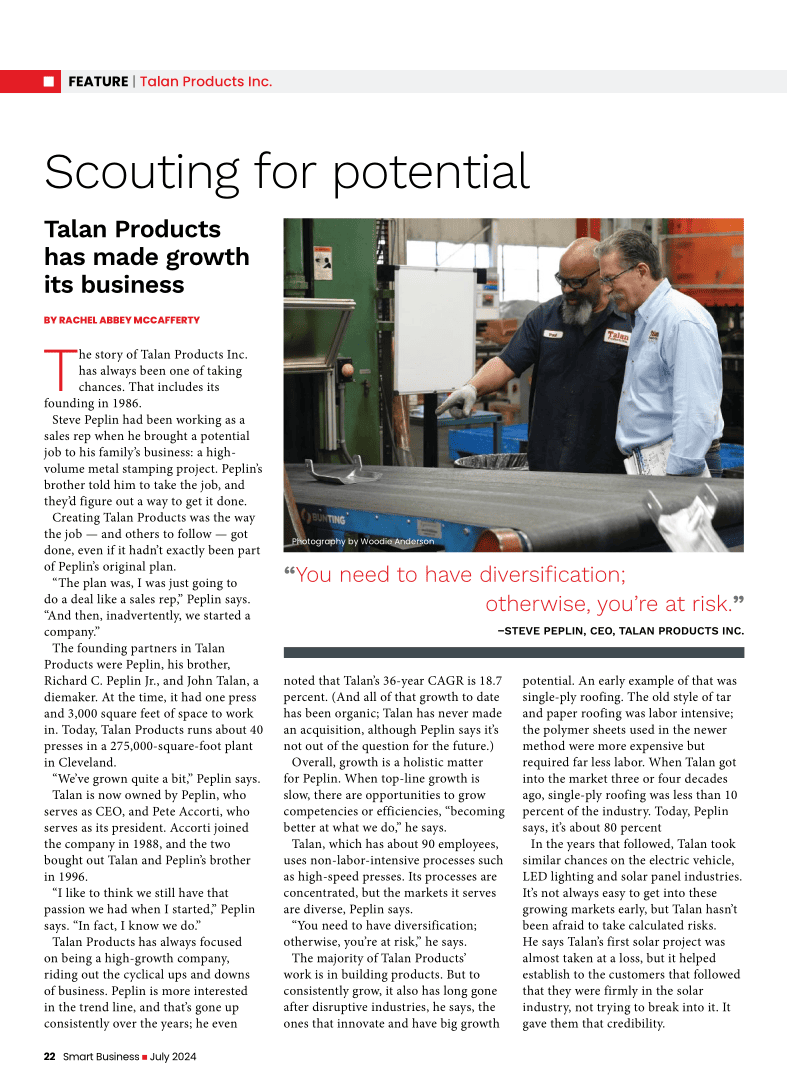
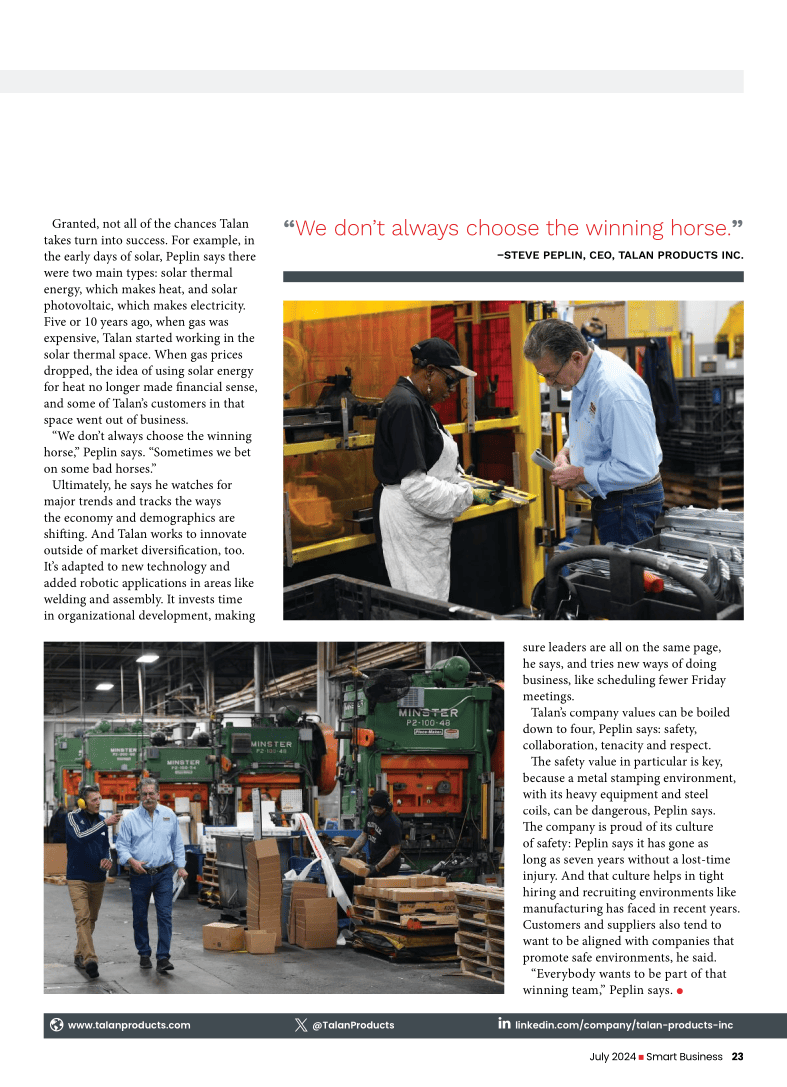
Cleveland Ohio-based metal stamping manufacturer ranks #68 on Initiative for a Competitive Inner City’s annual Inner City 100 list. This marks the 7th win for this Inner City 100 Hall of Fame member.
Cleveland, Ohio December 28, 2023 – Talan Products announced today that it has been named a winner of the 2023 Inner City 100 (IC100) awarded by Initiative for a Competitive Inner City (ICIC). Since 1999, ICIC has identified and celebrated the 100 fastest-growing businesses in under-resourced communities in the U.S. through the IC100 award.
The 2023 IC100 winners were evaluated based on revenue growth during the four-year period from 2018 to 2022. Talan Products, led by CEO Steve Peplin, was ranked # 68 on the list based on its strong four-year revenue growth.
Collaboration is one of our core values. It is not only practiced between our departments, with our customers, and our suppliers, but with the city we are located in as well. – Steve Peplin, CEO
This year’s IC100 list was unveiled during an awards ceremony at ICIC’s 2023 Annual Conference held in Miami on December 12th. The full list of 2023 IC100 award winners is available here.
Steve Grossman, CEO of ICIC, stated: “In 2023, small business owners redefine success amidst funding, economic, and societal challenges. Their journey is marked by resilience, seizing opportunities, and fostering community bonds. The 2023 Inner City 100 award winners used innovation and collaboration to not only survive but thrive. They pivoted, adapted, and transformed their businesses, embodying the entrepreneurial spirit. We applaud their grit and determination and stand in awe of their achievements.”
From 2018 to 2022, the 2022 Inner City 100 companies averaged 454% revenue growth and created 2,781 total jobs. Of these 100 winners, 57% are BIPOC-owned/led, and 50% are woman-owned/led, the latter of which ties last year’s record high-number in the program’s 25-year history.
2023 IC100 Winners by the Numbers:
| Cities Represented: | 54 |
| States Represented: | 26 |
| Industries Represented: | 23 |
| Woman-Owned/Led: | 50% |
| BIPOC-Owned/Led: | 57% |
| Veteran-Owned/Led: | 3% |
| LGBTQ+-Owned | 4% |
| First-Time Winners: | 31% |
| Hall of Famers (won IC100 5 or more times) | 24% |
| Average Four-Year Revenue Growth Rate: | 454% |
| Average 2022 Revenue: | $12M |
| Total Jobs Created (2018-2022): | 2,781 |
IC100 Methodology: Recognizing that concentrated poverty exists within metropolitan areas outside of big cities (and that poverty overall is suburbanizing), ICIC has revised its definition of an inner city (or under-resourced area) to encompass large areas of concentrated poverty in suburbs and smaller central cities as well as the large cities on which it has historically focused. The new “inner city” definition that ICIC has developed includes large low-income, high-poverty areas located in the urban and suburban parts of all but the smallest metropolitan areas. Every year, ICIC identifies, ranks, and awards the 100 fastest-growing businesses located in America’s under-resourced communities. In 2023, companies were selected and ranked by revenue growth over the four-year period between 2018 and 2022.
Talan Products is a world class contract manufacturer specializing in high volume metal stamping, fabricated aluminum extrusions, and assemblies. Based in Cleveland, Ohio the company offers exceptional opportunities for its team members, many of whom reside in the surrounding neighborhoods. Talan often promotes from within and gives every team member a chance to grow within the company. The owners of the company are dedicated to manufacturing in the US and have invested, and re invested, in equipment and people all working from one location in Cleveland’s Collinwood neighborhood. Over the company’s 38 year history it has achieved an 18.6% CAGR, which has consistently classified Talan Products as a “high growth” company.
Talan Products wins 2023 Inner City 100, growing in the Inner City
February 26th, 2024Talan Products, a rapidly expanding manufacturing firm based in the Collinwood neighborhood of Cleveland, has breathed new life into the old TRW Valve Plant. With an impressive Compound Annual Growth Rate (CAGR) of 18.6% throughout its 38-year history, this enterprise has stood out in the manufacturing sector. The Initiative for Competitive Inner Cities (ICIC), founded by Dr. Michael Porter, annually acknowledges the 100 most rapidly growing firms within America’s under-resourced areas. Talan Products has earned this prestigious recognition from the ICIC for the seventh time. The company is renowned for its expertise in producing high-volume metal stampings, fabricated aluminum extrusions, and assemblies.
Smart Business Magazine Recognizes Talan Products & CEO Steve Peplin as 2023 Smart 50 Award Winners
December 29th, 2023Steve Peplin and Talan Products win the 2023 Smart 50 Award.
Talan Products is One of the Best Employers in Ohio in 2023 – Crain’s Cleveland
July 10th, 2023https://www.crainscleveland.com/awards/2023-best-employers-ohio
https://www.crainscleveland.com/awards/talan-products-inc-2023-best-employers-ohio
What gets lost in translation when working remote
May 11th, 2023Read the article in Smart Business Magazine.

Communication is extremely effective when unspoken messages are accurately conveyed and received. However, issues often arise among colleagues because of mistakenly interpreted communications. This can happen whether a message is verbal or non-verbal.
I was at a bistro listening to a wonderful young lady sing jazz. It was very improvisational, with a lot of vamping and riffing. The solos felt very free form. When it was the bass player’s turn to run loose, he did his thing. After a while, it was time to hand the reins back to the singer. I saw them steal a glance at each other, which instantly communicated the timing and intent for when the singer was to take back over. No words were uttered. I thought, ‘Wow, they read each other’s minds.’ It felt like magic. What instantly went through my mind was how great that would be if my colleagues at work were able to communicate that seamlessly.
Some people in the business world struggle with non-verbal communication while for others it’s intuitive. Getting both types to work well together is imperative. At times, I think bad communication is the root cause of virtually all problems.
Unspoken communication struggles mightily in a remote work environment. Trying to effectively get a subtle, nuanced message across through video is challenging. The problems getting across a non-verbal message are compounded by not being in the same room and ‘feeling’ the participants and the situation.
At our offices, like many, we are now working using a hybrid model. The remote environment makes me feel, well … remote from some of my colleagues. I recall fondly the pre-COVID era. We used to all eat together, often bringing in shared meals. The sense of being on the same team or family was strong. Even with our best attempts at improving communications in this remote era, the vibe is just not the same — at least with those who work predominantly remote. I fear if we are not careful, we could inadvertently create two types or classes of employees who struggle to communicate effectively with one another.
But it’s not all bad. I saw an example recently when two co-workers — one who normally works remote and the other who is typically in the office — were sitting next to each other working collaboratively on a project. It was obvious (and we discussed it after) that if they were not both in the same place, it would have taken days, not hours, to successfully wrap the project up. The opportunities to enhance synergies by working co-located were obvious.
I am a student of human nature. I attribute much of my success with colleagues, and therefore in business, to the skills I’ve learned observing and interacting with people of all types. I have always been comfortable in settings as varied as a board room or a biker bar. I am confident I did not hone this skill by being on a lot of video conferences. ●
Don’t confuse money with wealth
February 14th, 2023Nothing elicits emotion like money. It seems like no one is ambivalent about it. Full disclosure — I’m one of those who really likes it. I am writing for a business magazine, after all. What is to follow will not be an exhaustive treatise on money, but merely some random ramblings about, what for some, is an obsession.
“Money don’t get everything, it’s true. But what it don’t get, I can’t use.”
—“Money (That’s What I Want),” Janie Bradford & Berry Gordy
Money, shekels, moola, ching, clamolas, dinero, cabbage, bread, dough, loot, cash, the almighty … you know. There certainly are some fun synonyms for it. I almost forgot a new one, crypto. Or, is that money? I don’t know, but it’s definitely not a fiat currency, so I guess it’s the same as clamolas.
Money confers wealth, power, prestige. It is easy to understand why obsessing over it is so common. Businesses revolve around money, wars are fought over it, relationship are torn asunder over it. It’s no shock that it is perceived by some as the root of all evil.
“Money doesn’t buy happiness, but it’s not happiness I want, it’s money that I want.”
— Unknown
Likely the greatest thing about having a lot of money is the ability to deploy it to make the world a better place. Philanthropy, charity and benevolence all are possible because someone accumulated a bunch of money. I am always amazed by the giving pledge many of our current round of billionaires take.
Many pledge to give away the vast majority of their accumulated wealth. It is easy to understand the value in that. What good is it to die with it?
Warren Buffett, famous gazillionaire, says, regarding great wealth and his children’s inheritance, he plans to give “enough money so that they would feel they could do anything, but not so much that they could do nothing.” There’s a guy who knows a thing or two about wealth accumulation.
“He who knows he has enough is rich.”
— Lao Tzu
I heard an interview with Jerry Garcia, leader of the Grateful Dead and an extremely successful businessman, in which he was asked how his wealth has changed his life. His reply was, “When I’m eating a bag of pistachios and I come across the occasional one that is really hard to open, well, now I just throw that one away and I don’t feel bad.” Sounds like being rich could be a pretty good thing.
Mid-life crises are a first-world problem. The poor don’t have time for such frivolities. Money certainly is not a solution there, it is likely part of the cause.
“I didn’t start my company to get rich, I started it to get filthy rich.”
— My friend
I suspect more lives are ruined by the quest for great riches than are made glorious by its accumulation.
Please do not confuse money with wealth. While I have a bit of money, I count my wealth by my friendships. In that regard, I am the wealthiest guy I know.
Read the article on Smart Business.
5 traits to help ensure success
December 1st, 2022Upon learning my job description was changing to “visionary,” I have to admit I was a bit dismayed. Visionary? Really? Like a dreamer, a head-in-the-clouds type?
I was put off until I learned the traits and duties of a successful visionary. Turns out, I already was one. Being a visionary and an entrepreneur is like bread and butter. The role of a visionary in business isn’t like the version portrayed in science fiction and fantasy. They don’t literally see into the future, although some might think they do.
They see an envisioned future. Visionaries see their version of the future.
There is a difference between being a visionary and being a visionary leader. Visionary leaders are almost always the CEO or president. Usually, they are an entrepreneur and/or founder. I posit that no one would ever start a company without being a visionary. It doesn’t have to be a grandiose vision, either. Building a well-loved local pizza joint, or an excellent dry cleaner, is just as gratifying as building a conglomerate; it’s just on a different scale.
Visionary duties often include creative problem solving, major external relationships, new ideas/ideation, rainmaker and identifying major players for the team, both internal and external. Let’s break it down and look at some styles or traits visionary leaders commonly exhibit. If you aspire to be one, you might consider developing your competencies in these.
- Persistence. Visionaries have lust and passion. They don’t phone it in. Getting buy-in from one’s team for the vision is not easy. Great spirits have always encountered violent opposition from mediocre minds. But great minds can be just as hard to persuade.
- Conviction/inspirational. Strength of vision, optimism, determination and tenacity are table stakes for the role. Entrepreneurs always see their own vision. They drink their Kool-Aid first. If they didn’t, how would they ever get others to follow? The difficulty comes in convincing the team to follow.
- EQ. Having high Emotional Intelligence is a huge advantage. Visionaries run more on emotion than on metrics. I believe both are needed to excel. Intuition and gut feel are used more than spreadsheets and regression analysis. People skills are inherently a part of convincing others to be on board. Otherwise, it’s a lonely journey. Working well with others and leading through collaboration are necessary in order to succeed.
- Risk-taking. If your vision entails change — and by definition they almost all do — being comfortable with risk comes with the territory.
- Knowledge/experience. Being a polymath is a desirable trait. Knowing many disciplines and fields is an obvious way to see examples of cross-pollination. Being able to not just think but to see out of the box enables one to see what isn’t always apparent to others. Having an organized mind and a clear vision is imperative. This is no place for the scatterbrained.
A visionary has to be grounded, as well. I am reminded of the architect who envisions a soaring, cresting wave of a roof over his dream cathedral, but the structural engineer breaks the reality to him that you need a column, right here, in the middle of it.
Reality can be a visionary’s nemesis.
Read the article on Smart Business.
Is it better to be lucky, or good? Relying on luck is not a sound business strategy. It’s best to be both. Do we have a choice? It turns out we do, sort of.
Studies show lucky people think and act differently than those who are not. When I talk about being lucky, I’m referring to the luck we choose, not the luck we’re born with. Being born into a good family, having the right mentor, educational opportunities, in a great country, during peace time — most of these things are out of our control.
Does it seem like some people are just lucky in life? They are. Lucky (and unlucky) people have been well studied and there are some common traits or behaviors that in retrospect seem obvious.
Is luck random? Not really. We create our luck in life experiences. I’m not referring to luck in gambling. That’s different. That’s probabilities and statistics. That kind of luck is intriguing, but it is beyond the scope of this column.
We’ve all heard the famous saying, “The harder I work, the luckier I get.” There is obvious synergy between the two concepts. Lucky people think differently. It’s not just hard work that pays off. Let’s break it down and take a look at the characteristics that can improve your “luck.”
■ Extroverted personality. This seems obvious. People who are out there a lot, doing lots of things, meeting lots of people, are logically exposed to more opportunities. Assuming they recognize some good ones, they would appear to have more luck. These are known as “people persons;” they seem to be lucky because they are. They helped make their own luck. They maximize their chances of luck striking them.
■ Tolerance for risk, even an affinity for risk. If you take more at bats, you’re going to hit more runs. If you are so risk-averse that you don’t even play, it’s hard to win. I’ve never met a winner that didn’t bet.
■ Optimism. Lucky people find the good in any situation. In my experience, those who are pessimistic, unhappy or miserable are less likely to be around the great chances to improve their situation. This can be construed as being unlucky.
■ Intuition/follow your instinct. “Got a hunch, bet a bunch. Hunch is wrong, bunch is gone.” Lucky people trust their intuition. They access below-the-surface unconscious knowledge. Malcolm Gladwell’s widely acclaimed bestseller, “The Tipping Point,” is about just this trait. Deep down, we are experts at things we aren’t even cognizant of. This can be for unknowable reasons. Our brains are always working on the subconscious level. Winners trust their gut. They think out of the box. There are ways to access this, through meditation, mindfulness, contemplation. All of these can help you hear your inner voice.
In closing, I feel luck is where opportunity meets preparation. While we’re on the merry-go-round of life, be prepared to grab the golden ring. Then again, maybe one is just lucky to be born optimistic, outgoing and not risk-averse.
When asked how I got this great gig writing for a prestigious business periodical, I just say, “Lucky, I guess.”
Read the article on Smart Business.
Talan Products at EV World Conference
August 25th, 2022
The STAMPING Journal / FMA Stamping in an EV World Conference proved to be an informative and fun event that covered battery technology, an industry forecast, stamping manufacturers’ experiences as EV stamping suppliers, and novel stamping and material approaches. Held for the first time in person at the Inn at St. John’s in Plymouth, Mich., the one-day conference offered an opportunity for fact-filled learning, lively discussions, and relaxed networking.
Outlook. The sage and knowledgeable Daron Gifford, partner with Plante Moran, led off the conference with an insightful and data-packed outlook. He discussed the drivers and influences of the transition to EVs. “All of these things feed into ‘how do we transport ourselves and get from place to place?’ The transition to electric is happening fast, and electric is where all of the investment is going right now. In the future we think mobility is going to change dramatically, and electric is only a piece of the puzzle. What is really going to affect us is autonomous driving,” he projected.
Batteries. The battery and its protection have emerged as a potential source of metal stamping business activity. It’s important for stampers to know what their battery enclosures are protecting. Our Next Energy’s (ONE) Dr. Najah George delved into various lithium battery chemistries, revealing which have become most prevalent. On June 14, ONE announced that the battery manufacturer signed an agreement with BMW to incorporate its Gemini Dual-Chemistry battery technology—with a 600-mile range—into the BMW iX all-electric sports activity vehicle.
SWOTs. One of the event’s highlights was the SWOTs panel. Motor City Stamping Account Manager Ray Davis; PTM President/CEO Donna Kuhr; Talan Products CEO Steve Peplin; and Director, Manufacturing Engineering, Diversified Tooling Group Mike Austin provided their insights and shared their experiences as EV stampings suppliers regarding strengths, weaknesses, opportunities, and threats that the stamping and automotive industries face as a result of the shift from ICE vehicles to EVs.
Read the original article By from Stamping Journal.
Exceeding expectations leads to great things
August 5th, 2022I’ve often been asked, “What’s the secret of your success?” Usually by someone young. I imagine they’re disillusioned when I blithely say, “It’s pretty boring. It’s all about long, hard work.”
The harder you work, the luckier you get. Sometimes I offer the tidbit that, to get really wealthy, pick your parents carefully, or, that you can marry more money in five minutes than you can make in a lifetime. But that’s not what they’re looking for.
I do know a formula for success, and it’s not exactly a secret: $ = A/E > 1. Really. It works. $ = Success, A = Actual performance, E = Expected performance. It’s simple. If you exceed expectations, you’ll make your customers, employees, boss, whoever, happy. And success should follow.
There really is no silver bullet, no one way, no “secret.” I try to keep to myself that age and guile trounce youth and enthusiasm; that lesson comes with age. Success has many fathers. A few come to mind.
- Exceed expectations – see above.
- If at first you don’t succeed — and you probably won’t — keep trying. Then when your second and third attempts aren’t as successful as envisaged, keep trying. Very few entrepreneurs hit it out of the park on their first company. It took me many tries before I made it beyond moderate success. Almost everyone I’ve met who has experienced great success also tried a great number of times.
- Be organized. In my estimation, it’s a significant reason for my success. Being organized is so much more than having lists, but that’s a good start. I make lists daily. I love making them. They’re covered with doodles and notes and are a major component in my system. They act as a mini-journal, a snapshot of my life. I get a jolt of dopamine when I take a check mark. At the end of the day, I have a visual reminder of what I’ve accomplished (hopefully). For me, lists can be contemplative, almost meditative. No airplane takes off without referencing a checklist. No surgery takes place without a checklist. Ever wonder when you’re at the hospital, why they keep asking your name and date of birth? It’s not so they can remember to buy you a birthday gift — it’s the first item on their checklist.
Knowing your goals — even a short term/daily goal — and having a process/roadmap for getting there is of paramount importance. Our business has a system of long-term goals, shorter-term goals and benchmarks that are more bite size. We constantly track our progress, so we’re not surprised when we achieve our goals.
Businesses that don’t have strategic goals mapped out and that don’t benchmark their progress are doomed to random results. Everyone in the organization needs to be playing from the same sheet of music. Randomness can be fun, but there’s a time and place for it, and it’s certainly not at a well-run, high-performance company.
I’ve been told by my friends in the deal community that businesses with optimized, effective formal management and strategic processes are worth more than those that aren’t, which makes sense. I suspect they make more money, too.
Now, systematizing the visionary’s or chief strategist’s role, there’s an interesting thought. Stay tuned.
Read the article on Smart Business.
Mojo? Corporate mojo? Really, can that be a thing?
I’m not referring to the Cuban marinade or the Marvel superhero. I mean the magic “stuff,” the special sauce, the indefinable thing that exhibits as all the best. Mojo has been around as long as, well, who knows? I believe it’s a concept that has been around as long as we have. Like so many of our cultural touchstones, mojo goes back to Africa and our early ancestors. It started as an amulet or actual physical thing thought to confer great power upon the person who possessed it. Today, the word, its modern use, is an ephemeral concept, implying a magical power to those who have it. Most if not all cultures have some word or thought for the magic I’m referring to. Think of all the times it comes up in lyrics, frequently in blues and rock songs.
So what is corporate mojo? Perhaps corporate isn’t the adjective I’m looking for. Maybe organizational mojo fits better. Organizations have a culture, or a defining zeitgeist, that seems real almost to the point of tangibility. Of course, the culture of a company is intangible by definition. When a person or organization experiences great success, we say that their mojo is working. Conversely, we’ve all seen a group or an individual who’s lost his mojo. Although it’s a truly sad thing to witness, I think we’ve all experienced at some point.
A great example of mojo is when a sports team punches above its weight. Having the intangibles — coaching, a vibe, the right place and right time — really working is the only way a team can perform beyond 100 percent. When a team or organization does perform to 105 or 110 percent, it’s due to something very special. After all, we can only get to 100 percent under normal circumstances, and anything more than that is special. To me, it’s obvious, it’s because of the group’s mojo.
A part of corporate mojo can be how it addresses ESG (environmental, social, governance) issues. Corporate mojo is when an employee stops the owner when he’s walking by to offer an unsolicited opinion about how much the employee likes working there. It’s when an employee recommends employment at the company to friends and family. It can be indicated — remember, it can’t be measured — by metrics such as employee turnover or customer churn. There are numerous measurements for culture, such as employee engagement, satisfaction, alienation, etc. But there is no way to measure mojo; it’s either there and working, or it isn’t. I compare it to trying to hold smoke in your hands.
Business author Bo Burlingham likens mojo to the business equivalent of charisma. When a company has it, people know. They also want to be part of it. Mojo is one of those things in life that one takes for granted when all is fine, but you sure are aware of and miss it when it’s gone. It’s one of those things that’s just there, until it isn’t.
I wish I could be more definitive, but that’s just not the way mojo works. Maybe if mine was working better, I would be able to describe it more adroitly.
Read the article on Smart Business.
Demand outstripping supply is stressing businesses
June 8th, 2022“A whole lotta things that I never done, But I ain’t never had too much fun,” is one of my favorite lyrics, with thanks to Billy C. Farlow and Bill Kirchen, two of Commanders Cody’s Lost Planet Airmen.
Unfortunately, that’s not what I’m referring to when I bring up too much of a good thing. Our current economic situation (unprecedented demand), coupled with supply chain disruptions and the ubiquitous lack of labor availability, have provided many businesses with a situation where they have too much of a good thing. Too much demand — coupled with insufficient resources both human and raw material to meet demand — is troublesome. This is being manifested not only in manufacturing; transportation, hospitality, architecture, health care, to name a few, are all experiencing similar demand/supply misalignment.
And just to keep it really interesting, the current level of inflation is keeping us all on our toes. The Fed strives for low inflation, around 2 percent. However, it’s running quite a bit higher now. Again, too much of a … well, you get it.
The C suite is populated with serious type A personalities. Many executives have always thought, too much is just enough. Mae West said, “Too much of a good thing is wonderful.” I am personally having a hard time adjusting to this new paradigm. But, as we all know, we must adapt or perish.
I do have one reassuring thought regarding this current imbalance. I suspect it will be a temporary situation. I expect the other shoe to fall and supply demand balances will return to most markets. After all, the invisible hand of the market is always at work. Prices will rise and/or demand will drop to match. At least it always has in the past.
There is some really serious demand being generated in domestic manufacturing these days. The offshore sourcing “advantage” utilized for so long has recently turned out to be anything but an advantage. I’ve heard talk of an expected $1 trillion of reshoring of manufacturing being brought back to America. If that is correct, the imbalance may continue to be around for a quite some time. In the 1950s in America, when there was very high demand for everything, an economic miracle ensued. Somehow, we managed to meet the demand then, but the world is a bit more complex these days.
Here is a personal story about getting too much of a good thing. In my youth, I was a passionate deep powder snow skier. We traveled far and wide to get to the highest altitude, deepest, lightest fresh powder. Finding too much of it was inconceivable to me.
One time after a particularly big snowfall, I was skiing — more akin to floating — in the freshest, deepest lightest snow imaginable. Chest deep. Loving life. Then all of a sudden, I went under. The snow depth (while I skied through a drift) went over my head, and it was pitch black under that snow. There is no light down there. I never expected that. I panicked and flailed wildly. In life, as in business, as I said, be careful of too much of a good … well, you know.
Read the article on Smart Business.
Team Talan Design 2 Part Show in Atlanta
June 3rd, 2022Team Talan had a booth at the recent Design 2 Part Show in Atlanta. We exhibit at several shows around the country. Follow us on social media to find out where you can meet us face to face next!
Embracing change: Seeing challenges as opportunities
March 4th, 2022Read the article in Smart Business Magazine.
We used to have a saying at my company, “We’re really good at identifying problems and then solving them.” I always attributed a big part of our success to that skill set. I added a corollary to it, “but the problems are always new ones.”
That is likely the mantra of all high-growth businesses. I remember being young and naïve and thinking, “Great, we’ve figured business out.” Little did I know it would provide me a lifetime of problem solving, albeit always different problems.
Our current environment has turned some old ways on their head. Take the old adage, “Hire slow and fire fast.” That advice has been gospel. But if one were to take their time hiring now, that prospective new hire will likely be taking someone else up on an offer they received in near real-time. How about firing fast? If business leaders did that today, they’d be exacerbating their current staffing issues, as businesses across the board are struggling to fulfill basic staffing requirements.
I met a retired young businessman once who instantly recognized my passion for business, especially regarding my company. He said it reminded him of when he was growing his company, and he had the passion, too. I was perplexed and asked what had happened. He replied that the company got really big, with revenue over nine figures in annual sales, and that the problems he had to solve were no longer fun problems.
That change is not always appreciated, and his happy ending was to sell the company.
How about the axiom about diversifying your offerings to avoid customer concentration? In contrast, we are advised to stick to our knitting, stick to our core competency and be the best in the world at that one thing. Again, a dichotomy exists — stick to your knitting but be diversified and avoid concentration. The way we square that circle is by sticking to a specific set of competencies and diversifying markets served. Near as I can tell, no change needed here.
This sea change caused by the Great Resignation looks like it’s going to be around for a long, long time. Due to a booming economy, demographic shifts, breeding patterns, untimely deaths related to COVID-19 and drug abuse, combined with immigration policies, the labor shortage appears to be the new normal. Time will tell, although so far, this new problem has not been a fun one to solve.
I would be remiss if I didn’t mention the other new normal, the COVID-19 workplace. If you told me two years ago that in one week, we would transition to nearly our entire office staff working remotely, yet not experience a single glitch, I wouldn’t have believed that was possible. Yet successful companies everywhere have adapted without blinking an eye.
In change, there is always opportunity. Change is uncomfortable; it seems just when we get good at something, the game changes. Then again, no one goes into business because they perceive it will be the easy way. Embrace change; it’s one of the few things in life we can count on.
Disruptive Markets – Inherent value and dangers
September 27th, 2021Read the article in Smart Business Magazine.
As a lifelong entrepreneur, Steve Peplin has started and operated numerous companies in the specialty building trades and building products industries. With a heritage as a third-generation manufacturer, he started Talan Products in 1986 with $2,100 and two partners. Talan today is an industry leader in manufacturing for the renewable energy and building products industries.
I always get a kick out of reading about a high-growth, world-changing, paradigm-shifting new thing that is widely praised while being labeled “disruptive.” I had a lot of experience with that adjective in my childhood, and I turned out OK, just as most disruptive markets do.
It’s easy to be captivated by the siren song of disruptive markets. Who doesn’t want to be on the good side of a skyrocketing growth curve? What many gloss over, though, is the other side of the equation. First mover advantage can rapidly turn into first mover disadvantage. Does anyone even remember MySpace, or GeoCities? One needs to be an internet historian (or check the Wayback Machine) to even find these early social media pioneers now.
The specific disruptive industries I’m familiar with include solar energy, LED lighting, single-ply roofing and electrification of transportation. In the early days of mass acceptance of solar energy, it looked like solar thermal (generating heat from the sun, as opposed to generating electricity) was going to achieve the widespread adoption it has in Asia or Europe. However, very low-cost natural gas quickly put an end to that industry in the U.S., while PV (photovoltaic) solar is the lowest-cost way to generate electricity in most countries today.
The LED lighting market grew from a niche of virtually zero to $100 billion annually in seven years. No downside here unless you were a supplier to a company that didn’t make it to the maturity the industry enjoys.
Single ply roofing, a disruptive product pioneered in Europe in the 1960s, came to America in the 1980s. Soon after, it was 8 percent of a $25 billion market, and today, it’s 80 percent of a $33 billion market. Not a bad ride, especially if you had the right partners. While there is a whole litany of roofing system companies that aren’t around anymore, the strongest ones emerged winners.
Discounting the earliest electric vehicles that were around when the auto was being invented, it’s now the early days of the electrification of transportation. One thinks initially of electric cars, but the whole industry of moving things is undergoing revolutionary transformation. Scooters, motorcycles, cars, planes, personal flying devices, trucks, buses, boats, even outboard motors, are all being electrified. Of course, many of the pioneers in the electric vehicle space have already run out of juice. The auto manufacturing landscape is littered with the carcasses of dead EV manufacturers.
The “slow and steady wins the race” crowd (all the major vehicle manufacturers) are going to be there to pick up the pieces as the industry explodes. Having been in the industry for a long time, fostering relationships, building experience, etc., should help some of the pioneers this time.
However there are many times the first mover initially has — and goes on to maintain — a long-term advantage. A recent example of a disruptive technology is the insulin pump, which is changing lives for the better, offering those with diabetes an easier way to manage the disease — in essence, their lives are less disrupted by the addition of new technology. Masks are another recent example of a necessary disruption. They are so ubiquitous now and they are made and sold in such huge numbers that whole factories have been built to satisfy the unprecedented demand.
I wonder if my childhood teachers are around to see how “disruption” can be a positive and how it has paid off for so many.
Perspectives on Business Management
September 27th, 2021Read the article on the MetalForming magazine website.
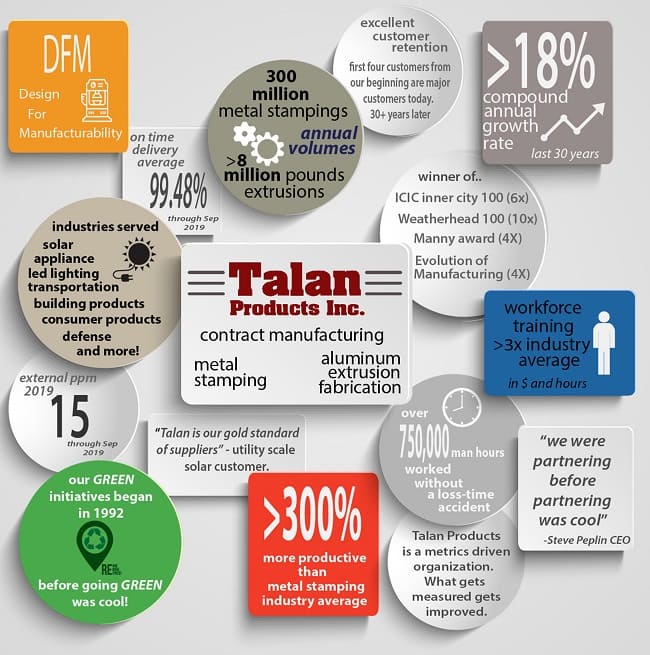
 This month we invite Steve Peplin, CEO of Talan Products, to share his insights. Cleveland, OH-based Talan Products “has been growing like a weed,” says Peplin, “at about 18 percent CAGR over the last 35 yr. And, our sales/employee ratio is high, three to four times that of the average metal former.”
The firm specializes in high-volume production using a combination of high-speed presses, progressive dies and a robust Design for Manufacturability program. The combo works exceedingly well, as Talan Products has won numerous industry awards and has received recognition from its vendors, customers, civic organizations, national trade groups and sustainability councils.
Q: What’s the best management-related book, webinar or event you’ve recently enjoyed, and what were one or two of the key takeaways?
Peplin: I’m a big reader and I attend a lot of webinars, so I’ll narrow this down to just two books. First: “The Surprising Science of Meetings,” by Steven Rogelberg, who interviewed thousands of employees from a variety of industries to come up with ways to enhance the quality of their meetings. So many meetings are ill-conceived, with the wrong people attending or without clear goals or objectives. I think I run a pretty good meeting, but after reading this book I uncovered opportunities to improve. One example: Bring positivity and optimism to every meeting. This affects the performance of the others in the meeting. Negativity can ruin the effectiveness of a meeting.
The second book that’s impacted me and how we manage Talan Products is “Team of Teams: New Rules of Engagement for a Complex World,” by General Stanley McChrystal, who took command of the Joint Special Operations Task Force in 2004 to do battle with Al Qaeda in Iraq. Initially, conventional U.S. military tactics were failing, he explains, because Al Qaeda operated a decentralized network designed to move quickly, strike ruthlessly and then vanish into the local population. To respond, McChrystal knew that his forces needed to match the agility of the Al Qaeda terrorist network. To do so would require building a ‘team of teams’—faster, flatter and more flexible than ever. I see the comparison to business today—the speed of business is much faster than ever before, so we’ve empowered our teams and driven decision-making down onto the plant floor. For example, when scheduling jobs in the shop, we sometimes let the people running the equipment determine the order of the jobs based on their tribal knowledge of how to improve efficiency.
Q: What is the biggest challenge you face as a company leader?
Peplin: Of course, like most companies we focus a lot of attention on attracting and retaining employees. And one thing we do well, that a lot of metal forming companies don’t, is attract a lot of media attention, which serves as a great marketing tool to not only attract new customers but to also attract talent. I always tell people, “We’re winning awards not to feed my ego, but to gain visibility.”
Bette Midler said once, “They can’t love you if they can’t see you.” That’s what marketing is and winning awards and gaining media attention has been invaluable for us in attracting employees to Talan Products.
Q: What are two or three of the most important things you look for in a mid-level manager?
Peplin: We start with our core values, and these are not the ones you display on signs and just talk about, like productivity and quality. I find that often companies do not live their values. So we boiled it down to four core values and insist that our management team live them. Safety, collaboration, tenacity and respect.
I feel that we have one of the safest companies in the industry, routinely going 5 years or longer without lost-time incidents. And safety pays—our MOD rate for workers compensation is 0.49, the lowest I’ve ever heard of. It helps us recruit team members, and customers like safe suppliers.
As far as collaboration goes, we designed the company around high-volume low-mix customers, which allows us to serve a relatively small base of key customers that we can focus a lot of attention on. We become so important to our customers that we’re like a part of their companies. If they have a problem, we have a problem, and it there’s a dollar to be saved, we’ll split it.
We’re also a tenacious company staffed by tenacious people—we keep working on challenging projects until we figure them out, and that philosophy filters from the top down. And, when it comes to respect, while that might mean different things to different people, we spell it out on our mission statement so there’s no ambiguity. We hire by these values, and we promote by them.
Editor’s note: Among the bullet points listed under “Respect” on the Talan Products mission statement:
- I take responsibility
- I am aware of how words and actions affect others and the entire team
- I listen to others
- I maintain my composure and never make it personal.
Q: What are two things that you believe your company is doing well? What’s one thing that you wish you could change?
Peplin: We grade very well on several industry benchmarks, key to managing the significant growth we’ve experienced—18-percent CAGR over the last 35 yr. We invest three times the industry norm on workforce development, including expansive adoption of the PMA METALFORM EDU virtual learning platform. And, our sales/employee ratio is very high, three times what the average metal former achieves. Keeping direct labor costs low allows us to compete, even with low-cost countries.
One key contributor to our grown continues to be identifying and targeting potential customers in disruptive industries with good growth potential. For example, about 12 years ago we targeted the LED lighting industry, which grew from nothing to a $100-billion industry in 7 yr., and more recently we targeted the solar-power industry, which went from a niche market to become a huge opportunity. We’ve grown in both markets. Now we’re targeting the electric-vehicle market in the same way.
As far as what do I wish I could change, we’re struggling with the shortage in raw materials, most notably extrusions—a big part of our business. Lead times for extrusions has grown from 6 to 8 weeks to as long as 25 to 30 weeks. This has added a layer of complexity to our lives, and to our customers’ lives, as we’re expanding our supply base and being more proactive with our purchasing—we’re already ordering material for Q1 2022.
Q: How do you encourage and motivate your management team?
Peplin: When we do well our team does well. Historically we’ve had huge end-of-year bonus pools, 10 percent of our profit. Profit sharing—while it’s not the only motivation—works, and I know our team members appreciate it.
Q: Can you provide an example of a solid management decision you made during the COVID-19 pandemic, and how it helped to address a major pandemic-related challenge?
Peplin: I feel like we—the entire management team—did everything we could to keep our employees healthy, a real “belt and suspenders” approach. Early on we created a robust COVID-19 committee that met several times/week to make sure that we stayed on top of the virus, and educated themselves and our workers. And while a few employees contracted the virus, we did not have a single outbreak.
During the peak months of the virus we did not lose any business, so maintaining employee health ensured that we were able to continue to serve our customers. At the beginning of 2021 we developed stress tests and planned for how we’d adapt if we lost 10 or 20 percent of our business, or more. During those discussions we didn’t plan for not losing any business, but that’s exactly what happened.
Q: I assume it can be “lonely at the top” for you at times. How do you relax, release your stress and rise above the endless list of problems you have to deal with each day?
Peplin: I’m never lonely! We have grandchildren nearby, and dogs running around the house. As far as hobbies, I play the ukulele and the standup bass, I ride motorcycles, pilot hot-air balloons, and I love to sail, fish and cook.
But really, I am obsessed-possessed regarding Talan Products, and I have a hard time letting it go. Even though the company doesn’t need me to run, I still take responsibility for the strategy and vision for the company.
So how do I unwind? Give me a cigar, a glass of rum, a ukulele, and some sun, sand and a straw hat!
Talan Products wins the Smart 50 Award from Smart Business Magazine
April 12th, 2021Talan Products CEO Steve Peplin has been recognized in the most recent class of NEO Smart 50 award winners. Since 2014, the Northeast Ohio Smart 50 Awards recognize the top executives of the 50 smartest companies in the Northeast Ohio region for their ability to effectively build and lead successful organizations. https://youtu.be/ivhm696ov7g
Miguel Lugo Cleveland Newsmaker of the Year
March 26th, 2021Miguel Lugo, Talan Products’ Plant Manager/Tool Room Manager is awarded position as one of Crain’s Cleveland Newsmakers of the Year.
https://www.crainscleveland.com/crains-award-webcasts/crains-2021-newsmaker-year
Evolution of Manufacturing Award 2021
March 25th, 2021We are honored to be part of the 2021 class of companies winning the Evolution of Manufacturing award. Here is our CEO Steve Peplin being interviewed during the virtual event. Click here to watch the video.
Talan Products Focuses on Partnerships
February 4th, 2021“We have a good culture here with a local, diverse workforce. I like to say we’re a cool company. If we find someone who has good mechanical aptitude and the right attitude, we can make them into a career employee.” Read Full Article Here

Reducing Labor Costs Per Part to Compete Globally
June 3rd, 2020

Bruce Kuvin
Editorial Director
Finding the Path to Optimizing Sales/Employee
“Training and automation are the focal points,” says Steve Peplin, CEO of Cleveland OH-based Talan Products, a supplier of high-volume extruded and stamped components and assemblies primarily to the building industry. “It comes down to metrics when you measure your company’s performance,” he says, noting that the company’s sales per employee is $700,000, significantly higher than the industry average.
“That points to a few key strategies that we follow,” Peplin says. “While we don’t use a lot of robots or hard automation, I view progressive dies as analogous to automation in that we try to perform as many functions as we can with minimal human input. We’ve always been focused on high throughput, even before this drastic labor shortage. And automation will play a bigger role for us in the years to come.”
Talan Products also has focused for a long time on workforce development. Its training dollars invested per employee is three times the industry median, says Peplin, and its training hours per employee are four times the median, according to benchmarking studies conducted by the Precision Metalforming Association (PMA).
On the automation front, Peplin describes a current project to perform value-added machining operations on a high-volume stamped extrusion. An inhouse-designed and built turntable setup replaced the work being performed by 12 people, and now turns out thousands of completed parts/hr., up by a factor of 10 compared to the manual process.
“That automated setup,” Peplin says, “performs drilling, tapping, deburring and machining operations, and even packages finished parts, allowing our workers to focus less on repetitious manual labor and more on higher-value operations.”
Peplin views automation as driving his company’s future success, but notes that along with automation comes a responsibility to train people to program and—most importantly—service and maintain the automated equipment. “We don’t even bid on jobs that require a lot of manual work,” he says, “such as hand-fed press work or manual assembly operations. But, with increased use of automation comes a commitment to develop a strong maintenance department. Even best-in-class automation and robotic operations, we feel, will experience a 95-percent operational efficiency, and we certainly don’t count on that. But we strive to get there, and include with every pro-forma for new automated projects the hiring or training of a new automation-maintenance technician.
“Further, the need for highly skilled maintenance techs,” Peplin adds, “is not just for keeping the equipment running. It’s for continuously tweaking the equipment to decrease cycle times. It takes a long time for an automated process to settle into its optimum run rate, and we’re always looking to improve.”
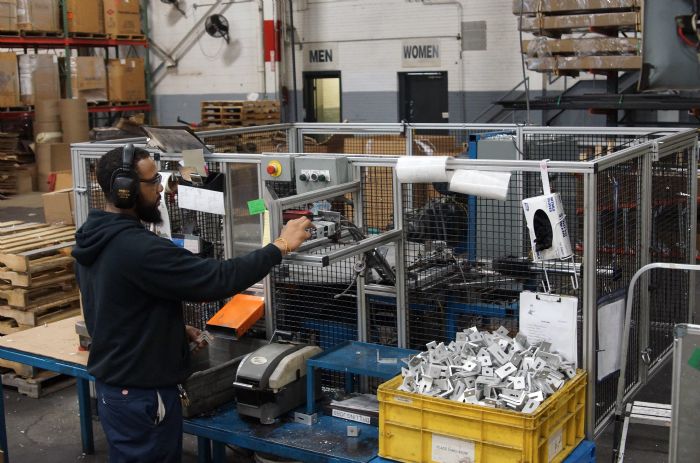 This automated cell at Talan Products finish-machines a stamped construction bracket that previously had been manufactured overseas. Talan stamps the brackets to tap, coin and emboss the parts, then moves them to this cell for precision machining.
Minimizing Touches
“We are pledging to minimize the times that our operators have to touch the parts, by using automation,” explains Hale Foote, president of Scandic Springs, a stamper and fourslide spring manufacturer in San Leandro, CA. “When we tell our people that, they also know that no one has lost a job here because we added automation. Our employees are happy to let go of the more mundane or repetitive jobs, and take on higher-skilled jobs instead. We invest in our employees by investing in that higher-skilled training, and they then can earn more pay—as operators of waterjet and laser cutting machines, for example.”
When it comes to dealing with the shortage of skilled labors, don’t count Foote as one of the hand-wringers.
“Yes, it’s hard to find good people,” he says, “which is exactly why we commit a significant portion of our budget to training and workforce development. We don’t sit around and complain about workforce issues, we take action.”
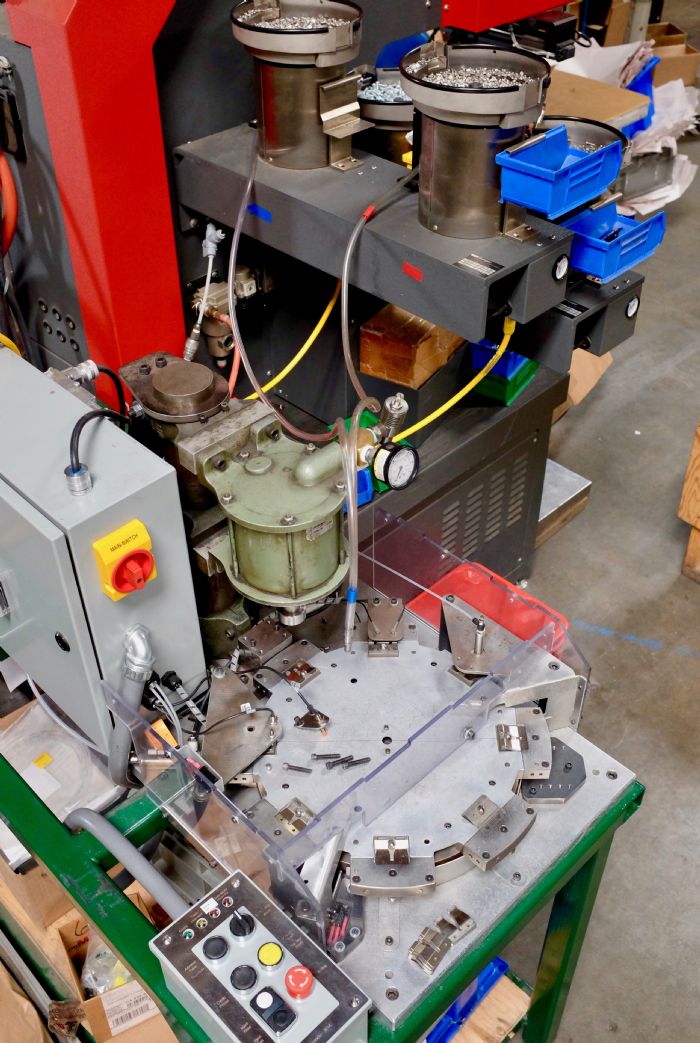 Scandic Springs developed this automated setup last year to take on an automotive job requiring assembly of 3.4 million rivets to stamped parts. “We initially had rows of operators performing the work manually,” says company president Hale Foote, “but we invested in automation using bowl feeders to remove the labor expense from that job.”
Some 10 percent of the Scandic Springs workforce actively is undergoing apprenticeship training, says Foote. “That might sound expensive,” he says, “but in the grand scheme of things, it pays off big time, especially with younger people who are motivated to learn and grow, and to earn more money.”Foote counts die design and toolmaking among the areas where Scandic Springs needs additional skills, and points to this as an opportunity to invest in automation. Specifically, he’s looking to upgrade the die-development process from using SolidWorks and AutoCad to a more advanced 3D software product such as Logopress.
“While this won’t replace an experienced toolmaker,” Foote admits, “I’m hoping that it will allow someone with 3 or 4 years of die-design experience to step up and be able to design particularly complex progressive dies, where they might not be able to do so using more basic software tools. This is the type of automation where I am happy to invest.”
Other areas at Scandic Springs ripe for automation, according to Foote: “We perform a lot of assembly operations here, value-added work as do a lot of metal stampers, and we definitely look to automate assembly where we can. For example, last year we took on an automotive job requiring assembly of 3.4 million rivets to stamped parts. We initially had rows of operators performing the work manually, but we invested in automation using bowl feeders to remove the labor expense from that job.”
Foote also expresses interest in automated machine and press tending, particularly using cobots, “a much more affordable and flexible option than using traditional robots,” he says. “I am particularly interested in looking at cobots for tending electric press brakes, as well as some of our straightside stamping presses. My only concern is that we tend to be a high-mix shop in those departments, with lot sizes typically under 10,000 parts. I’m not sure that cobots make sense on lower part volumes, but we’re looking at it.”
Automating the Quality Process
“In a tight labor market, we certainly do not want our production employees bogged down in non-value-added work, such as inspection and quality control.” So stresses Bill Adler, president of Cleveland, OH-based Stripmatic Products, primarily a fabricator of tubular metal products. Stripmatic specializes in stamping and wrapping tubes, and then completing the tubes with a highly automated laser seam-welding process.
“We’re continually challenged to get more productivity out of our machines,” says Adler. In particular, the firm’s 18-station rotary indexing tube laser-welding machines employ feed hoppers, bowl feeders and conveyors to move materials, and the company has automated the fault-detection process using sensors.
“The most complex stations,” Adler explains, “are where we must precisely locate the weld seams using vision systems, and then verify weld quality. Automating part-quality inspection allows us to redirect our skilled workers back to performing real value-added work, to help us boost productivity in other areas of the plant.”
Adler calls automated visual inspection a “huge win” for the company, and offers up another example: inspecting tubes coming off of a custom end-finishing machine. “That machine simultaneously machines both ends of a welded tube, and employs pick-and-place automation,” he says. “Every so often, about four pieces per 10,000, the automation either drops a tube or otherwise damages the part, and the tube would pass through the end-finishing machine not properly machined.”
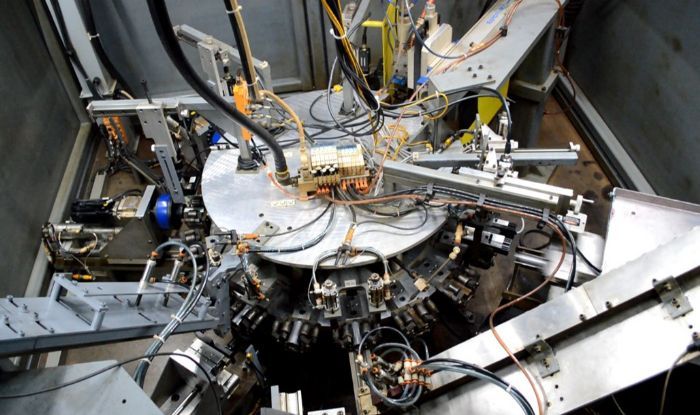 An 18-station rotary-indexing tube laser-welding machine at Stripmatic employs feed hoppers, bowl feeders and conveyors to move materials, and the firm has automated the fault-detection process using sensors to locate weld seams and verify the production of sound welds.
Rather than task his staff with visually inspecting every part, Stripmatic’s engineers developed an automated inspection setup using a feed hopper, conveyor, rotary bowl feeder and a pneumatic actuator. Every part leaving the finishing machine now moves through the inspection setup and is measured using sensors to ensure proper machining to spec, ensuring 100-percent good parts.“Continuing to find areas where we can add automation will be a key driver for long-term growth and viability,” Adler adds.
More on Automated Inspection
Out west, in Colorado Springs, CO, we find metal stamper Qualtek Manufacturing, where company president Chris Fagnant also has set his sights on automating the inspection process, “not to only reduce labor costs,” he says, “but also to increase our inspection capacity and capabilities. This has proven critical, and will continue to be so, as we take on more work for the medical and aircraft industries.”
The overriding challenge for Fagnant comes in the area of legacy parts that Qualtek has been stamping for several years. Some parts have been in production for 15 yr. or longer, and when launched, the vision technology needed to enable 100-percent inspection didn’t exist. Now Qualtek finds itself having to retrofit new automated inspection technology to these jobs, challenging Fagnant and his team to develop a cost-justification model that it, and its customers, can live with.
“For example,” offers Fagnant, “I’ve recently been working with an integrator on a part we’ve been stamping for 14 years, at 1 million parts/yr. The challenge is to agree on a pricing strategy that allows us to justify the investment we need to add the inspection equipment. In another case, for an aerospace customer, we’ll be investing more than $1 million in fixed and robotic inspection equipment, for a job where there’s simply no way to inspect every part without automation. We must be able to recover that investment. So while our customer may not realize an immediate cost savings as we pay for and implement the technology, long term they will definitely see the benefit.”
Fagnant, along with the rest of the executives interviewed for this article, has invested in the relatively new METALFORM EDU online training system introduced in 2019 by PMA, and he’s committed to finding ways to use the training system to grow his team’s skill sets. “We have a solid on-boarding process,” he says, “using some of the PMA products. Beyond that, though, we’re trying to find the best way to integrate MEALFORM EDU into our apprenticeship program. And, we’ll use METALFORM EDU to train our existing workers and expand their skill sets.”
Automation to Drive Quality
Customer requirements for process efficiency also have been driving automation projects at metal stamper and fabricator Waukesha Metal Products, Waukesha, WI. For several years the firm has been leveraging robots to automate its arc-welding operations, and, according to Chris Zuzick, vice president of sales and marketing, more recently the firm has been leveraging automated visual inspection to meet, similar to Qualtek, customer requirements for zero PPM and 100-percent verified quality.
“While we still, in some cases, manually inspect parts coming off of our presses,” says Zuzick, “the robotic-welding process can result in somewhat unpredictable results when it comes to dimensional tolerances on completed assemblies. Here we automated inspection to verify quality.”
Zuzick also notes that while the firm employs robots to perform arc-welding operations as much as possible, the firm still needs skilled workers knowledgeable in troubleshooting the welding cells, and that can perform manual welding tasks—gas-metal-arc and gas-tungsten-arc welding—when required.
“While automation remains important to our company, our managers often discuss the importance of developing sound process plans before looking at automation solutions,” he stresses. The management team at Waukesha Metal strictly adheres to an advanced planning and scheduling regimen to ensure that its processes optimally allocate raw materials and production capacity.
“One we have assurance that we’ve established a strong foundation in a process,” Zuzick shares, “only then do we consider automation. We want to avoid the temptation to use automation as a shortcut or a Band-Aid. Then, when we do invest, we seek to train and up-skill our workers to program and maintain the equipment. This gives them another notch in their belts, and adds value to our company and to our customers. And, it enhances our employee satisfaction and retention. All of that serves to line an ongoing path to operational excellence.” MF
Talan Products starts Training Program for Metal Stamping Press Operators
October 4th, 2018Talan Products offers on-the-job training programs for entry level metal stamping press operators.
Desman Leonard, 20, is among the new employees to take advantage of it. He is training to be a press operator and preparing to enter the company’s tool-and-die apprenticeship.
“At Talan there’s real opportunity to advance in my career path,” said Leonard, whose goal is to become a tool-and-die engineer. Read the full article.
Talan Products supports young workers with training, mentors: Pathways to Prosperity
October 3rd, 2018With consistent on-the-job training and close mentoring from seasoned press operators our 80-employee metal stamping company on Cochran Avenue in Collinwood is now providing training and building a workplace culture that is inviting to young workers. They are one example of several area businesses that are trying to close the skills gap. Talan has gone five years without an accident based on DART, or days away, restricted or transferred, an OSHA metric, said Woodie Anderson, the marketing manager. Read the full article.
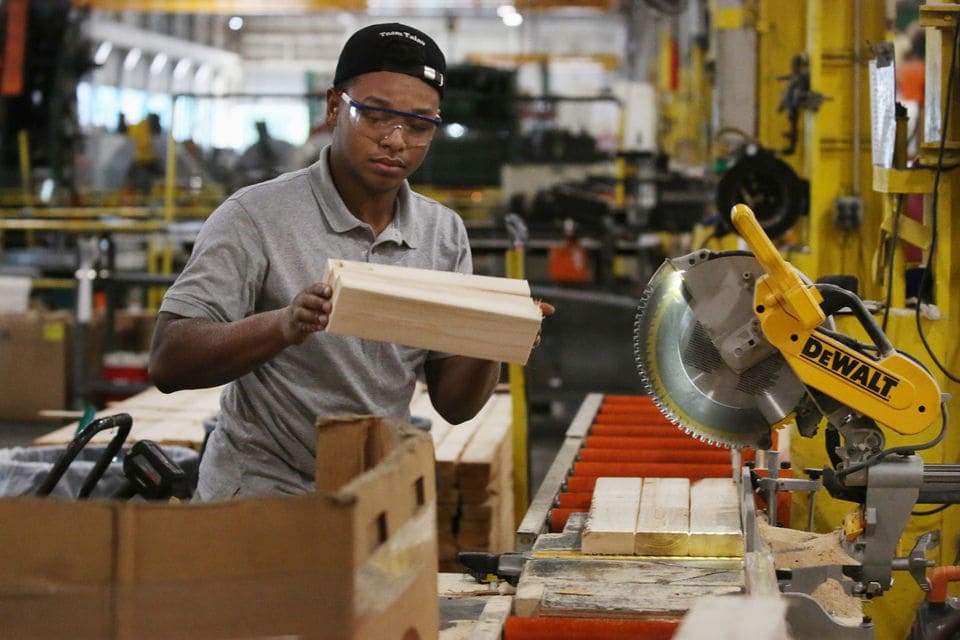
Talan Products Featured Article in Solar United Neighbors
May 23rd, 2018“We’ve pursued all aspects of solar, solar PV, utility scale, commercial, and residential,” said Fran Adler, a Talan Products Sales Manager. He said the company’s first solar-related project was for a solar thermal system. Read the full article.
Talan Products Receives 2018 Evolution of Manufacturing Award
April 4th, 2018A grab from @Smart_Business magazine current issue on the 2018 Evolution of Manufacturing Awards. Our CEO Steve Peplin receiving the award from @keybank Matt Nipper. @woodieand and Mike Burton from our team also.
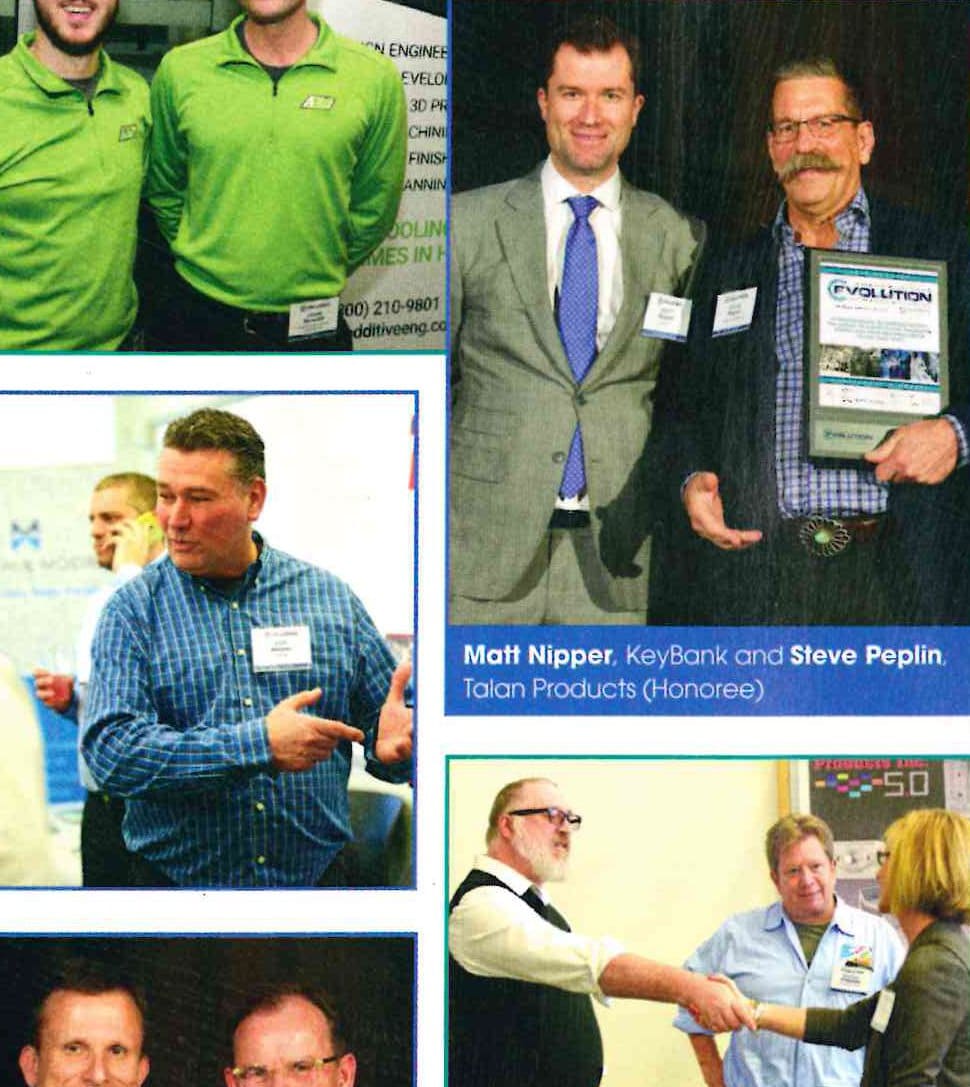
“In many ways, this year’s honorees represent not only an evolution, but also a revolution against the rigidity and limitations of the past. This year’s conference theme of Industry 4.0 speaks directly to the pressures we are all facing, especially in the war for talent.”
Talan Products 5th win of the “Inner City 100” in 2017
October 17th, 2017Cleveland’s Talan Products among the fastest-growing inner city businesses in America
Annual ranking published by the Initiative for a Competitive Inner City and Fortune recognizes high-growth companies in urban areas
Cleveland, Ohio – The Initiative for a Competitive Inner City (ICIC) and Fortune announced yesterday that Talan Products has made the 2017 Inner City 100 list. The list, which was revealed at the 19th Annual Awards and Conference in Boston on October 3rd, ranks the fastest-growing inner city businesses in America by revenue growth. Talan Products achieved a five-year growth rate of 61% from 2012-2016. This is the fifth Inner City 100 recognition for Talan Products. Talan’s feature and the full list is available on Fortune’s website.
ICIC’s Inner City 100 list seeks to celebrate and enable urban entrepreneurship. Over the course of nearly 20 years ICIC has awarded 928 companies whose success illuminates the innovation and business growth happening in our inner cities. Inner City 100 companies are forces of economic opportunity, optimism and transformation in their communities. Providing a platform for recognition, networking and learning, the Inner City 100 program continues to open doors for other budding urban entrepreneurs and stimulate inner city business development and job creation.
“We are extraordinarily proud of these pioneering entrepreneurs who lead the way in innovation, job creation and the economic revitalization of America’s inner cities,” said Steve Grossman, CEO of ICIC. “In addition to excellence in business, they have also demonstrated a deep commitment to and passion for their communities, which plays a huge role in the wellbeing of their local economies,” he said.
In addition to being published in Fortune, CEOs from the winning companies were invited to the Inner City 100 Conference and Awards, a full-day event featuring robust networking opportunities and educational sessions led by executives and academics from top-tier universities, including Harvard Business School and New York University. Past winners have reported connecting with multi-million dollar investors as a result of appearing on the Inner City 100 list and attending the Conference.
Keynote speakers at this year’s event included former CEO of Constant Contact, Gail Goodman; award winner and CEO of the Menkiti Group, Bo Menkiti; and Harvard Business School Professor and ICIC Founder and Chairman Michael E. Porter. Other speakers included Tom Lewand, CEO of Shinola, David Segura, CEO of VisionIT, Lynda Applegate of Harvard Business School, and David Whitford, Editor-at-Large at Inc. Magazine. ICIC also celebrated 17 businesses as members of the Inner City 100 “Hall of Fame,” which recognizes companies that have achieved making the list at least five times.
Boasting an average five-year growth rate of 320% between 2012 and 2016, the 2017 Inner City 100 companies represent a wide range of geography, hailing from 27 states. Collectively, the winners employed 9,402 people in 2016, and on average 42% of their employees live in the same neighborhood as the company.
Highlights of the 2017 Inner City 100 include:
- Employed 9,402 individuals in 2016.
- Created 5,724 new jobs in the last five years.
- On average, 42% of employees live in same neighborhood as the company.
- Average company age is 16 years.
- Average 2016 revenue is $13.1 million.
- 32% are women-owned.
- 45% are minority-led.
- 29 industries represented in the top 100.
# # #
Inner City 100 Methodology: The Initiative for a Competitive Inner City (ICIC) defines inner cities as core urban areas with higher unemployment and poverty rates and lower median incomes than their surrounding metropolitan statistical areas. Every year, ICIC identifies, ranks, and awards the 100 fastest-growing businesses located in America’s inner cities. In 2017, companies were ranked by revenue growth over the five-year period between 2012 and 2016. This list was audited by the independent accounting firm Rucci, Bardaro, and Falzone, PC.
Initiative for a Competitive Inner City (ICIC)
ICIC is a national nonprofit founded by Harvard Business School professor Michael E. Porter. ICIC’s mission is to promote economic prosperity in America’s inner cities through private sector investment that leads to jobs, income and wealth creation for local residents. Through its research on inner city economies, ICIC provides businesses, governments and investors with the most comprehensive and actionable information in the field about urban market opportunities. The organization supports urban businesses through the Inner City 100, Inner City Capital Connections and the Goldman Sachs 10,000 Small Businesses programs. Learn more at www.icic.org or @icicorg.
Talan Products is a contract manufacturer specializing in, metal stamping, and aluminum extrusion fabrication. Talan has been a bootstrapping company since it was founded in Cleveland’s West Park neighborhood in 1986. Having grown organically to be a 70 person strong manufacturing company within the Cleveland City limits Talan has proven a dedication to investment in urban job growth. In 1991 Talan moved to Cleveland’s Detroit Shoreway neighborhood and in 2006 revitalized a former TRW plant in Cleveland’s Collinwood to be the current home. Each move spurred by growth and each time the company deepened the companies Cleveland roots.
Media contacts:
Woodie Anderson, Marketing, Talan Products, Inc
(216) 458-0170 ext. 48 wanderson@talanproducts.com
Hannah Roccki, Senior Communications Associate, ICIC
(617) 238-3010 hroccki@icic.org
Talan Products – Design for Manufacturability (DFM)
August 31st, 2017Here at Talan, we believe in partnership and collaboration, and one of the ways we practice those values is through Design for Manufacturability (DFM). DFM is the engineering practice of proactively designing products so that they’re efficient to manufacture.
There are many pieces of the DFM puzzle, including: assembly, performance, fabrication, shipping, delivery, high quality, best cost, reliability, safety, customer satisfaction and regulatory compliance. Every piece of the puzzle is equally important. Without one, the picture isn’t complete!
At Talan Products, we put help that puzzle together by focusing on manufacturing. We partner with our customers to guide them to make the best manufacturing choices for their application early in their design process. For example, we help our partners select the best material for their product by looking at things like physical qualities, market value, price stability and availability. Are there features designed in that “look pretty” but have no functional purpose and inadvertently add expense? We reduce costs through our recommendations regarding some of the processes we know best, such as custom metal stamping, progressive die stamping and aluminum stamping.
After we’ve made our recommendations, we jump into action to bring you the best produced, most efficient and most cost effective component parts on the market. We will create for you all kinds of custom metal parts, such as shim washers, thin washers, custom metal stampings and custom aluminum extrusions.
We help our customers make decisions when they count most–at the beginning. Then we carry them out with all the optimized and actualized puzzle pieces of Design for Manufacturability.
We’re glad to be a DFM company. We believe that, together, we can all become stronger! Learn more about Talan and how we use DFM by checking out this video.
Reuters quotes CEO Steve Peplin on metal stamping press project, “You must be frugal to survive”
June 6th, 2017Working smart has always been a foundation at Talan Products. Reuters published an article featuring NE Ohio manufacturing companies who do just that, and Talan Products is included. Steve talks about a metal stamping press rebuild. Read the article here http://www.reuters.com/article/us-usa-manufacturing-investment-analysis-idUSKCN18E1DI
Crain’s cites Talan among reasons to be optimistic about manufacturing
August 17th, 2016All around the country, there are indicators that the manufacturing sector is on the rebound, from increased consumer spending to expansion in economic activity throughout the first half of 2016.
The improvement in the manufacturing sector is reflected in the strong performance of Northeast Ohio manufacturing companies, including Talan Products. Talan was recently featured in a Crain’s Cleveland Business article discussing the upward trend in manufacturing throughout the region.
Read the article here.
Talan shares our top safety tips with FMA
August 3rd, 2016It’s no secret that Talan’s top priority is the safety of our employees, and it shows in our record. We’ve gone more than 1,600 days on the job – over four full years – without a lost-time accident, while growing sales by 35 percent per year.
What is the key to maintaining a great safety record? We believe it starts with placing safety at the heart of everything you do. Recently, we shared our safety best practices with Fabricators & Manufacturers Association, Intl.® (FMA), including advice on how to establish a safety culture.
Read the full story.
Talan continues to grow at a rapid pace
February 26th, 2016If you treat customers and employees right, make the right investments in your company’s future, promote strong core values and live those values every day, you will position your company for tremendous growth. These are all important pillars to Talan’s company culture, which embraces customer service, high performance and safety as essential factors in our success.
Based on our performance over the last year, the results support our philosophy on how to run a company.
- From 2014 to 2015, we experienced year-over-year sales growth of 35 percent, and we’re forecasting another 35 percent in sales growth in 2016.
- Our employee count has grown at the same rate, increasing 35 percent from 2014 to 2015. Talan currently employs 75 people at our Cleveland headquarters and production facility.
- Our employee growth is helped by Talan’s commitment to safety. We’ve become a sought-after place to work due to our stellar safety record, which includes more than 1,500 days without a lost-time accident and a DART rating of zero for three straight years.
- We continue to add new machinery each year to increase our workload capacity and the scale of projects we’re able to complete for our customers.
- We’re in the planning stages of a major expansion to our production, warehouse and office space. Once completed, Talan will have more than 200,000 square feet of space under one roof – including 190,000 square feet of production space.
- We continue to add new customers and expand our business with existing customers.
Talan has achieved a lot of success by focusing on these key performance factors. But as we approach our 30th anniversary in 2016, now is not the time to rest on past successes. We’re committed to making our next 30 years even better than the first by always finding ways to provide value-added services and solutions for our customers.
Size does matter, at least when it comes to both the size of our equipment and of our company here at Talan.
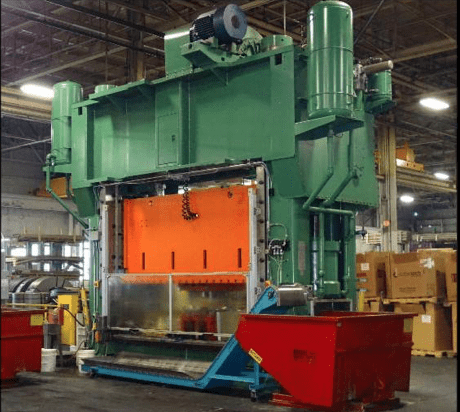
We are pleased to announce the installation of our latest new press, a remanufactured 600-ton Minster Hevi-Stamper, along with its new coil handling equipment capable of handling 30,000-pound coils up to 3/8” thick x 36” wide. As one of my friends (who is a heavy stamper) put it, “Welcome to the big league.” Everyone would agree that 3/8” thick stampings are in the big league. The equipment has the capacity to handle 1/2” thick x 12” wide HSLA steel, and our new crane has a capacity of 40,000 pounds.
Markets served by our new press include solar collector racking system components and transportation (automotive and truck). We had a lot of outsourced work that has transitioned to being produced in-house at Talan, increasing our control and level of service.
Size also matters when it comes to the size of the company. We’ve all heard the saying, “It’s not the size of the dog in the fight but the size of the fight in the dog.” It’s usually smaller dogs that say that. There is a right size for companies to be. In industry, you need to be big enough to spread out the support staff (quality, shipping, accounting, HR, etc.) over a nice volume to be the most cost effective. Yet when a company gets really big, it can lose the drive and ambition that define younger, hungrier companies.
I had a sourcing vice president from a major automotive tier one firm tell me, “$35 million to $50 million is the perfect size for our stamping suppliers to be. They are still hungry, the owners are involved and they haven’t succumbed to big-company thinking where they think they are more important than the customer.” We’re solidly in her perfect size for stampers. Our size also enables us to spread our fixed overhead costs over a larger amount of sales, thus making us more competitive. We still have small-company passion, coupled with big-company capabilities. We have successfully made the transition from an entrepreneurial style of management to professionally managed, yet we haven’t lost our style and verve.
Talan receives 2016 Evolution of Manufacturing award
February 18th, 2016CLEVELAND (Feb. 17, 2016) – Talan Products is pleased to announce it will receive a 2016 Evolution of Manufacturing award, recognizing the company as a regional leader in manufacturing practices and innovation.
Talan is among 11 area companies that will be recognized at the annual Evolution of Manufacturing awards program Feb. 18 at the 925 Euclid Building in Cleveland.
CEO Steve Peplin said the award is a reflection of all the hard work his team has done to remain a Northeast Ohio leader in manufacturing practices. The company has built its reputation on three key areas: technology, safety and customer service.
“We’ve invested in technology, and that has played a very important role in staying on top,” Peplin said. “But it’s really about our people. They’re the ones who are committed to delivering great customer service, and they’re the ones who are committed to safety every minute of the day. They’re the reason we’re poised to grow at a 20 to 30 percent clip over the next several years, and the reason we’ve gone more than 1,400 days without a lost-time injury. Our people are the ‘why’ in why we’re receiving this honor.”
About Talan Products
Incorporated in 1986, Talan Products is a full-service metal stamping company and manufacturer of tooling and engineered parts, dedicated to meeting and exceeding our customers’ expectations. Over the decades, we have become one of the most acclaimed and highly regarded stampers in the United States. We produce a variety of products for more than 150 customers in the fastener, building products, solar, LED lighting, appliance, hardware, defense and transportation markets. For more information, please visit www.talanproducts.com.
Crain’s [M]Power event provides a strategic forum for NEO manufacturers
October 13th, 2015Talan Products CEO Steve Peplin was among nearly 400 area manufacturing executives who attended the Crain’s Cleveland Business [M]Power event on Sept. 30 at the John S. Knight Center in Akron.
The event was designed as a forum for manufacturing company leaders throughout Northeast Ohio to exchange ideas and discuss the challenges facing the area’s manufacturing industry, both now and in the future.
“It was a really engaging event, with a lot of the big manufacturing companies in attendance,” Peplin says. “It was great to see how so many people in our industry want to take an active role in helping shape where we’re headed.”
Peplin was among three regional leaders invited to participate in the panel discussion “What Keeps Northeast Ohio Manufacturers Up at Night?” Peplin joined Shiloh Industries CEO Ramzi Hermiz and Ohio Aerospace Institute President Mike Heil to discuss the challenges faced by area manufacturers, and how to address them.
“I talked about Talan and how I worry about us losing our edge,” Peplin says. “It’s our passion, our mojo – essentially, it’s our culture. Complacency is the enemy as we try to grow from a $40 million company to a $100 million company with hundreds of employees. Could we lose what makes us special? And how do you try to keep that sizzle that sets our company apart?”
Peplin and the other panel members also discussed the future of the economy and how government incentives could impact manufacturing companies.
“We’ve had economic growth for six or seven years,” Peplin says. “So when the business cycle ends, will we have a slow downturn or another sharp downturn, like the last recession?”
Prior to the panel discussion, Aleris CEO Sean Stack delivered the event’s keynote address, followed by breakout sessions focused on topics of interest to manufacturers, such as workforce development, operating in foreign markets and cash flow management.
Manufacturing continues to be a critical industry in Northeast Ohio, which is why Peplin would like to see more events like [M]Power – where industry stakeholders can discuss their pain points and share strategies to address them.
“Ohio has more manufacturing per capita than any other state, so we really are the heart of manufacturing,” Peplin says. “Events like this are an opportunity to come together and discuss the important topics that are going to affect all of us moving forward. It was really an eye-opening experience for me.”
Listen to our story on Allegheny Front radio
October 6th, 2015Solar energy has gone big time, and Talan Products is part of the charge.
At Talan Products, which manufactures the metal mounting systems that hold solar panels in place on roofs, solar energy has gone from 3 percent of the company’s business to 18 percent in just five short years.
That success was recently recognized by the Allegheny Front, an award-winning public radio program covering environmental issues in Western Pennsylvania, which recently reported on Talan and the increasing use of solar.
In the report, Rick Umoff, of the trade group Solar Energy Industries Association, speaks with Talan CEO Steve Peplin about the industry’s grown and the company’s role in it. Umoff says he expects employment in the solar industry to reach 200,000 next year — more than double what it was just a decade ago – and some of that growth will be at Talan, which anticipates adding 75 employees in the next few years as a result of rapid sales increases.
We were honored to be featured on Allegheny Front and are immensely proud of the customers, employees and suppliers who are helping our company succeed in such a worthwhile and environmentally responsible industry.
Talan owner and CEO Steve Peplin attends clean energy manufacturing and policy roundtable to support green initiatives
Talan CEO Steve Peplin recently joined U.S. Rep. David P. Joyce (OH-14) and several Cleveland-area manufacturers that serve the clean energy industry for a clean energy manufacturing and policy roundtable at American Roll Form Products (ARF). The roundtable was held at ARF’s Painesville, Ohio, headquarters on Aug. 4, 2015.
Clean energy manufacturing is important to Talan, and the green ideology is one that the company shares with many of its customers.
“I know that our customers really like that we’re green – especially the young ones,” said Peplin. “Many of our customers in the solar industry entered into the space for ideological reasons, so the fact that we’re so green aligns with their interests and beliefs.”
Other roundtable participants included John Colm of WIRE-Net, Dewey Lockwood of Fabricating Solutions, Joshua Perkins, Rob Touzalin and Phil Misch, all of American Roll Form Products, and Mark Gorenc of The Dyson Corp.
Talan leaders and employees are continuously looking for opportunities to implement new sustainability initiatives and improve energy efficiency at Talan’s plants and offices. The company is in the midst of a zero waste-to-landfill initiative to capture and recycle 100 percent of its daily in-plant and office consumables, including paper, cardboard, plastic, metal and electronics waste. Talan already has a comprehensive program to recycle all of the offal, or scrap, from its facilities.
Peplin said in addition to it being the right thing to do, being green is economical when it is done the right way.
“Everyone likes suppliers who are cost-effective and efficient,” Peplin said. “One of the greenest initiatives we’ve ever completed is when we rehabbed our old, empty building. The amount of energy saved by fixing up an old building and making it functional is incredible.”
At the roundtable, Joyce applauded such efforts and said they are critical to supporting U.S. manufacturing, competitiveness and innovation, and the job creation that comes with them.
“Northeast Ohio manufacturers are on the ground making things happen,” Joyce said. “We have to use every arrow in our quiver to support them, including renewing the wind and solar production tax credits, because it means a lot of business for the region. And the faster we can do that, the more stability we create in the world.”
Talan is leading the way in those efforts. Reducing its carbon footprint is so fundamental to Talan’s business that doing so is built into the employee culture. The company created its own “Green Team” of employees who are charged with finding new ways to improve the company’s sustainability and are championed by Talan President Pete Accorti. Talan also includes a regular column about sustainability in its company newsletter.
New deburring machine offers more efficiency and value for Talan customers
June 15th, 2015Talan Products is pleased to announce the addition of a remanufactured Hammond Roto-Finish deburring machine to its metalworking lineup.
The automated vibratory deburring machine, installed in March, utilizes a ball-burnishing deburring process that can handle formed or stamped parts up to 14 inches in diameter. The machine also allows Talan to apply rust inhibitor while the part is still in the production line and automatically bulk-pack parts as they come out of the machine.
“The addition of our new deburring machine will allow us to bring more of our services in house,” said Steve Peplin, Talan’s CEO. “It will give our existing customers better service and better quality. It will also allow us to create opportunities to service new customers with the same outstanding level of quality and service our customers have come to expect.”
In conjunction with the new deburring machine, Talan has installed a new wastewater treatment facility.
“The machine utilizes a wet process, so it’s important that we treat all wastewater to make it safe for discharge back into the sewer system,” Peplin says. “The same holds true for all of the processes we perform. In addition to our commitment to our customers, we’re also committed to being a good steward of our natural resources.”
Talan Products wins 2015 Smart 50 Award
May 26th, 2015Talan Products has been honored with a 2015 Northeast Ohio Smart 50 Award, presented by Cuyahoga Community College’s Corporate College and Smart Business.
The Smart 50 Awards program recognizes Northeast Ohio businesses that are leading the way for the region’s rebirth by excelling in innovation, impact and sustainability. Talan has led the way in all three categories, particularly in sustainability, producing components that help the company’s customers become more energy efficient through the use of solar energy and LED lighting.
Winners were announced at the annual Smart 50 Awards event, held May 20 at Executive Caterers at Landerhaven.
“We are thrilled to be among the companies recognized by the Smart 50 Awards,” says Talan CEO Steve Peplin. “It’s an award we’ve worked very hard to earn as a company. I’m proud of our people for the work they’ve put in to make us an industry leader, and grateful to the Smart 50 program for recognizing the job we’ve done.”
2014 exceeded our expectations with a record year for sales, productivity growth and safety.
Find out what we’ve accomplished and what challenges lie ahead in our latest newsletter.
Talan wins 2015 Evolution of Manufacturing Award
February 23rd, 2015Talan Products is proud to announce that it has received a 2015 Evolution of Manufacturing Award presented by Smart Business Magazine.
Talan was honored for its achievements in manufacturing, including its commitment to safety and efficiency in its manufacturing processes. The company’s incident rate decreased from nearly 20 in 2006 to zero in 2014. Over the same span, its DART rate (days away, restrictions, transfers) decreased from 10 to zero. Talan has maintained a DART rate of zero since 2013.
Talan’s commitment to efficiency is demonstrated in its investment in new equipment. The company purchased a remanufactured 600-ton Minster Hevi-Stamper press, which will be operational in the spring. The press will be paired with a new deburring machine capable of handling stampings up to 14 inches in diameter. Both new machines will be installed as part of a new production line that will allow Talan to bring previously-outsourced work in-house.
“We are extremely honored to receive a 2015 Evolution of Manufacturing Award,” says Talan CEO Steve Peplin. “It’s a tremendous source of pride for us, because it’s come as the result of hard work and commitment from all of our people, as we continue to work to maintain high standards in everything we do, and continue taking steps to increase the ease of doing business with Talan.”
Talan Products staying true to its local roots
February 18th, 2015We’ve been in the Collingwood neighborhood of Cleveland since our founding in 1986, and even with our tremendous growth, we’re not going anywhere. We occupy about 150,000 square feet in a building that has 750,000 square feet, and as we continue to grow, we have plenty of room to expand. We’ve been operating in Cleveland for nearly 30 years, and look forward to at least another 30 years in the city we call home.
Read the full Crain’s story to see why we chose to maintain our current location in Cleveland, Ohio.
Talan Earns Spot On Crain’s Fast 50 List
November 5th, 2014Crain’s has named Talan to its Fast 50 list, which recognizes the entrepreneurial spirit, innovative business tactics and skyrocketing revenue growth of the 50 fastest-growing companies in Northeast Ohio.
With 32 percent growth in revenue from 2009 to 2013 and 2013 revenue of $24.3 million, Talan has earned the No. 45 spot on the prestigious list.
To be eligible for the award, companies had to be in business at least five years and have achieved revenue of at least $5 million by the end of 2013. Numbers were then crunched to identify those companies achieving the most substantial revenue growth between 2009 and 2013.
“Talan Products is honored to be named to Crain’s FAST 50,” says Steve Peplin, CEO of Talan, one of the premier metal stamping companies in the United States. “To be named among the best, brightest and fastest-growing companies in Northeast Ohio is humbling, and we are excited to be a part of this prestigious list.”
For a complete list of winners of Crain’s Fast 50 awards, visit www.crainscleveland.com/section/fast5014.
Safety is our most important value
March 31st, 2014Safety is our most important value
In an industrial environment, safety is front and center. There are a lot of moving parts to a stamping plant, and our coils of steel and aluminum and our pallets of finished parts weigh as much as a car. In our high-production environment, they are in constant motion around our facility.
My partner, Pete Accorti, and I simply could not sleep at night if we ran an unsafe shop.
Talan’s CEO Roundtables featured in Crain’s Cleveland Business
June 25th, 2013
At Talan, employees often have their sayCleveland metal stamping company holds roundtable chats with CEO By RACHEL ABBEY McCAFFERTY Leaders at Talan Products Inc. wanted “accurate feedback” from employees about what So, they asked. Rather than relying strictly on surveys, which can be generic, Talan Products’ In these biannual meetings, small groups of employees spend about an hour talking with Nancy Oates, a senior buyer who has been with Talan for about three years, said she “Everybody can say anything they want,” she said. |
Talan Products was among an elite group of 106 Northeast Ohio mid-sized companies to be recognized at The 2013 Leading EDGE Awards on May 23 at Lorain County Community College in Elyria, Ohio. In its seventh year, this prestigious award was developed by The Entrepreneurs EDGE to recognize value-creating, mid-sized companies in the region. Qualifying companies operate within the 17 counties of Northeast Ohio and generate revenues up to $750 million, a portion of which must be outside the region.
Honored companies were identified by the value they create in our regional economy, based on a sum of their EBIT (earnings before interest and taxes) and total taxable compensation for all Northeast Ohio-based employees.
“We are honored to be recognized for the 7th time as a top contributor to the economy of Northeast Ohio. We strive to be a major part of our local economy, and it is nice to have the metrics to prove it. Everyone knows ‘all politics are local’; to some extent, I feel all economics are local also.” – Steve Peplin, CEO.
Talan Products is a full service metal stamping company and manufacturer of tooling and engineered parts dedicated to meeting and exceeding our customers’ expectations. Over the decades we have become one of the most acclaimed and highly regarded stampers in the United States. We produce a variety of products for over 150 customers in the fastener, building products, solar, appliance, hardware, defense and transportation markets.
About EDGE
EDGE drives growth for companies by bringing together their leadership teams to share best practices and inspire each other to pursue the biggest opportunities. EDGE is a 501(c)(3) non-profit, and is the only Northeast Ohio economic development group that is focused on helping mid-sized companies strengthen their leadership teams in order to take their companies to the next level.
For more information, contact EDGE at 6801 Brecksville Road, Suite 160, Independence, Ohio 44131, 216.469.8299 or edgeneo.org.
Metal Stampings Company Talan Products Recognized as Silver Sponsor of SPRI 2013 Conference
January 9th, 2013Talan Products, a Cleveland Ohio-headquartered stampings manufacturer is proud to be among the companies recognized as Silver Sponsors of the annual SPRI – Single Ply Roofing Industry conference devoted to educating people in the commercial single ply roofing industry.  Membranes commonly described as “single-ply” are flexible sheets of compounded synthetic materials systems that provide strength, flexibility, and long-lasting durability as roofing materials. Because prefabricated sheets offer consistent thickness, they offer versatility in their attachment methods, and therefore are broadly used. Talan, a high volume stampings company provides a variety of attachment load plates which resemble intricate, specially designed washers used to secure material to roof substrates.
What kinds of roofing sheet goods are considered single-ply? SPRI identifies three major categories of single ply membranes: thermosets, thermoplastics, and modified bitumens. Talan custom stamps to order the varied styles of steel load plates required for mechanical fastening of these single ply roof systems. We have worked for years with manufacturers of the roof systems to help design for manufacturability roof deck fasteners, specialty washers and load plates used in the roofing industry. The SPRI 31st Annual Conference and Business Meeting will be held January 11 – 13, 2013 at the Miramonte Resort in Indian Wells, California. Talan’s president, Steve Peplin will be attending. Please stop by and introduce yourself if you are at the conference.
Metal Stamping Company, Talan Products Celebrates 25th Anniversary
September 23rd, 2011
Did you know that Talan Products is celebrating its 25th anniversary this Fall? The company was started in 1986 by Steve Peplin.
Partners Pete Accorti(President) and Pat Parziale (VP, Manufacturing) joined soon afterward. Initially housed in a 3,000 square foot space, Talan has expanded three times. Talan’s current home of 15 years is a 145,000 square foot manufacturing and warehouse space on the East Side of Cleveland. Currently a $25 million company with 50+ employees, Talan still has all four of its original customers. “It’s one of the real keys to our success,” says Steve. “We invest in our customers, and they’ve been loyal to us.”
Originally in the commercial roof products area only, Talan now makes products for a number of industries including automotive, construction, and appliance, and also the fast-growing solar and LED markets. It has developed particular expertise in both high-volume progressive die stamping and aluminum extrusions fabrication, and has earned ISO 9001 certification. “We are particularly proud of our extremely low PPM numbers, and our value-added-per employee is 150% of the industry average,” notes Steve.
Talan has been named to the national Inc. 100 list, the national Inner City 100 list, and has won numerous local awards for both growth and sustainability.
Stay tuned for more insights into Talan’s future plans.
Stampings Manufacturer, Talan Products Featured In PMA Article On Quality
March 3rd, 2011The Precision Metalforming Association (PMA) published an article in the March 2011 issue of MetalForming titled “The Link Between Total Cost of Quality and Profitability.”
The article discusses the connection between an important PMA benchmarking metric – PROFITABILITY, as measured by EBIT (earnings before interest and taxes) and the link between profitable manufacturing and the true costs associated with quality control methodology. (more…)
The Sunday, November 14 2010 issue of The Plain Dealer ran a column: Talk with The Boss featuring a conversation with CEO Steve Peplin of the Cleveland based progressive die stamping company, Talan Products.
The column contained excerpts from a chat between Peplin and Plain Dealer reporter Robert Schoenberger. The overarching theme of the talk? “We trust our employees enough to be open with them.” Here are some brief excerpts and below is a link to the entire article.
The Question: How do you maintain a culture of mutual trust as the company grows?
The Answer: You have to have people who have your philosophy, your care, your attitude. Because you can’t be everywhere.
People have to be able to make their own decisions and do things their own way . . . but they have to know how we do things.
The Question: Talan has grown from a startup to having more than $25 million in annual sales. How do you craft a strategy to guide the company from an entrepreneurial phase to a professionally run company?
The Answer: You have to set your goals carefully. In the early days, it was all about growth.
We knew we had to grow the top line quite a bit. In our business, you have to have about $25 million to $30 million [in sales] to justify the costs.
A few years ago, we decided it was important to have our own product line instead of being a contract manufacturer. So we set that as a strategy and looked for products that fit. [Talan formed GoPro in 2008, a company that makes aluminum brackets for building staircases.]
The Question: You’ve said that as the company has grown, you’ve filled in weaknesses by hiring people with specific skills. Is that a strategy that can work as the company matures?
The Answer: There’s always opportunity in change. Last year, even though we shrank 30 percent, we managed to not lose money. We managed to expand, hiring a new plant manager. We had to right-size our workforce, but we added to the office.
When times are tough, it’s not necessarily a time to cut back. You can add if you’re adding for strategic reasons.
To read the entire article click here: http://www.cleveland.com/business/index.ssf/2010/11/bosses_need_to_trust_employees.html
—-
Talan products is a Cleveland based metal stamping company specializing in producing large-volume metal stampings utilizing progressive die stamping. They work with a variety of metals including aluminum, steel, stainless steel, brass, Inconel, and copper.
Peplin Discusses Manufacturing Metal Stampings
November 11th, 2010Talan Products’ CEO Steve Peplin Discusses Manufacturing Metal Stampings on Cleveland NPR Affiliate
Steve Peplin, CEO of the Cleveland-based metal stamping company, Talan Products, was recently on the NPR / Ideastream radio show, ‘The Sound of Ideas.’ On the show, Steve discussed the current state of manufacturing in Northeast Ohio.
On the show, Steve pointed out that the state of manufacturing in Northeast Ohio is not as gloomy as some think it is. In regards to his own metal stamping company, Steve pointed out that many major companies constantly need metal stamping services during assembly of their own products. Machines at Talan Products produce thousands of stamped products an hour, and these products include everything from paint trays to door latches.
Steve also talked about some of the recent ups-and-downs he and his company have faced during this touch economy. Regarding 2009, Steve said, “We were down 30% in ‘09. We had our first layoffs in 24 years — which was pretty traumatic. But then, 2010 has been fantastic. The recovery for us started pretty late in ‘09.”
Talan products is a small company that employs only 65 people. However, a promising sign is that 20 of those employees are new hires.
Cleveland Metal Stamping Company Talan Products Featured on ‘The Sound of Ideas’ Radio Show
October 28th, 2010
Talan Products’ CEO Steve Peplin was featured on the Ideastream radio show, ‘The Sound of Ideas.’
On the show, Steve discussed issues relating to the state of manufacturing in Northeast Ohio, both from a broad perspective as well as from the perspective of his own Cleveland-based metal stamping company. Steve touched on the fact that in general, manufacturing in Northeast Ohio is seen by many to be a dead industry, but the reality is that this is not the case.
Steve also talked about the ups-and-downs he and his company has seen through its 25 year history, including how the recent downturn of the economy has impacted his business.
The Sound of Ideas’ is a Northest Ohio based radio news show that airs every weekday at 9:00 on 90.3 FM. For more information about the show, visit the show’s homepage.
Talan Products Featured in July 2010 Issue of COSE Update
July 16th, 2010Talan Products has been featured in the Council of Smaller Enterprises’ July 2010 publication, COSE Update. You can read the article in its entirety here:

COSE Update, July 2010: Loan Stars
Talan Products Receives Weatherhead 100 Award for 9th Time
December 23rd, 2009December, 2009
Talan Products, a metal stamping company headquartered in Cleveland Ohio, has been recognized for the 9th time as a 2009 recipient of the Weatherhead 100 award (www.weatherhead100.org/aboutus/about_wh100.asp).
The award, developed in 1987, acknowledges and honors companies that are the fastest growing in the Northeast Ohio region.
The Weatherhead 100 identifies and honors the 100 fastest growing companies based on sales from 2004 through 2008. Companies must have had sales over $100,000 in 2004 and over $1 million in 2008. Additionally, winning companies must have employed a minimum of 16 full-time employees in 2008.
The Weatherhead 100 award is named for the internationally recognized Weatherhead School of Management at Case Western Reserve University. The school’s spirit of innovation has elevated its management programs to global prominence, earning Weatherhead a reputation as one of the most innovative business schools in the world.
The Weatherhead 100 is compiled and managed by Cleveland-based Council of Smaller Enterprises (COSE).
GoPro Construction Company formed by Talan Products
September 23rd, 2008Stepping up–How Steve Peplin took an innovative idea and turned it into a company
By Megan Tackett
Smart Business Akron/Canton | September 2008
Steve Peplin hopes that the squeaky stair will be a thing of the past. For the past 20 years, Peplin has led Talan Products Inc., but in the past year, he created a new, exciting joint venture with Canadian entrepreneur Eric Gobeil.
Gobeil created the Universal Stair Bracket, which makes constructing stairs more efficient and stable, and after Peplin saw its success in Canada, he wanted to not just manufacture the units, but he wanted to create a whole new organization, so with that, GoPro Construction Solutions was born.
It was a perfect match. Gobeil had the product, and Peplin had the experience and resources. As CEO, Peplin has watched Talan balloon to a $25 million metal stamping company, expanding 19 percent between 2005 and 2007, all during a time when the industry trend was to fold under economic pressure.
Now, the entrepreneurial duo will face those economic pressures head-on with their new joint venture. As a Talan affiliate, GoPro has the advantage of having experienced Talan executives as well as new sales and marketing talent to give the company a leg up in its infancy.
GoPro is the product of Peplin’s “intellectual capital,” a strategy he put in place at Talan to ensure that his company was growing from within and not relying solely on the successes of customers. Traditionally, metal stamping companies make parts to order, but Peplin’s vision took the company to another level.
By investing in intellectual capital, he outlined specific goals to develop a line of proprietary products manufactured by Talan and marketed directly or through partnerships.
Gobeil’s Universal Stair Bracket is the first product that GoPro will market, but Peplin says that it is certainly not the last.
“This is just the first of many innovative construction products we will be introducing,” he says.
His innovation is catching attention, and WIRE-Net President and Executive Director John Colm has said before, Talan is a “poster child for business unusual.”
Smart Business Magazine names Steve Peplin Talan Products CEO as 2008 Business Visionary
September 23rd, 2008Steve Peplin Talan Products CEO Recognized as Business Visionary
September, 2008
Steve Peplin, CEO of metal stamping company Talan Products, was recently recognized as a “Visionary” at the 2008 Innovation in Business Conference. This conference was developed by Smart Business and Anthem Blue Cross and Blue Shield to recognize Northeast Ohio’s innovative businesses and business leaders.
The 2008 Innovation in Business Conference was held on September 18, 2008 and included an awards ceremony to honor business leaders in two categories:
RISING STARS — This award is given to business leaders from younger or start-up organizations with innovative approaches to a business process, idea or product. (Five years in existence or fewer.)
VISIONARIES — This award is given to business leaders who have demonstrated a history of innovative ideas throughout their careers or have developed cutting edge processes or products.
All companies receiving an Innovation in Business award are headquartered or have a physical presence within the 11-county region of Northeast Ohio — Ashtabula, Cuyahoga, Geauga, Lake, Lorain, Medina, Portage, Stark, Summit, Tuscarawas and Wayne.
Fran Adler Joins Talan Products as outside sales manager
August 23rd, 2008Fran Adler Joins Talan Products as Sales Manager
August, 2008
Fran Adler was named sales manager at Talan Products—a best-in-class, high volume, metal stamping manufacturer. Uniquely qualified, Adler melds relationships with his engineering background to deliver customized value creation on behalf of Talan customers.
Charged with developing new vertical markets, Adler’s hit-the-ground-running style complements his ability to effectively manage process with results. Adler said, “OEMs appreciate suppliers that truly understand their business. Oftentimes, with a minimal learning curve, we can fast-track viable solutions to help improve processes and reduce costs.”
CEO Steve Peplin added, “Fran personifies competitive advantage… he brings a spirit of tenacity to Talan. This newly-created position affords Talan the opportunity to explore and expand our expertise to targeted niche markets.”
Previously, Adler’s success reflects a steady progression of increased industry-related sales and managerial experience—mechanical design, plant engineer, operations, business development, executive level management and various sales management positions. This native Clevelander earned his bachelor’s and master’s degrees in industrial engineering from Cleveland State University and is a St. Ignatius grad.
Talan Products is a leading contract manufacturing company specializing in metal stamping, aluminum extrusions, assembly, and secondary operations supporting OEMs primarily in the building components, automotive, and fastener industries. Founded in 1986, privately-held Talan Products is headquartered on Cleveland’s East side. Talan Products is dedicated to customer-driven innovation, value creation and workforce development in order to ensure world-class performance.
Talan Ranked Among Inner City 100 by Inc. Magazine and ICIC
May 1st, 2008Boston, MA – May 1, 2008
Talan Products became the only Cleveland-based company to make the 2008 Inner City 100 list, a national ranking of the fastest growing inner-city companies from the Initiative for a Competitive Inner City (ICIC) and Inc. Magazine.
Talan, a manufacturer of high volume metal stampings, becomes the only Cleveland company to make the list in the past three years – but it is not the first time Talan has made the list.Talan was also chosen in 1998, the first year of ICIC rankings. This year, over 6500 nominations were received nationwide. Only 10 of the winners were manufacturers, and only one other was a manufacturer in the metals industry.
Talan’s growth rate of 156% over the past five years propelled it into the top rankings. “We were thrilled to win again,” said Steve Peplin, Talan CEO, who attended the two-day event in Boston. “We consider it a big deal. And it’s a great ‘Good News’ story for Cleveland.” Peplin attended seminars for Inner City 100 owners and managers at Harvard Business School and a gala awards dinner at the Boston Convention and Exhibition Center that drew more than 1,000 guests. “It was very well done and it helped me feel good about the potential of smaller U.S. manufacturers generally in the face of tough foreign competition. Rubbing shoulders with the other winners was inspiring.”
Third Consecutive NEO Success Award to be awarded to Talan Products
March 23rd, 2008March, 2008
For the third consecutive year, Cleveland Ohio-based metal stamping company Talan Products has received recognition as one of Northeast Ohio’s most successful companies. On March 11, 2008 Talan Products will be presented with the Team NEO Success Award. The company also received the Success Award in 2006 and 2007.
Since 1994, the NEO Success Awards have recognized Northeast Ohio’s most successful companies. The NEO’s began because the business community wanted to showcase the breadth and depth of business success in the region, a region that encompasses 17 counties.

Toward Becoming an Agile Enterprise – Metalforming Magazine (September 2007)
September 23rd, 2007Toward Becoming an Agile Enterprise
By Brad F. Kulvin, Editor; and Louis A. Kren, Senior Editor
Metalforming Magazine | September 2007
“Anyone can go purchase a die. But what sets the winners in this industry apart is the people you hire and train. Your employees have to work smarter, and you have to provide them with an environment and a system that allows them to succeed. Ultimately, that’s how you do more with less.”
Everyone must do more with less, help their customers develop new products, innovate, and find faster and lower-cost ways to produce. That’s the common theme of the five metalforming- company leaders we interviewed for this survey article on the metalforming markets, and what it takes to compete.
Other common themes, albeit described with unique, individual perspectives, include lean initiatives, intensified training efforts, and carefully selecting customers and then nurturing those most valuable customers to develop partnering relationships. Today’s successful stampers, simply, find out what they’re good at and then put all of their efforts into marketing those unique strengths. As our first subject, Steve Peplin, CEO of Talan Products Inc.,Cleveland,OH, says: “We’re dedicated to finding not just any customer, but on finding the right customer, the right relationship and the right projects.”
Since 2003, employment at Talan Products has doubled and revenue more than tripled, a growth spurt many, if not all, would relish. And for sure, Peplin does. However, handling that growth presents a unique set of challenges, such as ensuring that manufacturing inefficiencies don’t creep in. The firm, primarily a supplier of stampings and aluminum extrusions to the building- products market, has adopted practices to allow it to be what Peplin calls an “agile enterprise,” by eliminating waste. But rather than focus on that aspect of his company, when asked to describe future hurdles and strategies for jumping them, Peplin immediately turns to human-resource initiatives at Talan.
“While we’re not focused heavily in the automotive arena (the firm’s strategic plan caps its automotive work at 35 percent), we do face the same competitive pressures faced by automotive stampers,” Peplin says. As such, he cites being asked to do more for less, to be innovative and to find faster and lower cost ways to produce as his guiding principles are handed down from customers. Talan specializes in high-speed stamping of medium- to high-volume runs, as well as assembly, with part counts often in the millions. It operates 22 presses in capacities to 400 tons with bed sizes to 105 by 50 in.
“Yes, we invest in manufacturing technology where we need to—faster presses and new controls, for example. But I see machines, steel, tooling, etc. as commodities ,” Peplin opines. “Anyone can go purchase a die. But what sets the winners in this industry apart is the people you hire and train. Your employees have to work smarter, and you have to provide them with an environment and a system that allows them to succeed. Ultimately, that’s how you do more with less.”
Striving to achieve the classic lean/ Toyota Production System goals of more inventory turns and more value-added performance per hour, Peplin invests plenty of time and money into workforce training. “An emphasis the last five years or so on workforce development and creation of clearly defined career paths for our workers,” he shares, “allows us to, first of all, hire the best of the people that are out there. Then, it ensures that we will keep and develop the good people that we already have.”
Workforce development runs through the Talan Academy, designed to include courses to help employees climb a clearly defined career path. Developed in conjunction with the Cleveland organization Wire-Net (Westside Industrial Retention and Expansion Network), the academy even offers executive-level leadership training, which Peplin continues to engage in. “I’m participating in a very nontraditional education program to further develop my abilities in working with people,” he says.“As the company grows, working better with people becomes more critical.”
By focusing on human resource development, Peplin figures he’s preparing his company for its next wave of growth: being a solution provider. “Our strategic plan calls for us to be problem solvers for our customers,” Peplin shares, “not just being a low-cost provider of stampings. For sure, operational excellence is a must, but we’re positioning ourselves to be part of a bigger team along with our customers, to provide technical assistance and design support.We do this by building our mental capacity in addition to production capacity.”
The plan: Partner with a select group of customers and become critical strategic allies with each of them. “We look for opportunities to move stamping operations from a customer’s plant to ours,” adds Peplin. “It is our core competency, and allows the customer to better deploy its capital.”
Yet another way Talan Products brings value to its partner-customers comes via materials management. “While stamping of aluminum extrusions comprises about half of what we do,” Peplin says, “we also supply raw extrusions to customers through a highly developed supply chain. This sophisticated commodities metal-management service helps our customers manage what can be wildly fluctuating prices for raw materials.”
Always looking forward, Peplin shares the next step in his growth plan: Developing intellectual capital. Specifically, to develop a line of products designed and manufactured by Talan Products. “We’ve recently purchased some patents, and are developing others,” he says, “following through on one of our long-standing strategic-plan initiatives. A customer came to us to manufacture its part—we liked the concept of the part and its application, and also saw it as a good fit for our core fabrication competencies. So we bought half of the company and made them a partner. Basically, they needed a production partner and we were looking for a product.”
Talan ranks #73 amongst the 100 fastest-growing inner-city businesses.
July 23rd, 2007The best of the best.
Inner City 100 Hall of Fame companies have been ranked among the nation’s fastest-growing urban firms for five consecutive years or more. They are the best of the best. Over the last 13 years, 43 companies have been inducted into the Hall of Fame, employing more than 4,000 workers and posting a revenue CAGR of 53%.
For the entire list and more information visit the ICIC.org page
2007 Ernst & Young Entrepreneur of the Year® Finalist
July 23rd, 2007Steve Peplin grows Talan Products Inc. by establishing strong customer relationships – (July 2007)
By Abby Cymerman
Smart Business Akron/Canton | July 2007

Sometimes the simplest of strategies can create the most successful results, as Steve Peplin, the CEO of Talan Products Inc., can attest.
The Cleveland-based company provides custom metal stamping, tube forming, aluminum extrusion and aluminum fabrication services for many industries.
Talan was founded in 1986 with one goal: Find a customer who needs a part made for them, and then obtain the expertise and equipment to manufacture it. When Talan started, it made one part for one customer. During its second year, the company added another part for another customer.
The challenge in being the sole manufacturer of one part for one client is that it leaves no room for errors. If a mistake is made, a project can become a losing proposition, and too many losses could spell disaster.
Through its philosophy of partnering with customers, an idea that was just evolving in the ’80s, Talan found itself in a unique position. The company’s first two customers, as well as its third and fourth, continue their business relationship with Talan today.
Peplin takes an innovative approach to running Talan. Through open-book management, financial metrics are shared with the entire work force. Profit and loss reports are generated weekly and compared with the annual budget during meetings. Any variances over .1 percent are analyzed or discussed.
He has found that sharing this information with employees brings them together and keeps everyone working toward a common goal. By basing bonus plans on controllable costs and company profitability, all employees — not just the managers — are able to keep their eye on the ball.
Peplin strives to retain his employees and improve his work force through training initiatives and remedial training to enhance areas that are found to be deficient. His executive team is given proficiency and emotional intelligence assessments, as well as traditional and nontraditional leadership training.
Always looking toward the future, Peplin plans to maintain his company’s proven winning formula: Provide excellent customer care and success will follow.
Team NEO Success Award 2006 Given to Talan Products
March 23rd, 2007Team NEO Success Award 2006 Given to Talan Products
March, 2007
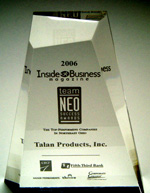
Talan Products, one of the larger independently owned metal stamping companies headquartered in Cleveland, OH was honored in March 2006 by Team NEO with the organization’s 2006 Success Award. The Team NEO Success Awards salute the fastest-growing companies in northeast region of Ohio.
Team NEO is a private-sector-led economic development organization with two primary goals. The organization helps the region’s employers grow their companies within Northeast Ohio and works to recruit medium to large companies to relocate to Northeast Ohio.
Team NEO works in conjunction with business and economic development partners on a continuing basis to help companies in Northeast Ohio reduce costs, introduce new products, explore new markets, step up marketing efforts, and increase customer service.
Team NEO works primarily with businesses in the medical/health care, financial services, chemistry, advanced manufacturing, and sustainability industries. These industries represent the present and future of Northeast Ohio, and many are among the leaders in the United States and the world.
Locally published magazine, Inside Business annually partners with Team NEO to recognize and honor the top-performing companies in Northeast Ohio via the Team NEO Success Awards.

WIRE-Net presents Mission Builder Award to Steve Peplin of Talan Products
June 23rd, 2006June, 2006
WIRE-Net (Westside Industrial Retention and Expansion Network) recently presented its Mission Builder Award. The award honors organizations and their leaders who exemplify the organization’s mission to strengthen manufacturing to create healthy communities and fuel economic growth.
The 2006 award winner was Steve Peplin, CEO of Talan Products, Inc. Talan Products, a fully integrated manufacturer of high volume, high speed metal stamping products, recently moved from their w.68th address to the Collinwood area of Cleveland. The move allowed for the company’s continued innovation, reinvestment, and job creation.
Since 2003, Talan’s employment has doubled and with this move, the company expects continued job growth and a 30% increase in sales over 2005.
Talan understands the importance of innovation – and uses cutting edge staff development tools including Open Book Management and Lean manufacturing techniques to remain competitive. Accepting this award at our Innovation Celebration in Steve’s absence was Pete Accorti, himself a long-time WIRE-Net supporter and 2004 award winner.
Talan Products wins Manny Award from MAGNET & Inside Business Magazine – (June 2006)
June 23rd, 2006Talan Products, along with GELCore and Lamson & Sessions received the 2006 Manny award in the “Top Growth” category.
Talan Products is a leading steel and aluminum metal stamping and metal fabrication company headquartered in Cleveland, Ohio.
The Manny award annually celebrates achievements of Northeast Ohio manufacturing and distribution companies. Entrants in the competition are judged by editors of Inside Business magazine and local business leaders. Fifteen awards were presented based on achievements including record years in growth, addition of new jobs to the region, creation of a new product or providing employees with outstanding educational opportunities.
MAGNET, the Manufacturing Advocacy & Growth Network, serves as the voice of manufacturing in Northeast Ohio The organization advocates for manufacturers in dealing with the multitude of regulatory agencies at the local and regional level and also represents the region’s manufacturers in influencing public policy.
Steve Peplin, Talan Products’ president and CEO identified the winning growth formula for the Cleveland, Ohio based Stamping Company as a continuation of record sales service to both companies within Ohio and an expanding USA market for Talan’s core competencies – high volume, high speed metal stamping, tube fabricating and end forming, and processing of aluminum extrusions.
Stamping Its Future – Crain’s Cleveland Business
May 23rd, 2006With move to larger space and new equipment, metalworking firm Talan Products Inc. sets out to grow via acquisitions
By David Prizinsky
May 8, 2006
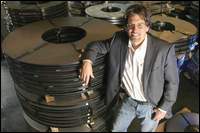
A change of address to Cleveland’s Collinwood neighborhood for Talan Products Inc. has created room for sales growth for the company that focuses on metalworking, an industry that is consolidating.
The 20-year-old company is projecting sales of at least $25 million this year, up 32% from $19 million in 2005, said CEO Steve Peplin. Talan spent $1 million on new equipment and building renovations in connection with the move, which enables the company to reduce operating costs through a more efficient layout of equipment, he said.
Before the move, Talan operated out of 58,000 square feet of cramped space in several buildings on the city’s West Side. Talan now leases 145,000 square feet of space in the huge Richard Melvin Building, which formerly housed TRW Inc.’s engine valve production operations.
Talan moved at the end of last year, and Mr. Peplin said Talan plans to acquire the space it now leases. “We intend to own it,” he said.
Plant layout and design are important to productivity, but Mr. Peplin said the key to Talan’s profitability and growth also has been its constant measurement of all shop floor functions and processes against key internal and industry standards. “What gets measured gets improved,” Mr. Peplin said.
Talan, which has 55 permanent and 20 temporary workers, began in 1986 by producing stamping dies. The company since has expanded to include metal stamping, aluminum extruding and tube forming. Mr. Peplin said the company operates 25 stamping presses. Talan’s sales per employee are twice the stamping industry average.
A Plan for Growth
Although employment will increase to 80 permanent workers over the next year or two, Mr. Peplin said sales must grow faster than expected employment growth if labor costs are to be kept under control. Mr. Peplin said the company will pursue long-term sales growth by heightening the awareness of Talan as a company that will form innovative relationships with manufacturers that can reduce overall costs.
“We want to be seen as a provider of solutions,” he said. “We want that to be our brand and our brand is really our people.”
He said the quality of the company’s work force is a source of pride. This year, the employees are slated to receive a substantial bonus that will be based on the gross profit margin for the year. The company did not pay a bonus last year.
Up until now, Talan has grown on its own without acquiring any other companies. But now that the company is settled into its new space and its systems are ingrained, it will seek acquisitions, Mr. Peplin said.
He said companies that might be acquired now could be more easily integrated into the Talan organization and culture thanks to long-standing efforts to establish an efficient production and quality control systems. He said opportunities for acquisitions are relatively numerous because a stamping industry consolidation that is under way. He did not offer a timetable.
Talan has been cited by many industry groups for its sales growth and its openness to new ways of conducting business. John P. Colm, president and executive director of the Westside Industrial Retention and Expansion Network, or Wirenet, a Cleveland manufacturing support group, said the company can serve as a role model for other industrial companies seeking to grow.
“Talan is our poster child for business unusual,” said Mr. Colm, who is familiar with the company because of its work with Wirenet. “Talan is moving ahead on a number of fronts and innovation is the theme.”
A Close Relationship
Mr. Colm said Talan, contrary to the conventional wisdom, has proved that a modernization strategy can work in traditional industries such as metalworking.
He said the company began exploring lean manufacturing practices in the 1990s before they were popular. And Talan is never satisfied with a business-as-usual approach and always is looking for ways to increase efficiency and to work with customers.
Mr. Peplin, one of the company’s two founders, said Talan’s willingness to work closely with customers is another key to its growth. The customers tend to be large since Talan has geared its operations to long-run stampings. Building construction components comprise the largest market. Other major markets are automotive, fasteners and appliances.
Just how closely the company is willing to work with customers is illustrated by Talan’s operation of an inventory management service for customers plus a materials management service.
The inventory management service results in a steady flow of the right quantity of products needed in a customer’s plant.
This enables the Collinwood company to maximize its production efficiencies and minimize equipment setups and other time-consuming changes.
Materials management provides advice regarding the pricing trends of steel and aluminum and gives customers a chance to accelerate or defer purchasing decisions depending on the direction of metal prices up or down.
“Customers rely on us for pricing trends. We spend a lot of time and money on materials information,” Mr. Peplin said, adding that steel and aluminum represent at least 60% of Talan’s costs and are a highly significant part of customers’ costs.
A dramatic example of working with a customer came in 2004 when Talan acquired five presses from an Ohio manufacturer that used them to make parts. Talan began operating the presses and supplying their prior owner with parts. Mr. Peplin said the deal made sense to both companies because Talan is a stamping specialist and can perform the work more efficiently.
From Crain’s Cleveland Business – May, 8 2006
Photo credit: Jannie Bentivegna
Crunching the Numbers – Inside Business (May, 2006)
May 23rd, 2006Crunching the Numbers: Careful Financial Management Keeps Talan Products Flying High
By Morgan Lewis, Jr.
May, 2006
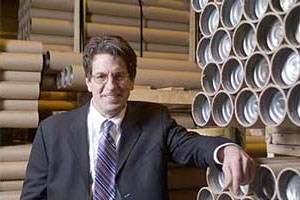
The only way to measure growth is to look at profits and losses, says Steve Peplin, co-founder and CEO of Cleveland-based Talan Products, a manufacturer specializing in metal stampings, tube forming and aluminum extrusions.
That’s why every week Peplin generates a real-time financial report to analyze every cent coming in and going out.
“Every week we meet with all managers, put all the numbers on the wall and anything that’s .1 percent over budget, we solve it,” Peplin says. “So at the end of the month, there are no surprises. We’ve known all along.”
For a company producing thousands of aluminum, copper and steel parts per hour, studying the numbers is critical for growth, and for Talan it has made the difference.
The company nearly doubled its revenue from $8.5 million in sales in 2002 to $19 million in 2005. Sales are expected to reach $23 million this year.
Likewise, Talan had 32 employees in 2002, which grew to 53 by 2005.
Such an expansion required Talan to move out of its 57,000-square-foot factory to a larger facility formerly owned by TRW Inc., where Peplin invested more than $1.5 million redesigning and adding equipment.
“We don’t do just one thing right, we do thousands of little things right every day,” Peplin says.
From Inside Business – May, 2006
PMA Zero Lost-Time Accidents Award Received by Talan Products for 6th Straight Year (April 2006)
April 23rd, 2006April, 2006
This spring, Talan Products was recognized by the Precision Metalforming Association for a continuation of a quality safety standard within the metal-working industry.
Talan Products, is an industry leading high volume metal stamper located in Cleveland, Ohio.
In addition to stamping metal parts, Talan Products produces finished, fabricated components from metal tube as well as finished cut-to-length and fabricated aluminum extrusion.
For the sixth consecutive year (2005), Talan Products was recognized by PMA’s Safety and Environment committee on “achieving zero incidents involving days away from work, days of restricted work activity or job transfer.”
With the United States, accidents involving workers in plants employing metal forming and metal working (including the Talan Products’ area of expertise – metal stamping), along with transportation equipment manufacturing and food manufacturing accounted for 42 percent of all injury and illness cases reported as by the Bureau of Labor Statistics (BLS) for 2004.
The Precision Metalforming Association has aligned itself with the Occupational Safety & Health Administration (OSHA) to promote worker safety and health in the metalforming industry. PMA and OSHA work together to reduce exposure to ergonomic hazards and address press-safety issues such as machine guarding and lockout/tagout to prevent injuries.
Meegan Moore, Talan Products director of Human Services, proudly noted that on January 19, 2006 Talan reached 2,100 consecutive days with zero lost-time accidents, a figure monitored by the Ohio Bureau of Worker’s Compensation.
Local Companies get State Tax Credits – The Plain Dealer (July 27, 2005)
July 27th, 2005July, 2005
Cleveland’s Talan Products Inc. and THI Holdings Inc. of Highland Hills are among nine companies to receive job creation tax credits from the Ohio Tax Credit Authority. Talan, a metal stamping company, will get an eight-year, 55 percent credit valued at $152,192 to expand its manufacturing operation – a project expected to create 45 jobs in three years. THI, a subsidiary of Nationwide Insurance Co., will receive a 10-year, 60 percent credit valued at $3 million to grow its headquarters by 250 employees in three years. 2 companies get development loans.
Two Northeast Ohio companies will receive loans from the state’s Development Financing Advisory Council, which allocates money to firms as an incentive to create and keep jobs in Ohio. Hudson’s QuaTech Inc., a maker of data communications products, will get an 8 percent, $2.5 million Innovation Ohio Loan to help acquire a wireless connectivity technology that will enable the company to grow into new markets and add 22 jobs in three years. Camaco LLC, a Michigan- based firm that produces seating frames for the auto industry, has received a 3 percent, $2 million direct loan to launch a tube and stampings operation at its Lorain campus. The Camaco project is expected to create 40 jobs in three years.
Copyright 2005 – The Plain Dealer and cleveland.com. Used by permission
Marketing Gives Balance to Talan – The Plain Dealer (January 31, 2005)
January 31st, 2005January, 2005
By Steve Peplin, as told to Plain Dealer reporter Marcia Pledger
Steve Peplin of Talan Products, Metal Stamping Company in Cleveland, OH
When you talk about manufacturing in America, you generally don’t use “high growth” in the same sentence. It’s a tough industry that is suffering from overcapacity, has low margins and is hyper-competitive. But we grew steadily and very quickly for many years, and we’re still having fun.
I started this company 19 years ago with two other guys. We each put in $2,100, and we clawed our way up the glass wall.
We are metal-forming specialists that make parts typically unseen in products – unless you’re a manufacturer. We’re in the metal stamping, tube-forming and aluminum-extrusion business. We make components for the fastener, appliance, building hardware and automotive industries. In the 1990s we got used to receiving awards for growth. We won Inc. 500 awards in 1993 and 1999 for being among the nation’s fastest-growing privately held companies.
We won the Manny award from Inside Business and CAMP for manufacturing excellence in 2000. We were named to the Weatherhead 100 list of fastest-growing private companies in Northeast Ohio from 1993 to 1997. That’s kind of unique, because by the fifth year, you’re not comparing such small sales numbers.
But that was the 1990s. Our sales stayed flat at around $10 million to $12 million for many years. My biggest mistake was not building a sales and marketing arm sooner. We were unbalanced. We concentrated on innovative tooling and processes of manufacturing, but I was the only one selling our manufacturing services.
After our high sales growth period settled down, we still grew at a rate of about 40 percent a year for a few years. And we made nice profits. We didn’t even have a brochure for a long, long time. When you’re growing fast, who needs one? We had built the business by networking and through our reputation. Our efforts were spent becoming a better manufacturer by working with an organizational development consultant.
We tried to just let growth happen. We never participated in trade shows or had reps doing work for us. Then, a few years ago, we finally decided to start marketing, and we fumbled. We hired someone, and it didn’t work out. Nothing was sold for a year. After we were burned by the experience, we got cold feet.
I was a little naive, though. It takes a few years to make it work. You have to have a formal process that includes a way to create leads, such as brochures and a Website. It took a while to get qualified leads. Then, once we did, we still didn’t have anyone in sales to chase them down. We ignored the sales process until we plateaued.
The good news is that in a four-year period when our sales were flat, we increased our productivity. Thanks to improved processes, 32 employees can do the same volume of business that 50 to 75 employees used to do.
Being more productive enabled me to spend more time landing a big job. After years of networking, we just closed a few deals that make us a $20 million company. Now I have breathing room to work with sales. Before, I was too busy doing what I call presidential crap.
About six months ago, we hired a known entity in our industry to be in charge of sales and marketing.
We’re successful in an industry that’s been hurt greatly by offshore purchasing. The industry is consolidating, too. Forecasters are saying that half the metal stampers will be out of business in just a few years. The ones that remain will be twice as big.
We’ve been fortunate. We still have the first, second, third and fourth accounts that we landed. Now that we’re generating leads, getting quotes and going after new business, I’m more excited than ever about our prospects.
It’s great to be high-growth again. Now, when I go to bed, I can’t wait to get back to work.
Copyright 2005 – The Plain Dealer and cleveland.com. Used by permission
Innovative Thinking – The Plain Dealer (November 12, 2004)
November 12th, 2004Innovative thinking is the key to surviving in a shifting market
November, 2004
By Thomas W. Gerdel
For six decades, the business model at Cleveland Wood Products was as plain as its name. From its plant on West 150th Street, the company designs and produces wood brush rollers for vacuum cleaners. The division of Scott Fetzer Co. supplies brush rollers to Kirby, a Clevelandbased sister company, and other vacuum cleaner makers. In its peak year in 2000, it turned out 7 million rollers and employed 200 people.
But since then, one large customer has gone offshore to Asia for its rollers, and now the business, whose workforce has fallen to 105, is reshaping its strategy. One of the company’s other products, a cloth vacuum cleaner bag, unexpectedly led to a new product – a pizza delivery bag.
So it has been learning all it can about the pizza delivery market so it can make and sell heated bags for delivering pizzas. After spending years working directly with large manufacturers, the company sales force now is learning how to reach small mom and-pop pizza stores through direct-mail promotions and trade show appearances In its quest for change, the manufacturer – now calling itself CWP Technologies Inc. – is getting encouragement from other local businesses that also seek ways to boost innovative thinking about products and markets.
Their group, called the Manufacturing Innovation for the Next Decade Learners Group, meets every month or so to share ideas and tour members’ plants.
“What the learner group really did was to challenge us as local manufacturers to abandon our paradigm,” said Russell Cooper, the West Side company’s manager of marketing and business development.
Many second- or third-generation manufacturers here tended to wait out a recession until business conditions got better, he said. But the last recession has not been like the past.
Robert Tucker, a California consultant who met with MIND last month on a trip to Cleveland, urges companies to take inventory of their competencies and ask who else might benefit from them.
Tucker likens innovation to a muscle that has been allowed to atrophy as manufacturers focused on cutting costs and making plant processes more efficient. Marketing and talking to new customer groups are “foreign to most of our manufacturing leaders,” he said. “The only time they do it is when they’re in a pinch.”
The MIND participants are trying to change that attitude. The group is a part of WIRE- Net, a nonprofit organization devoted to the advancement of manufacturing on the city’s West Side. The six firms in MIND have a combined work force of more than 450 people.
For Pete Accorti, an owner of Talan Products Inc., the group helps his metal-stamping firm learn to build innovation into its business structure and strategies, making it less accidental.
He said smaller firms often focus all their energies on squeezing costs “out of the middle of their business,” as opposed to seeing how they can grow their sales.
“You do have a tendency to get complacent,” said Gordon Barr, president of NewKor Inc., a maker of paper tubes and canisters that also is a MIND member. NewKor, which has lost some paint roller cover business to Asia, is trying to apply its know- how in precision cutting and highly engineered materials to new areas such as insulation jackets for rocket motors.
Another MIND member, E.C. Kitzel & Sons Inc., worked closely with jet engine maker Pratt & Whitney to develop a diamond indenting stylus for marking jet engine blades so they’re easier to identify.
Tom Schumann, general manager of the Cleveland cutting tool maker, said the new marker has potential applications in the automotive and other industries.
“You’ve got to be creative and come up with new products,” said Don Mottinger, an owner of Superior Products Inc. The Brooklyn manufacturer continues to increase its metal fittings business by developing new products and expanding into markets including the medical and beverage industries. In the last eight years, Superior has added five new patented products, and it recently expanded operations.
“You have to differentiate yourself from others,” said Mottinger, who is not a MIND member but recently talked to the group.
At Cleveland Wood Products, the leap from wood brush rollers to pizza delivery bags involved not just finding a new market but also a way to stand out. For the last 10 years, the firm has been making cloth bags for Kirby vacuum cleaners.
“We developed a capability to sew, join materials and to do ultrasonic welds,” said Brian Grabowski, product manager for CWP’s heated solutions group. That adds up to a pizza bag.
But he said the firm spent a year assessing the opportunities for making and marketing a new kind of bag that could hold heat longer than conventional insulated bags. “We gathered a lot of information about our competitors and felt that we could come up with a device that addressed all the negatives of what’s out there and attack them on price,” Grabowski said.
The result: a flat heating plate made from a special polymer that can be plugged into an electrical wall socket. Cooper said the bag, for which the firm has a patent pending, can keep a pizza hot up to 45 minutes. CWP also offers to put the customer’s own name on the bag, customizing it for thousands of pizza places.
“There are over 60,000 pizza shops in the United States, and over half of them deliver,” Cooper said. The company is exploring other markets as well, he said, including heated blankets, sleeping bags, catering trays, satellite dish covers and instrument insulation.
Copyright 2004 – The Plain Dealer and cleveland.com. Used by permission
The New Schneiderman – Socially Responsible Business (November 9, 2004)
November 9th, 2004The New Schneiderman – Socially Responsible Business Champion Nominees, Entrepreneurs for Sustainability
November, 2004
Champion: Peter J. Accorti – Talan Products
(Nominated by: John Colm – Westside Industrial Retention & Expansion Network, WIRE-Net)
Pete Accorti has been a champion of corporate social responsibility, environmental sustainability practice, systems thinking, experimentation and learning in many spheres, including education, design, and business.
I know of his work primarily in the business sector due to my involvement with him as a former Board president and current board member of the Westside Industrial Retention & Expansion Network or WIRE-Net, a Cleveland based non-profit organization devoted to a manufacturing-based economic development strategy. In that capacity, Pete was a founding and active member of WIRE-Net’s Employment & Training Committee, and our Manufacturing Assistance Program, which leveraged existing social capital among progressive manufacturing firms on Cleveland’s west side. Pete was a founding member of the NE Ohio Manufacturing Awareness Council, and is co-chair of the NE Ohio Campaign for American Manufacturing, which advocates for policies to strengthen and enhance domestic-based manufacturing.
Pete was instrumental in forming WIRE-Net’s Manufacturing Assistance Program, which brought together formerly isolated members of NE Ohio’s manufacturing world into a community to learn from and with each other about important strategies to maintain and improve their competitiveness. MAP explored ways to reduce employee turnover, improve hiring practices of Generation X, pursue manufacturing excellence and other topics. The program continues today, and a pilot Learners Group has just finished its first year of work on manufacturing innovation.
Pete was also a champion of a unique effort that resulted in WIRE-Net sending its director of Manufacturing for a internship at the Rocky Mountain Institute. That director was Holly Harlan. As a result of that experience, Holly formed a groundbreaking Manufacturing Sustainability Learners Group with several local manufacturing business leaders from industries that included a metal stamper, plumbing products company, a major dairy and a paint company. Several of these began implementing Natural Capitalism principles explored by the Learners, and one just completed construction of a major green-built, LEED certified distribution center, constructed on a former urban brownfield.
Pete was also a founding member of Entrepreneurs for Sustainability, and a major force behind E4S’ recycling design competition. In his own company, Talan Products, Pete was a central force to build a community of employees and managers, and implemented Open Book Management to engage employees more directly in efforts to improve the financial performance of the organization. Talan has won many awards due in large part to Pete’s leadership. Talan has been a multi-year winner of the Enterprise 100, and the Inc Inner City 100.
Pete is a strong believer that US companies can improve their commitment to and results from a concerted focus on the triple bottom line of profit, employees and community. His work has truly been catalytic, and best of all, many of us believe we did it…not Pete. This is the true mark of a “servant leader”, when your followers believe they did it without you.
Six Risky Things… – COSE Update (March, 2001)
March 23rd, 2001Six Risky Things They Did for Business That Actually Paid Off!
By Rosemary Rood-Tutt
From COSE Update – March 2001
Knowing the Score
“Open-book management is not the end all,” says Peter Accorti, one of the owners of Talan Products, a metal stamping company on Cleveland’s near West Side. “It’s a tool. And if it’s implemented correctly, it gives you a very competitive advantage.”
In 1999, Accorti began sharing the company’s financial information with all 45 employees, even hourly line workers. Greeted with mild cynicism, doubts vanished when Talan paid out 11 percent of gross wages in year-end bonuses. ‘Any time people realize they’re playing a game and they’re winning, it has a very positive impact on the culture,” he explains.
Open-book management cuts to the quick. “It distills everything to the most basic level which is ‘What are we here for?’ “ Accorti explains. “It’s difficult to drill down to that level unless you go right to the basics.” Inspired by Jack Stack’s book called The Great Game of Business, Accorti agrees that business is indeed like a game. “You’ve got to keep score,” he says. “But generally, only a handful of people know the score. No one else knows whether we are winning or losing, or what they can improve upon.”
Stack bought a nearly bankrupt International Harvester plant in Missouri with a 90-to-1 equity ratio. He kept the doors open by developing key critical numbers to sustain the business and shared them with everyone in the company. Then he devised games around those numbers. “Make everyone aware of the score by communicating information every day,” Accorti advises. ‘And then share in the rewards.”
Talan’s managers gather weekly to review profits and flag variances, and the entire company comes together every month for an update. “Everybody knows from week to week what our production is, what our margins are and where the variances are,” says Accorti. “Get the whole company focused on improving areas like market share, efficiency or inventory turns. If you want to stay competitive in the marketplace, can you imagine any better way?”
Accorti cautions that open-book management is no magic bullet. There are other things you need to be doing simultaneously. “I don’t think you can implement open-book management to the exclusion of other issues like a good, solid approach to strategic planning,” he says. “To generate this kind of thing you need a solid financial strategy, sophisticated software and an infrastructure to support it.” And a good accountant to generate figures on a weekly basis.
Open For Business – COSE Update (January, 2001)
January 23rd, 2001Open for Business
By Sallie Hoelscher
From COSE Update – January 2001
Although he knew the practice of “open-book management” was a bit unusual in smaller companies, Peter Accorti became intrigued with the idea 20 years ago when he read The Great Game of Business by Jack Stack. According to Stack’s Web site (www.greatgame.com), open-book management—the sharing of financial data with all employees—is a piece of the “great game” process, defined as “a total management system that encompasses the basic components of a game, applies them to the art of running a business and allows the players (employees) to understand and help control their destiny in the business.”
For Accorti, part-owner and vice president of operations for Talan Products, a metal-stamping company on Cleveland’s West Side, open-book management enables him to use financials as tools to set goals and educate employees. Sounds good in theory, so where is the “but” …
Open-book management, Accorti observes, does not come without its challenges, because you are, after all, sharing your financial information with your employees. He recommends that you have a solid business infrastructure already in place, along with strong lines of communication.
This year Talan Products enters its third year of open-book management, and Accorti admits they are still fleshing out the process. He says it has made a major impact in two ways.
Culturally, says Accorti, “open-book management gives us a competitive advantage, because we’re all focused on outcomes.” And operationally, he feels it forces him to be a better businessperson because of the constant accountability.
But he warns that the practice is not a panacea. “It will not solve all of your problems. But it does help employees understand what the drivers are. There is a greater sense of team.”
Talan Products, Inc., founded in 1987, has 50 employees and has been named to the Weatherhead 100 five times..
From School to Career – Catalyst Cleveland (December, 2000)
December 23rd, 2000Labor Pool Shrinking:
Act now, report urges educators and employers
By Sandra Clark
November / December 2000
From Catalyst Cleveland
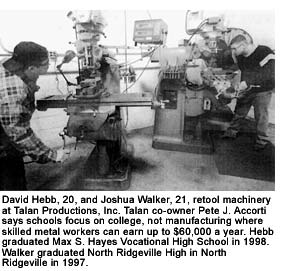
To stem the tide of unqualified workers, Cleveland schools, local businesses and community agencies are drawing up a plan to build a more sophisticated workforce. Together with the Greater Cleveland Growth Association, the district plans to assemble a School-to-Career Office, chiefly charged with translating business needs to schools. It also should see that skills and a rigorous curriculum are taught to students district wide.
“The business community is geeked up about the possibilities,” says George Coulter, director of the Growth Association’s Jobs and Workforce Initiative. “Now what?”
“I think things are going to change,” says local business owner Pete J. Accorti, owner of a local manufacturing firm and an advocate of the School-to-Career movement, “I’m more excited about what will happen in the future than I am about what’s happening now.”
The school district must act now, the report says. There is “a newfound optimism” and “a sense of urgency” among employers that schools can benefit from, it says.
Wired For Revitalization – Cleveland Enterprise (Summer 2000)
June 23rd, 2000Wired For Revitalization:WIRE-Net’s mission is to bring a much-neglected part of Cleveland a little TLC.
By Lori Ashyk
From Cleveland Enterprise – Summer 2000
When the Westside Industrial Retention Network (WIRE-Net) was launched in 1988, Cleveland’s manufacturers had been beaten up and bruised by a recession. WIRE-Net hoped to help them heal.
Twelve years later and looking much healthier, many of those same companies can credit WIRE-Net with offering them more than band-aids. The non-profit organization acts as an intermediary between businesses and the community by providing employment training and referrals; what it calls workforce development services; industrial real estate services, which includes a “brownfields” development project; and technology assistance to companies on Cleveland’s West Side.
“We didn’t know in 1988 there would be such a niche for this kind of work, says executive director John Colm. The niche was carved originally by three community development corporations: Cudell Improvement Inc., the Detroit-Shoreway Community Development organization, and the Stockyard Area Development Association. Those groups realized that in addition to neighborhood organizing around the issues of housing and commercial revitalization, the industrial employment base of their West Side communities needed to be stabilized and increased.
Today, WIRE-Net serves directly or indirectly some 700 manufacturing companies employing 30,000 people. It has 173 member companies. Within the past two years, it has added two more community development groups, Westown Community Development and Bellaire-Puritas Development Corp., which serve the city’s far west side, into its fold. Those groups now have more direct working relationships with WIRE-net and representatives on its board of directors.
“We have a much more diverse customer base now than when we started,” Mr. Colm says. He added that in its early days, WIRE-Net assisted many companies struggling to climb out of the recession. They often were older businesses founded on supplying the auto and durable goods industries. Some didn’t make it. Those that did now supply a much wider range of industries.
“They’re much stronger companies now; they’re innovators, they’ve proven they can survive,” Mr. Cohn says of WIRE-Net’s members.
WIRE-Net, which is funded by a combination of state and local grants, foundation grants, membership dues, and program revenues, has earned its stripes mainly in the area of workforce development. Its “Hire Locally” program matches the needs of employers with training programs at local schools such as Cleveland city schools, Polaris Career Center, and Cuyahoga Community College. It also coordinates a 30-week precision machining technology program with NASA Glenn Research Center.
At Destiny Academy, located within Max Hayes High School in Cleveland, students learn “work-readiness” skills such as workplace behavior and ethics, showing up on time, and, in general, meeting the expectations of employers. They also meet potential employers and have job – shadowing opportunities.
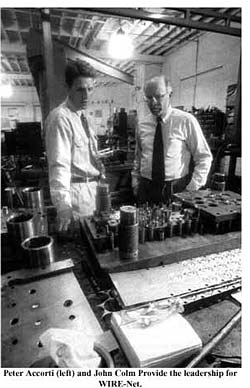
Peter Accorti, vice president of Talan Products, Inc. and president of the board of directors of WIRE-Net, says the group’s services have been invaluable to him as an employer at a time when labor shortages have made businesses “desperate for help.” He says students who work with WIRE-Net often show greater results from their training than do students from more traditional vocational programs. “The reality is that companies don’t have the luxury of on the-job training anymore,” he says. “We have to get people trained faster.” Five years ago, businesses on the West Side may have been growing about 5 percent a year, he says. Now they’re growing, in aggregate, 15 percent a year and need workers who are ready to work productively the day they’re hired. Mr. Accorti also notes that WIRE-Net helped Talan, a metal stamping company, set up its own apprenticeship program. Talan has hired students from Destiny Academy for its program.
“There’s a lot of value in a WIRE-Net membership,” says Mr. Accorti. He added that WIRE-Net’s small, “non-bureaucratic” staff Of 12 is easy for businesses to work with. The average WIRE-Net member company has only 40 employees, and often doesn’t have the resources or time to do extensive training.
The organization has been recognized for its effectiveness. Public/Private Ventures, a Philadelphia based non-profit group which studies the effectiveness of social programs on youth, evaluated WIRE-Net’s effectiveness in a 1998 study called “Working Close to Home.” It concluded that among WIRE-Net’s strengths are its ability to “target” employment areas such as metalworking and to hone in on the needs of businesses, as opposed to focusing solely on finding jobs for the unemployed. Thereby, it makes sure that those businesses can actually use the people it trains, the study says.
Although more than half of WIRE-Net’s budget is dedicated to its employment programs, another major area of growth in recent years has been its industrial real estate efforts. In the early 1990s WIRE-Net conducted a survey which found that one reason companies leave their West Side base is because they want to expand and simply don’t have the space. In order to fulfill its mission of retaining and expanding industry on the West Side, WIRE-Net decided to develop a 15-acre industrial park near West 65th and I-90.
“It turned out the land wasn’t green,” says Mr. Colin, referring to the need to clean up the property by digging up underground tanks, testing for groundwater contamination and digging out lots of dirt. WIRE-Net assembled the parcels and cleaned up the property with much assistance from the City of Cleveland and the State of Ohio. A coalition of state, city, community development groups, and WIRE-Net has been working since 1992 to bring the park to fruition. One of WIRE-Nees member companies, B&R Machine Co., has its headquarters under construction there, and more land is available.
Mr. Cohn sees the real estate development side of WIRE-Net’s operation growing rapidly in years to come, as healthy businesses on the West Side seek to expand.
MANNY Award – the CAMP CONNECTOR (May 2000)
May 23rd, 2000CAMP C-Hosts 3rd Annual MANNY Awards
May / June 2000
From The CAMP CONNECTION
More than 300 local manufacturers and business representatives gathered at the Renaissance Cleveland Hotel in May to honor the winners of the third annual MANNY Awards.
Hosted by Inside Business Magazine in partnership with CAMP, the MANNY Awards celebrate manufacturing excellence in Northeast Ohio.
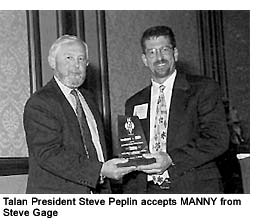
CAMP member winners this year included Osborn International, Parker Hannifin Corp. and Talan Products. Other winners included CAM-LEM Inc., EasiJet Inc., Lighting Products Inc. and MeriTool. CAMP member finalists included Haitek Solutions. Additional finalists were Advanced Technology Corp., ATC Nymold Corp. and VendorTech.
Winners were chosen on the basis of how each company solved various challenges showcasing invention, cooperation and excellence. Judges included Inside Business editor Steve Gleydura, moved from a bearings distribution company to a technology company, noting that “In addition to broadening our product lines, we needed to add value to our customer transactions by assisting them in applying ever-changing technologies.”
In offering useful insights and advice for the future, Dannemiller notes that “it’s important that you (companies) think in a manner that allows for developments that extend beyond our human ability to anticipate only what we now understand. Your company will be truly revolutionary when it learns faster than its competition!”
Open-Book Management – Cleveland Enterprise (Spring 2000)
April 23rd, 2000Open-Book Management:
After a bad year in 1998, Talan products adopted an open-book management philosophy that has turned the company around.
By David R. Wasserstrom
From Cleveland Enterprise
This is one of the first companies I’ve worked for that’s “That’s had open-book management, and I think it’s great,” says Eugene Sawyer, second-shift production supervisor at Talan Products. “If you could have been here in December and seen these guys leave with bonus checks – everyone had a smile on their face.”
Talan distributed $115,000 in bonus money in 1999, representing 12 percent of gross wages. And for the first time, Talan’s internal culture dubbed Team Talan – has begun to attract outside workers to its ranks.
It wasn’t always this way.
Not long ago, the owners of Talan Products realized that their company had become mired in mediocrity. As managers and floor workers passionlessly went about their daily routines, executives foresaw an inevitable slide in product quality and customer satisfaction. For this modest-sized metal stamping business at the heart of Cleveland’s blue-collar West Side, it was a potentially fatal situation that sent owners scurrying for answers.
“We had a bad year in 1998, and part of it was the culture that needed mending,” recalls president and founder Steve Peplin. “There wasn’t really a smoking gun … but we’re such a low-margin business that [you’re] looking at 50 items,” he explains, “and every one of them was a tenth of a point off because you spent a little more on shop rags, used more waste and were just a little less efficient. [Suddenly], there’s 5 percent missing, and that’s your profit margin.”
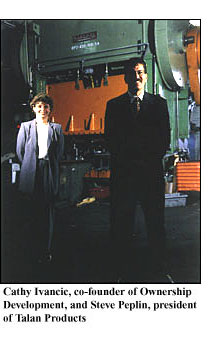
So Peplin began to ponder an idea his partner, Pete Accorti, had suggested a few years earlier: an open-book management style, whereby a company shares financial information with its employees, sets and measures goals and rewardsthose who achieve those goals – all in hopes of helping employees see how their work affects the entire company.
Peplin became especially intrigued by a well-known method of open-book management called The Great Game of Business, a phrase coined by the book’s author, Jack Stack, and now marketed to businesses nationwide. Its underlying premise is to track performance based on a company’s income statement.
In November 1998, Talan retained Cathy Ivancic, cofounder of Akron-based consulting group Ownership Development Inc., to help turn things around. Her first task: Identify what variables drive Talan’s business forward while enhancing employee performance.
“We worked on developing an incentive that was easy to communicate, under standable and one that would pay for itself,” Ivancic says. “That turned out to be a proportion of Talan’s operating profits.”
Ivancic and ownership agreed to set goals every six months and let departments create “minigames” to measure performance. The quality assurance department game, for example, was structured as a car race and measured quality against customer complaints during a three-month period. A large, graphic representation of the race was placed on a wall in the department and updated regularly. The result: Quality outpaced customer complaints.
The shipping department, meanwhile, focused on having each tow-motor operator complete a government-mandated safety checklist each morning without fail for one month. The reward: Leave work one hour early with pay.
A key step in this process involved teaching workers what financial indicators mean. Recalls Peplin, “At one class we held for the workers, an instructor held up a dollar bill and asked, ‘How much of it does the guy on top get to keep for every dollar we sell?’ They honestly thought that I put between 30 and 40 percent of it in my pocket. They’ve never had business classes before, and they don’t realize that I actually get a little comer of the white border on one side of the bill!”
A year after the program’s inception, Peplin still marvels at the results he sees throughout his company, whose dramatic turnaround has earned it a 2000 Manny Award.
Though Talan won’t release specific figures, it reports that profits rose from a five digit loss one year to a six-digit gain during the next as sales increased 12 percent. “It was like throwing a switch … you could feel the change,” he says. “Now I walk through the shop, and everybody cares.”
Talan Products Reaps Rewards of Inner-City Work Environment
May 24th, 1999May 24-30 1999
From Crain’s Cleveland Business
By David Prizinsky
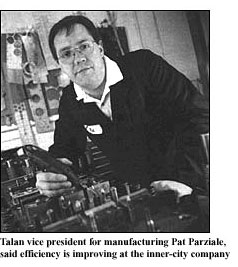
At a time when inner cities are losing manufacturers to the suburbs, the owners and employees of Talan Products Inc. say the metalworking company’s West Side location is one of the keys to improving its operations.
“We see the inner city as a competitive advantage,” said Peter J. Accorti, vice president of operations at Talan, a 13- year-old company at 1985 W. 68th St. that has gained a reputation for rapid growth in a traditional, low-growth industry.
Talan was one of 100 small, inner-city companies in the United States cited for rapid sales growth in April by the Initiative for a Competitive Inner City, a nonprofit group in Boston that is an advocate of locating businesses in the inner cities.
Five other companies in Cleveland that made the group’s list were Thermagon Inc., Complete Personnel Management Inc., Colormatrix Corp., Ullman Electric Co. and Even Cut Abrasive Co. The group said lower real estate costs, closeness to customers and the availability of workers are among the advantages enjoyed by inner-city companies.
Talan ranked 73rd on the list, with sales growth of 123% from 1993 and 1997, when Talan’s sales were $8.2 million. Sales last year were just over $8 million, but are expected to be $10 million in 1999, Mr. Accorti said. Mr. Accorti said the company’s location directly influences its success.
“There is access to a workforce,” he said. “There is the central location that is close to highways, the airport and vendors. There is the availability of lower priced real estate.”
Talan has 37,000 square feet of manufacturing space in several buildings on West 68th. The company operates stamping presses and tube forming machine tools. It also makes aluminum extrusions.
The company’s inner city location isn’t the only edge it is trying to exploit. Since the end of last year, Talan has been implementing an “open book management” style that includes daily reports to the employees on the rates of machinery utilization and monthly reports that analyze the company’s operating profits.
As part of the “open book” approach, a team of 12 workers was formed to define key production measurementsand to identify the major impediments to improved equipment utilization.
“In the last five month, we have improved efficiencies by 20%,” said Pat Parziale, Talan’s vice president of manufacturing, who, along with Mr. Accorti and president Steve Peplin, is one of Talan’s three owners.
Talan measures efficiency by comparing the standard number of hours needed to complete an order with the actual hours taken. The open book approach also includes a profit-sharing program that is expected to pay a bonus this year of between 10% and 15% of Talan’s total wages.
Holly Harlan, a program director for the Westside Industrial Retention and Expansion Network, said Talan is known for innovation and hard work. She said the company invests in worker training and education.
“They’ve created an environment where the employees motivate themselves to work smarter,” Ms. Harlan said.
Mike Wimberly, Talan’s production manager, agrees. He described employee morale as good and said employees, including himself, think of themselves as part of a team.
“They are sharing the gains with everyone,” said Mr. Wimberly, a tool and die maker who started at Talan three years ago. “If they make money, we make money. The owners are working as hard as we are.”
On the Cutting Edge of Low Technology – Cleveland Enterprise (Spring, 1994)
April 23rd, 1994From Crain’s Cleveland Business
Spring 1994
“OUR COMPANY MOTTO IS ‘Good parts, shipped on time, at the low bid,'” says Steve Peplin, president and CEO of TaIan Products, Inc., a Cleveland-based contract manufacturer specializing in long—run stampings and the fabrication and sale of aluminum extrusions.
Sales figures for the privately held manufacturing company were not disclosed, but were in the “under $5 million range” on the 1993 Weatherhead 100 list of northeast Ohio’s fastest growing companies. Talan placed #6 on this list, with sales growth of over 1,000 percent and employment growth of 400 percent in the last five years. From 1992-1993, says Peplin, sales increased 50 percent. In the last three years the company has outgrown its 15,000 square foot facility located on Cleveland’s west side. “We use off-site warehousing on an as-needed basis and plan to relocate when the right place comes along at the right price,” Peplin says.
Talan’s product mix is dominated by the appliance and building construction component industries, but it also includes fastener and retail display manufacturers; defense contractors; and electronics, container, and toy manufacturers among a growing list.
Peplin says that since 1986, Talan’s client base has increased tenfold. The complete client list includes American companies and US-based but Swiss, German, and Japanese-owned companies that range geographically from California to Massachusetts and Arkansas to Hawaii. “I think that savvy business people know that partnering is a good way to build long-term business relationships particularly in an already mature, over-capacity industry,” he says. “We are very used to partnering and being involved in projects from the design stage on.”
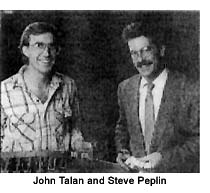
While Talan does a hefty amount of prototyping implicit in design, the company does try to distinguish its operation from high-volume manufacturers, “One of our biggest assets is to look at a part, come up with a redesign to ease manufacturing, and save the customer money,” Peplin says. “Our input saves a project time and money and helps us in the long run.”
Peplin says that he foresees a manufacturing renaissance in the Midwest and that the Cleveland infrastructure—its supplier base, labor pool, machinery support, and geographic location—make the Midwest a desirable location for Talan. The company was created with a $6,000 private initial investment.
Peplin; his brother Rich; John Talan, vice president of engineering; and Peter Accorti, director of operations, will pay off their first round note of capitalization in 1994. “We have an excellent relationship with Society Bank. This is a low margin business and therefore very capital—intensive,” Peplin says.
Successful as it is, this manufacturing company still has hurdles to leap. Peplin says that a 10 percent increase in Talan’s 1993 steel costs posed an immediate threat to its ability to make the low bid. “Without the low bid we’re lost,” Peplin says. To compensate for rising costs, he says, “We wear a lot of hats here and keep a minimal front office staff.” In fact, every day Peplin, wearing his chief-of-sales hat, uses his background in contract and manufacturing repping for Talan, which does without a staff of outside representatives.
“We’re on the cutting edge of low technology, and our biggest goal is to maintain a quality culture; it’s more efficient than reinventing it later,” he says.
Talan executives have also learned to use a contingency work force to accommodate the increased business during the company’s third and fourth quarters, which is due to an increase in summer construction. “Last time this year we had 25 employees. Today we have 35 employees, most of whom operate machinery and receive a competitive wage, benefits, and bonuses,” Peplin says. A temporary agency provides Talan with a workforce it can train and screen, and puts Talan executives in a position to make knowledgeable employment decisions. “Not one employee has quit this company, ever,” Peplin says.
Talan’s business may be low tech, but the company uses technological advances to increase its efficiency wherever possible. It has expanded its automation system to secure quality assurance and tie its information system together.
Implementation of Talan’s new network is expected to increase the company’s production capabilities and keep the growth rate up. “We hope to see another 30 to 50 percent growth in sales this year,” Peplin says, “without doing it at the expense of quality.”
Talan executives hope to introduce their own product to the market soon. (Until it’s ready, they naturally prefer to keep the specifics about it to themselves.) With a few ideas and prototypes already in the works, they plan to create an innovative product, realize production efficiencies, and fine-tune existing components of the business. “Our own product will allow us to fight the marketplace rather than other stamping companies,” Peplin say’s. “But we know that we are primarily a job shop, that we bid on a small number of jobs and close nearly one-third of them—an unusually high ratio,” he adds.
Talan is already capable of modem purchase orders and of exporting CAD drawings, and Peplin expects automation to add a new dimension to the company. “Our new automation system will expedite the entire work flow here from quotes all the way through to shipped products. In addition, we’re really concentrating on expanding our quality control department, and we’re doing more non-metallic stamping, including plastics,” he says.
For now it’s back to the grind in a small front office, attending to ringing telephones and new computers, designs, and clients. After all, a job shop has to stay focused on its core business. For a futurist like Peplin, it happens day by day, one customer at a time.
End of Year Party – Inside Business (May, 1993)
May 23rd, 1993Annual End-of-the-Year Party
From Corporate Cleveland
May 1993
Like many companies, Cleveland-based Talan Products, which manufacturers stamped metal parts, had always hosted a year-end celebration for its 45 employees and their significant others – usually a catered affair at the Cleveland Athletic Club.
“We have people with different religious beliefs, so we never liked to hammer home the fact that this is a Christmas party,” says Pete Accorti one of the company’s three partners. But the club sported traditional Christmas decorations that made some employees uncomfortable. And because Talan ascrIbes to the ‘open book’ theory of management and shares its monthly financial statements with employees, they knew what the outing cost. Although the company could afford the expense, Accorti says, employees believed the money could be better spent.
“We’re a pretty small company,” Accorti explains. “It’s not hard to get a sense of how people are feeling.”
So in 1999, company officials tried something different —they reduced the party’ budget to $2,500, then asked a shop-floor supervisor to assemble a committee of workers from all departments to decide what sort of year end event the company should have.
The result? An employee-only potluck luncheon prepared by the workers themselves, served up in Talan’s West 68th Street facility.
Everybody brought a dish, including president Steve Peplin, who deep-fried a turkey. Instead of spending the $2500 on a catered spread, the committee purchased prizes to raffle off after the meal, everything from TV’s and VCR’s to Blockbuster gift certificates.
“We’ve been in business since 1987 and having events since 1989” Accorti says. “This was probably the only event that had universal buy-in. Everybody felt a part of It.”
Guiding Principle: Employee participation. “We feel were going to be more effective as a company if everybody is focused on the primary goal of the company, which ultimately is earning a profit.” Accorti says. “As opposed to having a select group of people focused on that goal — and keeping score with regard to that goal —we have the whole company focused on that goal.”
Best Practice: Win-win raffle. In addition to the big-ticket items, the party-planning committee purchased enough small items so everyone could take home a prize.
Setting: Employees broke bread in the plant on a mid-December workday so everybody could attend.
Keeping it Clean – Corporate Cleveland (May, 1993)
May 23rd, 1993Keeping it Clean: Taking responsibility because it’s good business and it’s free
From Corporate Cleveland
May 1993
Recycling is the name and saving money is the game, says Steve Peplin, president of Talan Products Inc., a metal-stamping plant on Cleveland’s West Side that employs 25 people and produces goods ranging from electric products to armored parts for military vehicles.
Peplin believes you have to challenge preconceived notions about improving the environment in your own workplace.
In Talan’s case, that meant taking a look at the packaging of outbound products. At one time, Peplin says, each truck that left the plant carried up to 6,000 pounds of non-recyclable cardboard packing.
“We fiddled with this thing, worked on it and have just about arrived at a combination for repackaging” Peplin says. That effort will reduce the weight of packagIng by about 75 percent without, he emphasizes, putting the cargo at any additional risk.
Peplin says environmental issues have always been a concern at the seven-year-old company, but adds that they have taken on a new emphasis of late.
“We’re young guys In our 30’s and we want to be the corporate citizens with a conscience,” he explains. “We’re the good guys.”
“It’s not that difficult and can be done easily,” Peplin says, citing as an example the simple act of opening the mail. “After sorting through the mail, take the recyclable paper and drop it in one canister, and the shiny, non-recyclable junk mail in the other,” he says. “It’s easy.”
Peplin says such efforts throw another dart at the often-held belief that being environmentally conscious is a costly proposition. “We’re saving the envIronment and saving dollars,” he says.
View Brighter for Industry – Crain’s Cleveland Business (October, 1992)
October 23rd, 1992October 1992
From Crain’s Cleveland Business
By David Prizinsky
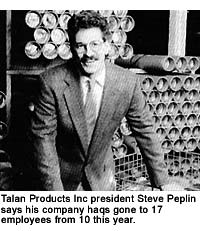
The city’s small manufacturers are upbeat about near-term spending and hiring plans, according to a survey 100 neighborhood manufacturers by the non-profit Westside Industrial Retention and Expansion Network.
“I was surprised by the large number of companies that said they were adding jobs and by the 70% who said they will be making capital investments,” said WIRE-Net director John CoIm.
According to the WIRE-Net survey, which was conducted in July and completed last week, 61% of the respondents said they would add an average of at least three jobs before the end of the year.
“This is almost a 5% expansion in the average work force size for responding companies,” Mr. CoIm said. In addition, 71% told Mr. Coim they had capital spending projects on the drawing boards; their planned investments total $8 million. About 40 member companies of WIRE-Net answered the questionnaire, Mr. CoIm said.
A rebounding auto industry and an aggressive cost-cutting strategy were cited by two of the WIRE-Net members as responsible for their good fortune this year.
“We figure out a way to do something at less cost,” said Steve Peplin, president of Talan Products Inc., a 6-year-old metal-stamping company at 1985 W. 68th St. “We’re lean; we’re efficient, and we work for slim profit margins.
Mr. Peplin said Talan started the year with 10 employees and now has 17.
“We are looking at a record year, with sales up 35% to 40% from last year,’ he said.

 Facebook
 Twitter
 LinkedIn
 YouTube