The Importance Of Metal Pressing In Ensuring Smooth Manufacturing Operations
April 15th, 2026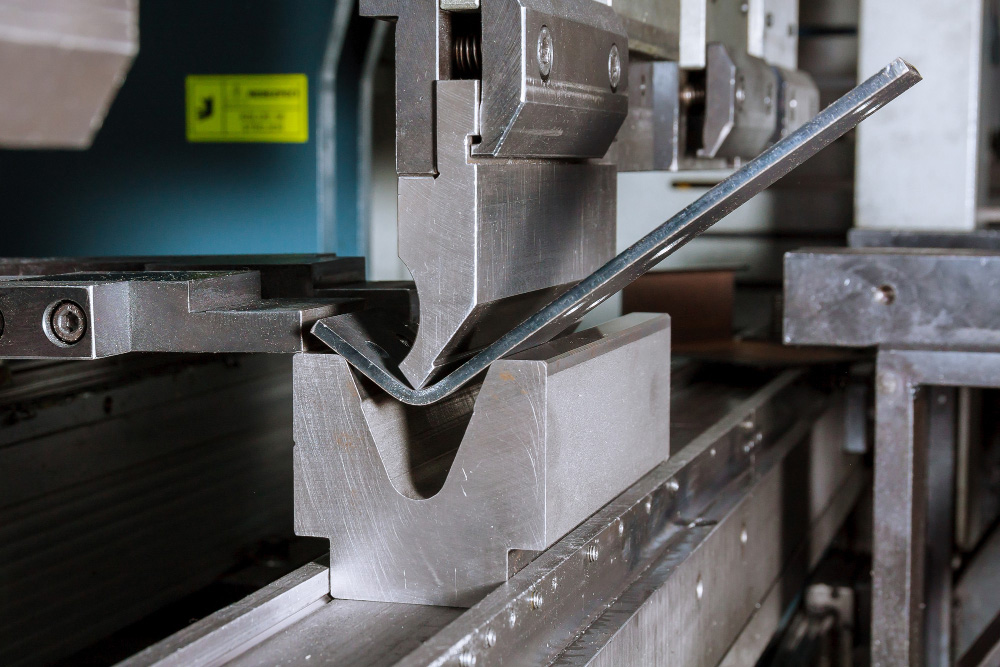
A single metal component may pass through thousands of products without drawing attention, yet its precision shapes the performance of the final assembly. Manufacturing lines depend on parts that fit without adjustment, align without force, and repeat without variation.
This level of consistency does not come from manual fabrication. It comes from metal pressing, where controlled force shapes sheet metal into uniform components at remarkable speed.
Across industries, this method transforms flat stock into accurate forms that keep production lines stable and predictable from start to finish.
Understanding Metal Pressing in Modern Production
Metal pressing, often referred to as metal stamping, shapes sheet metal through a press tool made of punches and dies. Each stroke of the press forms, pierces, bends, or blanks the material into a defined profile. The result is a component that matches the previous one with very little deviation.
Unlike manual metalwork, this process relies on engineered tooling rather than operator judgment. That difference removes variation from part to part and allows manufacturers to run long production cycles with confidence. When thousands of components must perform the same function, metal pressing becomes a practical foundation for smooth operations.
Consistency that Supports Assembly Efficiency
Assembly lines depend on uniform parts. A bracket that varies by fractions of a millimeter can disrupt an entire workflow. Metal pressing eliminates this risk by producing identical parts in rapid succession.
This consistency improves more than fit. It reduces the need for inspection adjustments, rework, and sorting. Downstream processes move faster because parts arrive ready for use. Over time, this reliability contributes to stable production schedules and predictable output.
Lower Costs Through Repeatability and Speed
The economics of metal pressing become clear in high volumes. While a press tool requires upfront investment, the unit cost of each component drops significantly once production begins. Compared to cutting methods such as laser fabrication, pressing forms parts at a fraction of the cost per piece.
This advantage grows as volumes increase. A press can form components in seconds, which reduces labor input and shortens production time. Employees shift focus from repetitive shaping tasks to roles that add greater value across the operation.
Progressive die stamping increases this efficiency further. Multiple forming stages occur within a single press cycle as the material advances through the die.
Capability for Complex and Innovative Designs
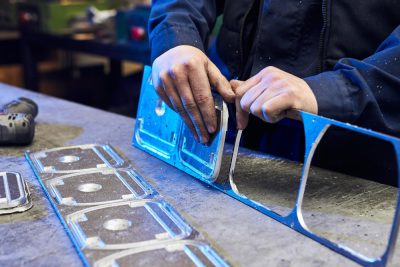
Design limitations shrink when metal pressing becomes part of the manufacturing plan. Press tools can form intricate bends, embossed features, coined details, and pierced patterns within one controlled process.
Parts that would require multiple manual steps can be formed in a continuous cycle. This capability encourages engineers to design components that improve performance without concern for manufacturing difficulty.
Sample stamping during early design phases allows teams to test these shapes before full tooling begins. Observing how material reacts to forming forces guides design refinements that translate directly into production success.
Material Versatility in Metal Pressing
Metal pressing works across a wide range of materials and thicknesses. Stainless steel, aluminum, copper, brass, spring steel, HSLA, Galvanized steel, and mild steel each respond to press forces in unique ways. Press tooling accommodates these differences through tailored die geometry and controlled clearances.
This versatility allows manufacturers to select materials based on performance needs rather than fabrication limitations. From thin gauges to thicker stock, the process adapts to suit the application while maintaining repeatability.
Custom metal stamping services often use this flexibility to match material properties with part function, which improves long-term performance in demanding environments.
Partner With Talan Products for High-Volume Metal Stamping
At Talan Products, metal stamping drives everything we do. For nearly 40 years, we have refined progressive die metal stamping, aluminum stamping and fabrication, and tool and die design for high-volume production. Our ISO 9001:2015 registration, low PPM performance, and long-standing customer partnerships reflect a focus on precision and efficiency.
Let us work with you to turn engineered concepts into reliable, repeatable components at scale.
Don’t fall in love with an idea so much that it blinds you to reality
December 9th, 2025It seems like all manufacturers, when young, myself included, yearn to have a world-changing invention. They often strive for a product or a line of their own, incorporating some new idea that they envision will make them not just rich, but filthy rich. I did. My grandfather, in his day, had similar visions for his manufacturing company. Many of his peers realized that goal.
For manufacturers, owning intellectual capital (patent protected inventions) are a barrier to entry, offering protection from the competition. Understandably, it is a goal of many.
Ask a designer how to change a light bulb, you might hear, “Does it have to be a light bulb?” True creative professionals are accustomed to thinking of new things. That’s their raison d’être.
Unsurprisingly, I find those who ply the design trade to be extremely bright, with intellect that is sharp as a tack and wit to match. Inventing is fun. Working on new things can inject excitement into the less exciting world of making pieces parts.
As a contract manufacturer, our involvement with the invention process is usually tangential. However, we often come up with innovative processes and ways to produce a product or component. That is usually our contribution to the creative process.
We figuratively and literally bought into a disruptive idea that was a game-changing, innovative product. We obtained the patent rights. Despite being fully aware of the difficulties of introducing new ideas into the notoriously conservative building products industry, we forged ahead. We were going to change the old way of doing it.
We spent a fortune developing this product. When we exhibited at trade shows, attendees beat a path to our door. Little did I realize, we were self-selecting for confirmation bias. The prospects who came to see us and showed interest were those that liked the product. The detractors simply stayed away.
We conducted focus groups to confirm our beliefs in how great the invention was. The focus group participants universally panned the idea. We instinctively knew they were wrong. We were in love with the idea, with our product.
We spent millions of dollars and years of effort chasing the invention dream, eventually to no avail. This story is simply one of many.
It should be kept in mind that a huge win can be had by many small gains. Games are won by hitting lots of singles, not always by a grand slam of an idea.
The corollary is, we have been extremely successful by playing small ball and focusing on what we do well: manufacturing. It is not inventing. As fun and exciting as inventing is, it just was not our core competency.
There were three major lessons learned:
- Don’t fall in love with an idea or a product so much that it blinds you to reality.
- Listen to focus groups.
- A new product isn’t a winner until it flies off the shelves.
I am reminded, no matter how many times I read the parable, the rabbit never wins the race.
How a board game influenced my career
December 9th, 2025After starting our company, we knew what we wanted to produce, but needed the big players in our industry to learn about us and become our customers. We knew that was easier said than done. I also knew that if we wanted to catch big fish, we needed to go where the big fish were.
We started by attending the industry’s main association’s annual meetings. It did not hurt that it was a young industry and we were all innovating as we went. The annual meetings featured a strong social element, with many opportunities to meet the right people. One example was the late-night Trivia Pursuit games (this was 40 years ago, after all). Much to my surprise, I was asked to be our team captain. That year, the teams were organized as boys vs girls. I was clearly not the smartest in the room, but I had great skills at figuring out who was. That people-reading skill led to our team being a dynasty.
The next day, we were listening to a featured speaker. Her talk included the following: You all think your customers buy from you because of your specs, your product’s color, its warranty, its chemistry, your pricing, or something unique. No! Your products all have different names, but they all do the same thing. All of your warranties are the same. You all sell for, in essence, the same price. Your products are all installed the same way and do the same thing. The reason your customers buy from you is because of your sales people. They like the salesperson they buy from. People buy from people.
I was dumbfounded. I felt like she had somehow learned about my secret sauce. That was my M.O. I cannot say I had any technical expertise or crazy smarts that set me or my company apart. My skill was in being likable. I thought I invented it. It was working. And it had been working for me for my whole life.
A few years later, at the same annual event, we enjoyed numerous social activities — golf, tennis, and croquet tournaments were scheduled. I participated in all. My goal was not to play the sports, but to hang around and get to know the head technical people at each company. Again, it worked. While playing croquet, I was asked to be a supplier to one of our largest prospects. I signed them right up (after running into a brick wall for years). These are but a few examples. I have literally done this hundreds, if not thousands, of times.
I have read management gurus who claim charismatic leadership is not critical to success. My career and success definitely did not follow that path. I have always had an overdeveloped sense of humor. People like to laugh. I viewed it then, and still do now, as a tool to make friends and be liked. Being a ‘nice guy’ was and, for me, continues to be a critical success factor. Of course, I am not advocating a lack of technical knowledge. One also needs competency. But being a nice guy has benefits beyond your customers liking you. It is just a great way to be.
Metal Stamped Construction Components Featured In Crain’s Story On The Overall US Housing Market
April 3rd, 2013Crain’s Cleveland Business reporter Dan Shingler recently spoke with Talan Products’ President, Steve Peplin about the resurgence of residential building and how that resurgence in turn affects our business. Steve mentioned having met with a client and reviewing the ABI – the Architectural Billings Index which is a gauge of construction activity. The ABI has been charting up nicely indicating there’s some positive improvement in building.
A couple great quotes from the story, which can be read here on Crain’s Cleveland Business.
Mr. Peplin said his construction-related sales are up by more than 10% in the last six months due to increased construction activity. The vast majority of Talan’s products are linked to the construction market, Mr. Peplin said. That includes items such as brackets and other parts used in the actual construction of homes and commercial buildings, as well as parts for solar panels that are, more often than not, linked to a construction project.
So when data show that construction in the United States is on the way up, that’s a good indicator that Mr. Peplin’s business also will be on the rise, he said. Lately, he has seen signs of strength from more than just the ABI. For instance, the U.S. Department of Commerce reported on March 19 that housing starts for February were at 917,000 nationally — up 10% from the month before and at their highest levels since the recession brought hammering to a halt.
As Mr. Shingler points out in the article, lots of new construction requires lots of stamped metal parts. And as metal stamping companies like Talan add customers and production, we ultimately wind up adding employees to keep pace. So stay tuned!
Metal Stampings Company Talan Products Recognized as Silver Sponsor of SPRI 2013 Conference
January 9th, 2013Talan Products, a Cleveland Ohio-headquartered stampings manufacturer is proud to be among the companies recognized as Silver Sponsors of the annual SPRI – Single Ply Roofing Industry conference devoted to educating people in the commercial single ply roofing industry.  Membranes commonly described as “single-ply” are flexible sheets of compounded synthetic materials systems that provide strength, flexibility, and long-lasting durability as roofing materials. Because prefabricated sheets offer consistent thickness, they offer versatility in their attachment methods, and therefore are broadly used. Talan, a high volume stampings company provides a variety of attachment load plates which resemble intricate, specially designed washers used to secure material to roof substrates.
What kinds of roofing sheet goods are considered single-ply? SPRI identifies three major categories of single ply membranes: thermosets, thermoplastics, and modified bitumens. Talan custom stamps to order the varied styles of steel load plates required for mechanical fastening of these single ply roof systems. We have worked for years with manufacturers of the roof systems to help design for manufacturability roof deck fasteners, specialty washers and load plates used in the roofing industry. The SPRI 31st Annual Conference and Business Meeting will be held January 11 – 13, 2013 at the Miramonte Resort in Indian Wells, California. Talan’s president, Steve Peplin will be attending. Please stop by and introduce yourself if you are at the conference.
Progressive Stamping Equipment
April 4th, 2012Talan operates 24 presses ranging up to 400 ton SSDC. Press bed sizes are up to 105″ x 50″. Press stroke ranges from 2″ to 8″ for stamping. Our physical plant is 4 acres under one roof & arranged for the most efficient material handling possible. Sometimes, customers like to ‘peek behind the curtain’ at our high speed stamping equipment. Feel free to view a complete list of equipment we use for stamping metal parts.
A REAL “WIN-WIN” HELPS TALAN CUSTOMER IMPROVE ROA
Talk about “Win-Win,” smiles Talan Products CEO Steve Peplin. “This is textbook.”
For years, Talan had counted a major international fastener company in the building products arena as a small customer with great potential. Talan manufactured stampings and aluminum extrusions for the company, which also had its own in-house stamping operation, making 100 different parts.
Steve felt the in-house operation wasn’t nearly as efficient as it could be. So he had an idea. A big idea.
Only a few months later, Talan actually owned all the stamping equipment and tooling and had relocated it to the Talan manufacturing facility. Annual inventory turns went from 2 per year to 20, saving the customer 11% annually.
How was this possible?
“It’s actually pretty simple,” said Steve. They know fasteners. We know stamping. We analyzed the situation and realized we could do it better if we took over the whole thing and introduced best practices. We made an aggressive proposal. Their new president had a banking background and understood deployment of capital as well as anyone. He saw the opportunity and jumped at it.
“Now, we even work together on R&D. Prototype development time has dropped from months to a few days…and we have even been awarded a patent together.”
The contract between the two companies is long-term. It is Talan’s responsibility to offset inflation increases with annual efficiency improvements. There is a material cost adjustment clause, but Talan’s buying process of materials in this space is more sophisticated than the customers’ previous system, leading to further real savings. Also, product quality is better – with all parts made in the U.S.
“Talan is a trusted supplier, and a very important supplier,” says the fastener company president. “I’m a corporate investment banker by trade and I recognized the advantage of significantly lowering investment in inventory. Our agreement allowed Talan to do what they do so well, and allowed us to focus on fasteners. Importantly, Steve made the whole process, which could have been complicated, very simple.”
Peplin says there are a lot of ways to structure this kind of agreement, from outright purchase to lease to lease/purchase. “Lots of companies could benefit from this kind of thinking. The first step is a feasibility study which I head up personally. There is no cost, and if I can’t offer the customer significant savings, I won’t make a proposal. But it is surprising how often we can uncover an opportunity for real savings. Of course, the recommendation doesn’t always include us taking the whole process over….but if so, we are large enough – and aggressive enough – to work together with the customer make it happen.”
Steve Peplin started working in 1977 and by 1986 had been involved in a number of companies – as a manufacturer’s rep, distributor, and installer in the roofing business, plus a bit of manufacturing.
Steve’s family owned Lakewood Manufacturing on the West Side. The company was a well-known and well-respected mid-size full-service manufacturing company primarily focused on high-quality, complex parts – high value-added, low-to-mid volume. Steve’s younger brother Rich also worked for Lakewood.
In 1986 Steve came to his father with a “deal” – a potential order from a prospective customer that he had pursued. Steve’s father decided that this job wasn’t really in Lakewood’s sweet spot, but Steve’s brother liked the idea and encouraged him to take the order – they would figure out how to get it done. Rich came up with a price, the customer agreed, and we were off to the races. Rich suggested the addition of John Talan as a partner. John owned Talan Machine and Tool and was well known to all of us as an excellent tool-and-die maker.
Rich, Steve, and John soon formed a company, and successfully completed the order (the company still has that customer!) Steve had been a computer science major in college, but his strengths were in sales and customer relations, so he became the “rainmaker.” John was the “in the plant” guy. Rich was essentially a silent partner, so they invited Pete Accorti, with whom we had grown up with on the West Side, to be the operations head. Pete was a geologist by education, but was known to be very disciplined and effective in everything he did. For the first year or two they were essentially a “virtual” company – although that term had yet to be used in business the way it is now. It really was “boot-strapping.”
John Talan sold his company two years later. At that point, the four divided up ownership of the new company called Talan Products. They rented a 3,000 square foot facility on Chatfield Avenue on the West Side of Cleveland, with a 10” X 10” office space (the size of a small trade show booth.) “The office space was so small that you literally would have to ask someone to ‘slide in’ in order to open the file drawer!” Steve recalls, adding “Our only “splurge” was $400 for a window! But we were turning out good work for a few customers. It was a different world technologically. We bragged about having a FAX machine…our delivery company’s trucks proudly displayed the term “radio-equipped.”
LESSON: Don’t bite off more than you can chew. We’re still lean—no waterfalls in the lobby. If it doesn’t add value for the customer, don’t do it.
At first John Talan ran the company, which bought the steel and contracted out the stamping, packaging, and shipping. Things progressed slowly but surely. In 1987 they obtained revenue from a customer that they still have today (International Diamond). In 1988 they landed GenCorp in Akron – also still a customer. They made a roofing product called a batten bar. Since Steve knew roofing well, he went to companies he knew that needed stamped parts.
Initially Talan offered three main processes: high volume progressive die stamping, aluminum extrusions supply and fabrication, and tube forming. “We no longer do tube forming – we have focused on the first two areas,” says Steve. “We used to produce short-run stampings, too, but no longer. On the other hand, we’ve been open to other areas that we could make money at, such as light assembly of components that we manufacture. The question is, is it a good fit for us and our core competencies.” Bill Gaskin, President of the Precision Metalforming Association, notes that some stampers became too reliant on one customer or failed to diversify processes when they might have.
LESSON: Focus on a niche — or two — and become experts. Constantly improve and expand core competencies within that space. The added value will be apparent to your customer, and to prospects with similar needs.
Soon came their first international order. It was a drop in the bucket for this $1 billion company, but the order for over $1 million was huge for the new company. (“Even now, $1M gets my attention!” says Steve.) The specs were demanding, but they did it. (Interestingly, they were told at that time that ISO would never become important in the U.S….it of course did, and Talan was eventually ISO-certified…now ISO 9001-2008).
LESSON: You can never try too hard regarding quality. It’s everything.
Steve offers this additional insight into quality: “Last year we made 300 million pieces with an excellent PPM of 22 …meaning 6,600 or so pieces “escaped” that shouldn’t have. (We got them back and fixed them). Even very simple parts sometimes have close tolerance – especially those that go into “automatic” use, where no human eye sees the product and the user can discard an improperly made product before use. (Examples – roofing nails – roofers using hammers routinely discard imperfect nails. But with a roofing nail gun one bad nail can jam the entire gun and slow everything down big-time.”
In 1991 the company moved into a 15,000 square foot building on West 65th Street. It had housed a plating company and there had been a fire, so they got a good price.
In 1994, discussions began about selling the company. John wanted to sell. Pete and Steve bought the company, and added a third partner, the key manufacturing manager, Pat Parziale, who in some ways would take over what John had done. Steve wound up with a controlling interest, with Pete next and Pat with a smaller piece. Steve describes the process: “The whole thing took a couple of years. We were friends as well as partners; there was “real money” involved and families to feed, so it was very sensitive. But we all remain friends today. Chrysler was sold in 30 days…but I’m not sure all the partners are buddies. The payout was scheduled to be five years – and we did it exactly on schedule. It was a fairly creative buyout arrangement that made sure it was fair to everybody.”
LESSON: Treat everyone right – customers, partners, vendors – it pays dividends.
In 1996, with the new ownership, the company was up to about $7 million with 10 people. They added two offsite warehouse facilities on nearby Clark Avenue, to 58,000 square feet in total. They were early adaptors of integrated manufacturing software packages. “I remember working with CAMP (a precursor to MAGNET and WIRE-NET) in terms of developing an RFP,” says Pete. “We paid them $1200 to do so. Only one or two vendors out of 30 had a Windows-based system. The system we bought was Version 1.3B (B for Beta testing). It was a box of diskettes. The program needed a lot of work. (This was even before MRP.) We still use the company that we hired back then – Visual Manufacturing.”
LESSON: Look beyond yourself to embrace new technology. For us, that includes organizations like WIRE-NET and MAGNET and PMA (the national Precision Metalforming Association). It’s more important now than ever. You also need vendor partners whom you trust and who can take you to the next level.
By the early 1990’s, Talan was ramping up and becoming a professionally managed company, upgrading management positions and incorporating strategic planning and an open book management philosophy. Other stamping companies were falling by the wayside. Talan had been early adaptors of technology, and they implemented ISO 9000…no easy chore. “We run lean re: SGA, with “no waterfalls in the lobby,” according to Pete. “ On the other hand, their growth required more space, so in 2005 they moved into a 145,000 square foot manufacturing and warehousing facility with 10,000 square feet of office space on Cochran Avenue in the Collinwood area of Cleveland’s East Side.
Talan’s growth spurt earned them a spot on the Inc. 100 list, and the Weatherhead 100 list nine times. In 2006, they celebrated their 20th anniversary by moving into a new 150,000 sq. foot space in Collinwood. In 2007 Talan entered into a joint venture to market their first-ever branded product – the Universal Stair Bracket – to the building construction industry under the name GoPro Construction Solutions LLC. The bracket is already in retail stores nationwide — through Do it Best, Orgill, and Lumberman’s. Talan also won awards for inner-city support and sustainability.
Then came 2009. Steve recalls: “We hit the recession head-on, just like everybody else. We had grown to 50+ employees, and we had to cut way back in every area – for the first time ever. The plant was eerily silent too much of the time. We lost money for many consecutive months, which had never happened before. But we kept our customers, and their business came back, and so did ours. Luckily we entered that year with a strong balance sheet and had a great relationship with our bank, or we wouldn’t have made it. By the end of the year we had made a small profit…no small feat. We were back to our previous employee numbers. We had upgraded a couple of key management positions by finding outstanding people who had been displaced by the economy through no fault of their own.”
LESSON: The best way to succeed in business is to stay in business. Have a strong balance sheet and a solid, honest relationship with your bank, or suffer the consequences when the economy goes south. Again, it’s all about relationships.
In 2011, Talan celebrates its 25th anniversary. Steve says “The future looks exciting. We are getting involved with bigger jobs, bigger companies, in solar and LED…fascinating and important stuff.”
INVESTING IN THE CUSTOMER
For years, Talan had counted a major international fastener company in the building products arena as a small customer with great potential. Talan manufactured stampings and aluminum extrusions for the company, which also had its own in-house stamping operation, making 100 different parts. Talan felt the in-house operation wasn’t nearly as efficient as it could be, and recommended that Talan actually buy all the stamping equipment and tooling and relocate it to their manufacturing facility. Within three months it was done. Annual inventory turns went from 2 per year to 20, saving the customer 11% annually.
LESSON: Partner with your customers. Invest in them. Keep them.
FAST-START CAPABILITY
There have been a number of situations when a prospect or customer needed things done on an extremely tight timetable…so tight that many of our competitors bowed out. We jumped in with both feet and made it happen. We got the other employees to buy in to the tough assignment. We made money, and we kept the customer. In that case, simply the “attitude” was a competitive advantage.
LESSON: You have to be hungry…you have to be smart about it, but attitude is everything.
OPEN BOOK MANAGEMENT
In the late 90’s we introduced “open book management”. Our results on a daily basis are posted on the wall in the plant. There aren’t any secrets. Even individual results are there, when appropriate. If we’re doing well, we don’t hide it. If not, we are honest about that, too. It has made quite a difference in motivation, pride and performance. It’s no panacea, but now we can’t imagine not doing it that way. And the results speak for themselves.
LESSON: Partner with your employees….all of them. Make them part of the team. Let them know the score, and feel like they can all winners if they work well together.
By the late 90’s, the recognition of ongoing success started, and hasn’t stopped. The company was named one of Fortune’s Fastest Growing Small Businesses, won the prestigious local Weatherhead 100 award nine times; three Manny awards, three TEAM NEO awards, two national Inner City 100 awards, and ISO 9001 registration in 2008.
ADVICE FOR ENTREPRENEURS
- Find a niche and focus on it
- Treat your customers like gold
- Don’t ever skimp on quality
- Don’t get overextended financially
SUSTAINABILITY
We take it very seriously. We recently won the Inside Business magazine award for its sustainability efforts, and Pete Accorti won the “Green Lantern” award at the recent Crain’s Cleveland Business Emerald Award ceremony. Manufacturing is a noble profession that we are proud to be involved with, and with that comes an obligation to ourselves and to the rest of the world to constantly be reducing our carbon footprint.
DIVERSIFICATION AND FLEXIBILITY
Although we have always thought it important to focus on our niches, we have also aggressively pursued new customers and embraced new processes within that focus.
TALAN’S FUTURE
Our success has been in part because we found a couple of niches and became experts. It happened naturally – organically – because of our experience. Now we are beginning to see a couple of new, exciting niches…solar and LED lighting. The solar business is a natural outgrowth of our understanding commercial roofing systems…we understand how the solar collectors need to be interface with the building racking/mounting system. That’s an area we understand well – it’s called B.O.S. — “Balance of System”. Secondly, we have worked with GE Lighting for years, and their LED lighting ventures are taking us into that area. In both cases, they are growth industries. That’s important, too.
We have always been contract stampers, making manufacturer’s products. In 2007 we began an effort to make AND market a branded product ourselves. The product is called the universal stair bracket. It’s a revolutionary way to build stairs – you don’t cut the stringers from a 2 X 12. We are marketing the system to the hardware/home center industry, which is obviously in a huge downturn, so we are managing that investment very carefully. But we have added a national customer every year for the past three years, and we are very optimistic.
We are always looking for acquisitions, but we are cautious about it. The organization needs to be a good fit culturally. We’ve worked too long building a great culture to undo that with a bad acquisition.
We’re still in our “young 50’s,” and still as engaged in the business as ever. There is no lack of opportunities – not to mention challenges – but we’re ready for both…as always.”
HIGH-VOLUME METAL STAMPER FIGHTS BACK TO RECORD SALES
Cleveland, OH – Talan Products is celebrating record sales in its 25th year, but only after working hard to claw its way back after the recession hit in 2009.
“We were down 30% that year,” says President Steve Peplin. “We are in the custom aluminum extrusion/fabrication and progressive die stamping business, and much of our historical business was in the construction, automotive and appliance industries. But Pete Accorti and I have been growing this company successfully for 25 years. We’ve seen downturns before. We knew what to do.”
So how did Talan come back, even while the industry is still depressed? There was an “inside” solution and an “outside solution.”
- First, the inside solution. “We re-invigorated our own factory floor,” says Peplin. “We did a lot of little things that made a big difference in efficiency. In general, we created a flatter decision-making structure and created a “home production line” for each tool we run. One result was an outstanding 22 ppm customer defect rate.We’re ISO 9001-certified, and we’ve employed open-book management, strategic planning, and lean manufacturing methods since the 90’s, but you need to keep re-inventing yourself, especially in tough times.”
- Second, Peplin went outside Talan’s traditional customer base. “We knew we needed to diversify, and we figured out ways to get involved in supplying aluminum extrusions and metal stamping in high-growth areas like solar and LED.
“The solar business is a natural outgrowth of our understanding of commercial roofing systems,” says Peplin…” We understand how the solar collectors need to be interface with the building racking/mounting system. That’s an area we understand well -– it’s called B.O.S. — “Balance of System”. We now make many parts for the photovoltaic solar panel market and solar-voltaic thermal products market.”
In the LED industry, the company now makes aluminum extrusions and stamped metal parts for well-known consumer lighting product companies for use in their lamp fixtures and assemblies.
Talan still has all of it first four customers from the late 1980’s. It has been named one of Inc.’s Fastest Growing Small Businesses, has won numerous awards for growth, sustainability, and has been given the national Inner City 100 award for commitment to its inner city neighborhood four times.
Talan Process Improvements in 2010-2011
November 29th, 2011Talan came roaring back from the recession to achieve record results in 2010 and again in 2011 by working harder than ever to create a more efficient process.
(1) Talan incorporated a flatter in-plant decision-making structure. Every employee was empowered and encouraged to take immediate action on all issues affecting safety, quality, and customer satisfaction.
(2) Talan established a “home production line” for each tool. This created more consistent set-ups and better performance predictability. Quality and throughput improved significantly.
(3) Operators have each been given a production line to lead and this has created a superior sense of ownership and improved results. They fill out daily downtime logs to identify all production logs.
(4) Floor leaders monitor the logs, and cross-functional teams analyze them weekly.
(5) Daily production data is openly posted and all employees know how everyone else is performing at any given time.
(6) We communicate with employees regularly about all current issues.
(7) Most importantly, the hiring process has become more rigorous. Extensive testing and multiple interviews ensure that we have a good cultural fit in every case. We are taking more time and care, and it is paying off.
We do not use results as a stand-alone metric. We also are very sensitive to the process, which will ensure even better results long-term.
We deliver on time,
every time.
On Time,
at the Right Price.
We’re committed to
Northeast Ohio growth.
Talan has Beaten the Odds against Metal Stamping Companies
October 28th, 2011 Still Smiling: Steve Peplin Tells Crain’s Cleveland Business How Talan has Beaten the Odds against
Metal Stamping Companies.
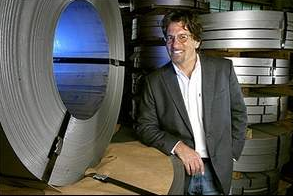 Still Smiling: Steve Peplin Tells Crain’s Cleveland Business How Talan has Beaten the Odds against
Dan Shingler of Crain’s Cleveland Business wondered why Steve Peplin, CEO of Talan Products, is still smiling, so he recently visited the Cleveland based metal stamping company to learn more. Although Talan manufactures metal stampings for a variety of applications, the construction market, which represents a significant portion of Peplin’s customer base, has been particularly hard hit by the recent economic slow-down. (more…)
Metal Stamping Company, Talan Products Celebrates 25th Anniversary
September 23rd, 2011
Did you know that Talan Products is celebrating its 25th anniversary this Fall? The company was started in 1986 by Steve Peplin.
Partners Pete Accorti(President) and Pat Parziale (VP, Manufacturing) joined soon afterward. Initially housed in a 3,000 square foot space, Talan has expanded three times. Talan’s current home of 15 years is a 145,000 square foot manufacturing and warehouse space on the East Side of Cleveland. Currently a $25 million company with 50+ employees, Talan still has all four of its original customers. “It’s one of the real keys to our success,” says Steve. “We invest in our customers, and they’ve been loyal to us.”
Originally in the commercial roof products area only, Talan now makes products for a number of industries including automotive, construction, and appliance, and also the fast-growing solar and LED markets. It has developed particular expertise in both high-volume progressive die stamping and aluminum extrusions fabrication, and has earned ISO 9001 certification. “We are particularly proud of our extremely low PPM numbers, and our value-added-per employee is 150% of the industry average,” notes Steve.
Talan has been named to the national Inc. 100 list, the national Inner City 100 list, and has won numerous local awards for both growth and sustainability.
Stay tuned for more insights into Talan’s future plans.
From Progressive Die Stamper to Trusted Partner
June 1st, 2011Steve Peplin Discusses Talan’s Commitment to Relationship Building For IndustryWeek
In a recent IndustryWeek article, Julie Jusko discusses strategies for building mutually advantageous customer-supplier partnerships. According to Jusko, effective customer-supplier partnerships start with effective two way communication. Conventional wisdom often stresses suppliers listening to customer needs, but customers can learn from suppliers too. The result of this paradigm shift is often the discovery of cost saving ideas that benefit the customer. Jusko also points out that effective partnerships are often formed and nurtured at the C-Level. CEOs need to set the right tone for a collaborative relationship to flourish. Jusko’s emphasizes the notion of developing mutual benefits for no true partnership can be born out of a one-sided relationship. Talan’s own CEO, Steve Peplin is cited on this score, noting that one of his company’s guiding principles is to develop relationships which in turn become integral to the success of his customers. Jusko reminds her readers that effective partnerships require constant care and feeding, much like relationships between people. Partnerships take time and effort, but the rewards of better customer-supplier relationships will include a positive impact on your organization’s bottom line.
About IW-IndustryWeek uses print media and an online presence to connect C-level decision-makers within the manufacturing sector to share strategies that inspire action. IndustryWeek is widely read and consulted among corporate and executive leadership; operations and plant management; along with engineering, research and development, IT, and purchasing and sourcing management.
Stampings Manufacturer, Talan Products Featured In PMA Article On Quality
March 3rd, 2011The Precision Metalforming Association (PMA) published an article in the March 2011 issue of MetalForming titled “The Link Between Total Cost of Quality and Profitability.”
The article discusses the connection between an important PMA benchmarking metric – PROFITABILITY, as measured by EBIT (earnings before interest and taxes) and the link between profitable manufacturing and the true costs associated with quality control methodology. (more…)
Progressive Die Stamping Company Utilizes LEAN Manufacturing
February 10th, 2011A manager can’t pick up a business magazine or book that doesn’t extol the virtues of lean manufacturing. The benefits—reduced costs, less scrap and improved customer service, to name a few—are well documented.
But few small manufacturers are implementing “lean.” Maybe it seems like a big-company strategy requiring the hiring of consultants and additional training, and maybe it seems like it’s just not for your company. After all, everybody talks about the Toyota Production System but is anybody telling us what assembling cars and stamping metal parts have in common? Or,maybe it’s just the name of the concept itself. After all, you’re probably pretty lean as it is. (more…)
Stainless Steel Stampings provide a high degree of corrosion resistance and a long wearing, brilliant finish.
Because stainless steel offers greater tensile strength than carbon steel, heavier stamping presses are needed in order to effectively form the finished product. Talan Products operates 22 presses ranging up to 400 ton SSDC, with press bed sizes are up to 105″ x 50″, and press stroke ranges from 2″ to 8″ for stamping even the most difficult stainless steel materials. Our equipment, combined with a highly skilled work force, and ISO 9001 quality standards, take your stainless steel stamping from the drawing board to completion on time and on budget. Best of all, stainless steel stampings can be produced in a wide variety of grades and surface finishes suiting your specifications.
Physical properties of Stainless Steel
Stainless steel (also known as corrosion resistant steel or CRES) is defined as a steel alloy with a minimum of 10.5 or 11% chromium content by mass. Stainless steel offers better corrosion resistance than carbon steel, but it is not stain-proof. There are different grades and surface finishes of stainless steel to suit the environment the alloy must endure. Stainless steel is used where both the properties of steel and resistance to corrosion are required.
Stainless steel differs from carbon steel by the amount of chromium present. Unprotected carbon steel rusts readily when exposed to air and moisture. This iron oxide film (also known as rust) is active and accelerates corrosion by forming more iron oxide. Stainless steels contain sufficient chromium to form a passive film of chromium oxide, which prevents further surface corrosion and blocks corrosion from spreading into the metal’s internal structure.
Stampings From Austenitic / 300 Series Stainless Steel
Austenitic Stainless Steel (300 series) is used for the vast majority of stainless steel stamping projects. 3oo series stainless steels are non-magnetic, and possess high ductility, low yield stress and relatively high ultimate tensile strength when compared to carbon grade steels. Austenitic stainless steel also offers corrosion resistance in the atmosphere, in many aqueous media, in the presence of foods, and in oxidizing acids such as nitric acid. Non-magnetic properties combined with exceptional durability at a wide range of temperatures make 300 series stainless steels an excellent selection for a wide variety of applications. The most common austenitic steel is Type 304 (also known as T304, 304, and 18/8 which describes the composition of 18% chromium and 8% nickel). The second most common form of austenitic steel, Type 316 stainless is used widely for food, surgical and medical, and pharmaceutical applications.
Stainless Steel Applications
Stainless steel’s resistance to corrosion and staining, ease of care, and brilliant, shiny appearance make it an ideal material for many applications, including:
- Appliances
- Automotive
- Cookware and Food Grade Applications
- Medical and Surgical
Contact the Stainless Steel Stamping Experts
If high volume, low cost, progressive die stainless steel stampings made with ISO 9001 certifications are required for your project, contact the experts at Talan products. Learn more about our stainless steel stamping capabilities, or submit your drawing here.
Streamlining Supply Chain Operations in a Progressive Die Metal Stamping Company
November 17th, 2010For many companies, the most advantageous cost-savings efforts during a recession are within their supply chain operations.
But leaders know these types of changes can be the most challenging to implement. Talan Products CEO Steve Peplin joined with Patrick Lo, CEO of NETGEAR to create the PNC- sponsored webinar: “How to Drive Immediate Supply Chain Cost Savings.”
Below are some excerpts and a link to the webinar and transcript.
Given the truly global nature of today’s economy, the U.S. slowdown had serious impacts on businesses and nations around the world. Rapidly declining customer requests began to catch up with companies that had stocked inventory to meet previously high demand. Business leaders everywhere quickly found themselves pondering their companies’ futures and facing tough choices – such as which operational changes to make to help their companies survive.
In 2008 and 2009, Peplin’s progressive die metal stamping company was faced with a convergence of no sales, high-cost inventory and plummeting product value due to record-low commodity prices. The only thing to do was to explain the situation and ask for help. “It felt like we were looking into the abyss,” recalls Peplin. “When we called our vendors to ask if they were willing to work with us, to extend terms, they were concerned that we might go under, but that wasn’t an issue for us. We went into the recession with a very strong balance sheet, which helped us convince our suppliers that we weren’t going anywhere.”
Creative Strategies for Cash Flow
Peplin says that, in order to survive, his company had to become more proficient in commodities metals management. His progressive stamping company partnered with its materials suppliers to blend in spot market, low-cost metals with its existing contracts.
“We already had metal to stamp, so we had to negotiate extended deliveries on the high-priced material, and blend in some lower cost material to offset it,” Peplin says. “We asked for special terms. We also had to get people to believe in us, to know that we weren’t going anywhere – and to know that the situation was temporary until we could get back to some longer term business.”
To soften the blow, Peplin says that he pushed out the higher-priced materials, in some cases by an entire year. Because steel prices had dropped by about 65 percent, many Talan customers only wanted to pay the market price.
For the webinar and full transcript see www.pnc.com/manufacturers
—-
Talan Products is a progressive die metal stamping company based in Cleveland, OH. Talan Products has the stamping machinery necessary to stamp high-volume orders of various metal products. By utilizing progressive die stamping, Talan Products is capable of stamping parts requiring a complex series of bends and perforations.
The Sunday, November 14 2010 issue of The Plain Dealer ran a column: Talk with The Boss featuring a conversation with CEO Steve Peplin of the Cleveland based progressive die stamping company, Talan Products.
The column contained excerpts from a chat between Peplin and Plain Dealer reporter Robert Schoenberger. The overarching theme of the talk? “We trust our employees enough to be open with them.” Here are some brief excerpts and below is a link to the entire article.
The Question: How do you maintain a culture of mutual trust as the company grows?
The Answer: You have to have people who have your philosophy, your care, your attitude. Because you can’t be everywhere.
People have to be able to make their own decisions and do things their own way . . . but they have to know how we do things.
The Question: Talan has grown from a startup to having more than $25 million in annual sales. How do you craft a strategy to guide the company from an entrepreneurial phase to a professionally run company?
The Answer: You have to set your goals carefully. In the early days, it was all about growth.
We knew we had to grow the top line quite a bit. In our business, you have to have about $25 million to $30 million [in sales] to justify the costs.
A few years ago, we decided it was important to have our own product line instead of being a contract manufacturer. So we set that as a strategy and looked for products that fit. [Talan formed GoPro in 2008, a company that makes aluminum brackets for building staircases.]
The Question: You’ve said that as the company has grown, you’ve filled in weaknesses by hiring people with specific skills. Is that a strategy that can work as the company matures?
The Answer: There’s always opportunity in change. Last year, even though we shrank 30 percent, we managed to not lose money. We managed to expand, hiring a new plant manager. We had to right-size our workforce, but we added to the office.
When times are tough, it’s not necessarily a time to cut back. You can add if you’re adding for strategic reasons.
To read the entire article click here: http://www.cleveland.com/business/index.ssf/2010/11/bosses_need_to_trust_employees.html
—-
Talan products is a Cleveland based metal stamping company specializing in producing large-volume metal stampings utilizing progressive die stamping. They work with a variety of metals including aluminum, steel, stainless steel, brass, Inconel, and copper.
Peplin Discusses Manufacturing Metal Stampings
November 11th, 2010Talan Products’ CEO Steve Peplin Discusses Manufacturing Metal Stampings on Cleveland NPR Affiliate
Steve Peplin, CEO of the Cleveland-based metal stamping company, Talan Products, was recently on the NPR / Ideastream radio show, ‘The Sound of Ideas.’ On the show, Steve discussed the current state of manufacturing in Northeast Ohio.
On the show, Steve pointed out that the state of manufacturing in Northeast Ohio is not as gloomy as some think it is. In regards to his own metal stamping company, Steve pointed out that many major companies constantly need metal stamping services during assembly of their own products. Machines at Talan Products produce thousands of stamped products an hour, and these products include everything from paint trays to door latches.
Steve also talked about some of the recent ups-and-downs he and his company have faced during this touch economy. Regarding 2009, Steve said, “We were down 30% in ‘09. We had our first layoffs in 24 years — which was pretty traumatic. But then, 2010 has been fantastic. The recovery for us started pretty late in ‘09.”
Talan products is a small company that employs only 65 people. However, a promising sign is that 20 of those employees are new hires.
Cleveland Metal Stamping Company Talan Products Featured on ‘The Sound of Ideas’ Radio Show
October 28th, 2010
Talan Products’ CEO Steve Peplin was featured on the Ideastream radio show, ‘The Sound of Ideas.’
On the show, Steve discussed issues relating to the state of manufacturing in Northeast Ohio, both from a broad perspective as well as from the perspective of his own Cleveland-based metal stamping company. Steve touched on the fact that in general, manufacturing in Northeast Ohio is seen by many to be a dead industry, but the reality is that this is not the case.
Steve also talked about the ups-and-downs he and his company has seen through its 25 year history, including how the recent downturn of the economy has impacted his business.
The Sound of Ideas’ is a Northest Ohio based radio news show that airs every weekday at 9:00 on 90.3 FM. For more information about the show, visit the show’s homepage.
Talan Products Featured in July 2010 Issue of COSE Update
July 16th, 2010Talan Products has been featured in the Council of Smaller Enterprises’ July 2010 publication, COSE Update. You can read the article in its entirety here:

COSE Update, July 2010: Loan Stars
Progressive Die Stamper Talan Products Listed on the Inner City 100 List for Fourth Time
January 14th, 2010In the middle of 2010, during a year when the manufacturing sector was struggling to come out of a worldwide recession, Talan Products, Inc., the Cleveland Ohio metal stamping company made the Inner City 100 list for the third year in a row. 2010 marks the 4th win for the progressive stamping company with previous awards earned in 1999, the first year, 2008 (10th anniversary of the award), and 2009. The list is a national ranking of the fastest growing inner-city companies from the Initiative for a Competitive Inner City (ICIC) and Inc. Magazine ( View PDF of Award here ). The 2010 award represents Talan’s fourth time on the list in the 11 years of the award.
Progressive Die Metal Stamping Company Talan Products Receives Weatherhead 100 Award for 9th Time
January 14th, 2010Last month, Talan Products, a metal stamping company headquartered in Cleveland Ohio, was recognized for the 9th time as a 2009 recipient of the Weatherhead 100 award (https://weatherhead.case.edu/events/weatherhead100/). Talan Products award acknowledges and honors the manufacturer as one of the fastest growing companies in the Northeast Ohio region.
The Weatherhead 100, developed in 1987, identifies and honors the 100 fastest growing companies based on sales from 2004 through 2008. Companies must have had sales over $100,000 in 2004 and over $1 million in 2008. Additionally, winning companies must have employed a minimum of 16 full-time employees in 2008.
The Weatherhead 100 award is named for the internationally recognized Weatherhead School of Management at Case Western Reserve University. The school’s spirit of innovation has elevated its management programs to global prominence, earning Weatherhead a reputation as one of the most innovative business schools in the world.
The Weatherhead 100 is compiled and managed by Cleveland-based Council of Smaller Enterprises (COSE).
Talan Products Receives Weatherhead 100 Award for 9th Time
December 23rd, 2009December, 2009
Talan Products, a metal stamping company headquartered in Cleveland Ohio, has been recognized for the 9th time as a 2009 recipient of the Weatherhead 100 award (www.weatherhead100.org/aboutus/about_wh100.asp).
The award, developed in 1987, acknowledges and honors companies that are the fastest growing in the Northeast Ohio region.
The Weatherhead 100 identifies and honors the 100 fastest growing companies based on sales from 2004 through 2008. Companies must have had sales over $100,000 in 2004 and over $1 million in 2008. Additionally, winning companies must have employed a minimum of 16 full-time employees in 2008.
The Weatherhead 100 award is named for the internationally recognized Weatherhead School of Management at Case Western Reserve University. The school’s spirit of innovation has elevated its management programs to global prominence, earning Weatherhead a reputation as one of the most innovative business schools in the world.
The Weatherhead 100 is compiled and managed by Cleveland-based Council of Smaller Enterprises (COSE).
GoPro Construction Company formed by Talan Products
September 23rd, 2008Stepping up–How Steve Peplin took an innovative idea and turned it into a company
By Megan Tackett
Smart Business Akron/Canton | September 2008
Steve Peplin hopes that the squeaky stair will be a thing of the past. For the past 20 years, Peplin has led Talan Products Inc., but in the past year, he created a new, exciting joint venture with Canadian entrepreneur Eric Gobeil.
Gobeil created the Universal Stair Bracket, which makes constructing stairs more efficient and stable, and after Peplin saw its success in Canada, he wanted to not just manufacture the units, but he wanted to create a whole new organization, so with that, GoPro Construction Solutions was born.
It was a perfect match. Gobeil had the product, and Peplin had the experience and resources. As CEO, Peplin has watched Talan balloon to a $25 million metal stamping company, expanding 19 percent between 2005 and 2007, all during a time when the industry trend was to fold under economic pressure.
Now, the entrepreneurial duo will face those economic pressures head-on with their new joint venture. As a Talan affiliate, GoPro has the advantage of having experienced Talan executives as well as new sales and marketing talent to give the company a leg up in its infancy.
GoPro is the product of Peplin’s “intellectual capital,” a strategy he put in place at Talan to ensure that his company was growing from within and not relying solely on the successes of customers. Traditionally, metal stamping companies make parts to order, but Peplin’s vision took the company to another level.
By investing in intellectual capital, he outlined specific goals to develop a line of proprietary products manufactured by Talan and marketed directly or through partnerships.
Gobeil’s Universal Stair Bracket is the first product that GoPro will market, but Peplin says that it is certainly not the last.
“This is just the first of many innovative construction products we will be introducing,” he says.
His innovation is catching attention, and WIRE-Net President and Executive Director John Colm has said before, Talan is a “poster child for business unusual.”
Smart Business Magazine names Steve Peplin Talan Products CEO as 2008 Business Visionary
September 23rd, 2008Steve Peplin Talan Products CEO Recognized as Business Visionary
September, 2008
Steve Peplin, CEO of metal stamping company Talan Products, was recently recognized as a “Visionary” at the 2008 Innovation in Business Conference. This conference was developed by Smart Business and Anthem Blue Cross and Blue Shield to recognize Northeast Ohio’s innovative businesses and business leaders.
The 2008 Innovation in Business Conference was held on September 18, 2008 and included an awards ceremony to honor business leaders in two categories:
RISING STARS — This award is given to business leaders from younger or start-up organizations with innovative approaches to a business process, idea or product. (Five years in existence or fewer.)
VISIONARIES — This award is given to business leaders who have demonstrated a history of innovative ideas throughout their careers or have developed cutting edge processes or products.
All companies receiving an Innovation in Business award are headquartered or have a physical presence within the 11-county region of Northeast Ohio — Ashtabula, Cuyahoga, Geauga, Lake, Lorain, Medina, Portage, Stark, Summit, Tuscarawas and Wayne.
Fran Adler Joins Talan Products as outside sales manager
August 23rd, 2008Fran Adler Joins Talan Products as Sales Manager
August, 2008
Fran Adler was named sales manager at Talan Products—a best-in-class, high volume, metal stamping manufacturer. Uniquely qualified, Adler melds relationships with his engineering background to deliver customized value creation on behalf of Talan customers.
Charged with developing new vertical markets, Adler’s hit-the-ground-running style complements his ability to effectively manage process with results. Adler said, “OEMs appreciate suppliers that truly understand their business. Oftentimes, with a minimal learning curve, we can fast-track viable solutions to help improve processes and reduce costs.”
CEO Steve Peplin added, “Fran personifies competitive advantage… he brings a spirit of tenacity to Talan. This newly-created position affords Talan the opportunity to explore and expand our expertise to targeted niche markets.”
Previously, Adler’s success reflects a steady progression of increased industry-related sales and managerial experience—mechanical design, plant engineer, operations, business development, executive level management and various sales management positions. This native Clevelander earned his bachelor’s and master’s degrees in industrial engineering from Cleveland State University and is a St. Ignatius grad.
Talan Products is a leading contract manufacturing company specializing in metal stamping, aluminum extrusions, assembly, and secondary operations supporting OEMs primarily in the building components, automotive, and fastener industries. Founded in 1986, privately-held Talan Products is headquartered on Cleveland’s East side. Talan Products is dedicated to customer-driven innovation, value creation and workforce development in order to ensure world-class performance.
Talan Ranked Among Inner City 100 by Inc. Magazine and ICIC
May 1st, 2008Boston, MA – May 1, 2008
Talan Products became the only Cleveland-based company to make the 2008 Inner City 100 list, a national ranking of the fastest growing inner-city companies from the Initiative for a Competitive Inner City (ICIC) and Inc. Magazine.
Talan, a manufacturer of high volume metal stampings, becomes the only Cleveland company to make the list in the past three years – but it is not the first time Talan has made the list.Talan was also chosen in 1998, the first year of ICIC rankings. This year, over 6500 nominations were received nationwide. Only 10 of the winners were manufacturers, and only one other was a manufacturer in the metals industry.
Talan’s growth rate of 156% over the past five years propelled it into the top rankings. “We were thrilled to win again,” said Steve Peplin, Talan CEO, who attended the two-day event in Boston. “We consider it a big deal. And it’s a great ‘Good News’ story for Cleveland.” Peplin attended seminars for Inner City 100 owners and managers at Harvard Business School and a gala awards dinner at the Boston Convention and Exhibition Center that drew more than 1,000 guests. “It was very well done and it helped me feel good about the potential of smaller U.S. manufacturers generally in the face of tough foreign competition. Rubbing shoulders with the other winners was inspiring.”
Third Consecutive NEO Success Award to be awarded to Talan Products
March 23rd, 2008March, 2008
For the third consecutive year, Cleveland Ohio-based metal stamping company Talan Products has received recognition as one of Northeast Ohio’s most successful companies. On March 11, 2008 Talan Products will be presented with the Team NEO Success Award. The company also received the Success Award in 2006 and 2007.
Since 1994, the NEO Success Awards have recognized Northeast Ohio’s most successful companies. The NEO’s began because the business community wanted to showcase the breadth and depth of business success in the region, a region that encompasses 17 counties.

Toward Becoming an Agile Enterprise – Metalforming Magazine (September 2007)
September 23rd, 2007Toward Becoming an Agile Enterprise
By Brad F. Kulvin, Editor; and Louis A. Kren, Senior Editor
Metalforming Magazine | September 2007
“Anyone can go purchase a die. But what sets the winners in this industry apart is the people you hire and train. Your employees have to work smarter, and you have to provide them with an environment and a system that allows them to succeed. Ultimately, that’s how you do more with less.”
Everyone must do more with less, help their customers develop new products, innovate, and find faster and lower-cost ways to produce. That’s the common theme of the five metalforming- company leaders we interviewed for this survey article on the metalforming markets, and what it takes to compete.
Other common themes, albeit described with unique, individual perspectives, include lean initiatives, intensified training efforts, and carefully selecting customers and then nurturing those most valuable customers to develop partnering relationships. Today’s successful stampers, simply, find out what they’re good at and then put all of their efforts into marketing those unique strengths. As our first subject, Steve Peplin, CEO of Talan Products Inc.,Cleveland,OH, says: “We’re dedicated to finding not just any customer, but on finding the right customer, the right relationship and the right projects.”
Since 2003, employment at Talan Products has doubled and revenue more than tripled, a growth spurt many, if not all, would relish. And for sure, Peplin does. However, handling that growth presents a unique set of challenges, such as ensuring that manufacturing inefficiencies don’t creep in. The firm, primarily a supplier of stampings and aluminum extrusions to the building- products market, has adopted practices to allow it to be what Peplin calls an “agile enterprise,” by eliminating waste. But rather than focus on that aspect of his company, when asked to describe future hurdles and strategies for jumping them, Peplin immediately turns to human-resource initiatives at Talan.
“While we’re not focused heavily in the automotive arena (the firm’s strategic plan caps its automotive work at 35 percent), we do face the same competitive pressures faced by automotive stampers,” Peplin says. As such, he cites being asked to do more for less, to be innovative and to find faster and lower cost ways to produce as his guiding principles are handed down from customers. Talan specializes in high-speed stamping of medium- to high-volume runs, as well as assembly, with part counts often in the millions. It operates 22 presses in capacities to 400 tons with bed sizes to 105 by 50 in.
“Yes, we invest in manufacturing technology where we need to—faster presses and new controls, for example. But I see machines, steel, tooling, etc. as commodities ,” Peplin opines. “Anyone can go purchase a die. But what sets the winners in this industry apart is the people you hire and train. Your employees have to work smarter, and you have to provide them with an environment and a system that allows them to succeed. Ultimately, that’s how you do more with less.”
Striving to achieve the classic lean/ Toyota Production System goals of more inventory turns and more value-added performance per hour, Peplin invests plenty of time and money into workforce training. “An emphasis the last five years or so on workforce development and creation of clearly defined career paths for our workers,” he shares, “allows us to, first of all, hire the best of the people that are out there. Then, it ensures that we will keep and develop the good people that we already have.”
Workforce development runs through the Talan Academy, designed to include courses to help employees climb a clearly defined career path. Developed in conjunction with the Cleveland organization Wire-Net (Westside Industrial Retention and Expansion Network), the academy even offers executive-level leadership training, which Peplin continues to engage in. “I’m participating in a very nontraditional education program to further develop my abilities in working with people,” he says.“As the company grows, working better with people becomes more critical.”
By focusing on human resource development, Peplin figures he’s preparing his company for its next wave of growth: being a solution provider. “Our strategic plan calls for us to be problem solvers for our customers,” Peplin shares, “not just being a low-cost provider of stampings. For sure, operational excellence is a must, but we’re positioning ourselves to be part of a bigger team along with our customers, to provide technical assistance and design support.We do this by building our mental capacity in addition to production capacity.”
The plan: Partner with a select group of customers and become critical strategic allies with each of them. “We look for opportunities to move stamping operations from a customer’s plant to ours,” adds Peplin. “It is our core competency, and allows the customer to better deploy its capital.”
Yet another way Talan Products brings value to its partner-customers comes via materials management. “While stamping of aluminum extrusions comprises about half of what we do,” Peplin says, “we also supply raw extrusions to customers through a highly developed supply chain. This sophisticated commodities metal-management service helps our customers manage what can be wildly fluctuating prices for raw materials.”
Always looking forward, Peplin shares the next step in his growth plan: Developing intellectual capital. Specifically, to develop a line of products designed and manufactured by Talan Products. “We’ve recently purchased some patents, and are developing others,” he says, “following through on one of our long-standing strategic-plan initiatives. A customer came to us to manufacture its part—we liked the concept of the part and its application, and also saw it as a good fit for our core fabrication competencies. So we bought half of the company and made them a partner. Basically, they needed a production partner and we were looking for a product.”
Talan ranks #73 amongst the 100 fastest-growing inner-city businesses.
July 23rd, 2007The best of the best.
Inner City 100 Hall of Fame companies have been ranked among the nation’s fastest-growing urban firms for five consecutive years or more. They are the best of the best. Over the last 13 years, 43 companies have been inducted into the Hall of Fame, employing more than 4,000 workers and posting a revenue CAGR of 53%.
For the entire list and more information visit the ICIC.org page
2007 Ernst & Young Entrepreneur of the Year® Finalist
July 23rd, 2007Steve Peplin grows Talan Products Inc. by establishing strong customer relationships – (July 2007)
By Abby Cymerman
Smart Business Akron/Canton | July 2007

Sometimes the simplest of strategies can create the most successful results, as Steve Peplin, the CEO of Talan Products Inc., can attest.
The Cleveland-based company provides custom metal stamping, tube forming, aluminum extrusion and aluminum fabrication services for many industries.
Talan was founded in 1986 with one goal: Find a customer who needs a part made for them, and then obtain the expertise and equipment to manufacture it. When Talan started, it made one part for one customer. During its second year, the company added another part for another customer.
The challenge in being the sole manufacturer of one part for one client is that it leaves no room for errors. If a mistake is made, a project can become a losing proposition, and too many losses could spell disaster.
Through its philosophy of partnering with customers, an idea that was just evolving in the ’80s, Talan found itself in a unique position. The company’s first two customers, as well as its third and fourth, continue their business relationship with Talan today.
Peplin takes an innovative approach to running Talan. Through open-book management, financial metrics are shared with the entire work force. Profit and loss reports are generated weekly and compared with the annual budget during meetings. Any variances over .1 percent are analyzed or discussed.
He has found that sharing this information with employees brings them together and keeps everyone working toward a common goal. By basing bonus plans on controllable costs and company profitability, all employees — not just the managers — are able to keep their eye on the ball.
Peplin strives to retain his employees and improve his work force through training initiatives and remedial training to enhance areas that are found to be deficient. His executive team is given proficiency and emotional intelligence assessments, as well as traditional and nontraditional leadership training.
Always looking toward the future, Peplin plans to maintain his company’s proven winning formula: Provide excellent customer care and success will follow.
Team NEO Success Award 2006 Given to Talan Products
March 23rd, 2007Team NEO Success Award 2006 Given to Talan Products
March, 2007
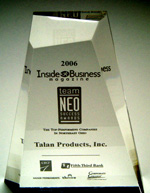
Talan Products, one of the larger independently owned metal stamping companies headquartered in Cleveland, OH was honored in March 2006 by Team NEO with the organization’s 2006 Success Award. The Team NEO Success Awards salute the fastest-growing companies in northeast region of Ohio.
Team NEO is a private-sector-led economic development organization with two primary goals. The organization helps the region’s employers grow their companies within Northeast Ohio and works to recruit medium to large companies to relocate to Northeast Ohio.
Team NEO works in conjunction with business and economic development partners on a continuing basis to help companies in Northeast Ohio reduce costs, introduce new products, explore new markets, step up marketing efforts, and increase customer service.
Team NEO works primarily with businesses in the medical/health care, financial services, chemistry, advanced manufacturing, and sustainability industries. These industries represent the present and future of Northeast Ohio, and many are among the leaders in the United States and the world.
Locally published magazine, Inside Business annually partners with Team NEO to recognize and honor the top-performing companies in Northeast Ohio via the Team NEO Success Awards.

WIRE-Net presents Mission Builder Award to Steve Peplin of Talan Products
June 23rd, 2006June, 2006
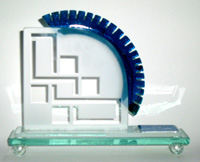
WIRE-Net (Westside Industrial Retention and Expansion Network) recently presented its Mission Builder Award. The award honors organizations and their leaders who exemplify the organization’s mission to strengthen manufacturing to create healthy communities and fuel economic growth.
The 2006 award winner was Steve Peplin, CEO of Talan Products, Inc. Talan Products, a fully integrated manufacturer of high volume, high speed metal stamping products, recently moved from their w.68th address to the Collinwood area of Cleveland. The move allowed for the company’s continued innovation, reinvestment, and job creation.
Since 2003, Talan’s employment has doubled and with this move, the company expects continued job growth and a 30% increase in sales over 2005.
Talan understands the importance of innovation – and uses cutting edge staff development tools including Open Book Management and Lean manufacturing techniques to remain competitive. Accepting this award at our Innovation Celebration in Steve’s absence was Pete Accorti, himself a long-time WIRE-Net supporter and 2004 award winner.
Talan Products wins Manny Award from MAGNET & Inside Business Magazine – (June 2006)
June 23rd, 2006Talan Products, along with GELCore and Lamson & Sessions received the 2006 Manny award in the “Top Growth” category.
Talan Products is a leading steel and aluminum metal stamping and metal fabrication company headquartered in Cleveland, Ohio.
The Manny award annually celebrates achievements of Northeast Ohio manufacturing and distribution companies. Entrants in the competition are judged by editors of Inside Business magazine and local business leaders. Fifteen awards were presented based on achievements including record years in growth, addition of new jobs to the region, creation of a new product or providing employees with outstanding educational opportunities.
MAGNET, the Manufacturing Advocacy & Growth Network, serves as the voice of manufacturing in Northeast Ohio The organization advocates for manufacturers in dealing with the multitude of regulatory agencies at the local and regional level and also represents the region’s manufacturers in influencing public policy.
Steve Peplin, Talan Products’ president and CEO identified the winning growth formula for the Cleveland, Ohio based Stamping Company as a continuation of record sales service to both companies within Ohio and an expanding USA market for Talan’s core competencies – high volume, high speed metal stamping, tube fabricating and end forming, and processing of aluminum extrusions.
Stamping Its Future – Crain’s Cleveland Business
May 23rd, 2006With move to larger space and new equipment, metalworking firm Talan Products Inc. sets out to grow via acquisitions
By David Prizinsky
May 8, 2006
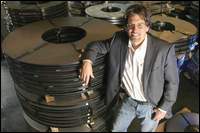
A change of address to Cleveland’s Collinwood neighborhood for Talan Products Inc. has created room for sales growth for the company that focuses on metalworking, an industry that is consolidating.
The 20-year-old company is projecting sales of at least $25 million this year, up 32% from $19 million in 2005, said CEO Steve Peplin. Talan spent $1 million on new equipment and building renovations in connection with the move, which enables the company to reduce operating costs through a more efficient layout of equipment, he said.
Before the move, Talan operated out of 58,000 square feet of cramped space in several buildings on the city’s West Side. Talan now leases 145,000 square feet of space in the huge Richard Melvin Building, which formerly housed TRW Inc.’s engine valve production operations.
Talan moved at the end of last year, and Mr. Peplin said Talan plans to acquire the space it now leases. “We intend to own it,” he said.
Plant layout and design are important to productivity, but Mr. Peplin said the key to Talan’s profitability and growth also has been its constant measurement of all shop floor functions and processes against key internal and industry standards. “What gets measured gets improved,” Mr. Peplin said.
Talan, which has 55 permanent and 20 temporary workers, began in 1986 by producing stamping dies. The company since has expanded to include metal stamping, aluminum extruding and tube forming. Mr. Peplin said the company operates 25 stamping presses. Talan’s sales per employee are twice the stamping industry average.
A Plan for Growth
Although employment will increase to 80 permanent workers over the next year or two, Mr. Peplin said sales must grow faster than expected employment growth if labor costs are to be kept under control. Mr. Peplin said the company will pursue long-term sales growth by heightening the awareness of Talan as a company that will form innovative relationships with manufacturers that can reduce overall costs.
“We want to be seen as a provider of solutions,” he said. “We want that to be our brand and our brand is really our people.”
He said the quality of the company’s work force is a source of pride. This year, the employees are slated to receive a substantial bonus that will be based on the gross profit margin for the year. The company did not pay a bonus last year.
Up until now, Talan has grown on its own without acquiring any other companies. But now that the company is settled into its new space and its systems are ingrained, it will seek acquisitions, Mr. Peplin said.
He said companies that might be acquired now could be more easily integrated into the Talan organization and culture thanks to long-standing efforts to establish an efficient production and quality control systems. He said opportunities for acquisitions are relatively numerous because a stamping industry consolidation that is under way. He did not offer a timetable.
Talan has been cited by many industry groups for its sales growth and its openness to new ways of conducting business. John P. Colm, president and executive director of the Westside Industrial Retention and Expansion Network, or Wirenet, a Cleveland manufacturing support group, said the company can serve as a role model for other industrial companies seeking to grow.
“Talan is our poster child for business unusual,” said Mr. Colm, who is familiar with the company because of its work with Wirenet. “Talan is moving ahead on a number of fronts and innovation is the theme.”
A Close Relationship
Mr. Colm said Talan, contrary to the conventional wisdom, has proved that a modernization strategy can work in traditional industries such as metalworking.
He said the company began exploring lean manufacturing practices in the 1990s before they were popular. And Talan is never satisfied with a business-as-usual approach and always is looking for ways to increase efficiency and to work with customers.
Mr. Peplin, one of the company’s two founders, said Talan’s willingness to work closely with customers is another key to its growth. The customers tend to be large since Talan has geared its operations to long-run stampings. Building construction components comprise the largest market. Other major markets are automotive, fasteners and appliances.
Just how closely the company is willing to work with customers is illustrated by Talan’s operation of an inventory management service for customers plus a materials management service.
The inventory management service results in a steady flow of the right quantity of products needed in a customer’s plant.
This enables the Collinwood company to maximize its production efficiencies and minimize equipment setups and other time-consuming changes.
Materials management provides advice regarding the pricing trends of steel and aluminum and gives customers a chance to accelerate or defer purchasing decisions depending on the direction of metal prices up or down.
“Customers rely on us for pricing trends. We spend a lot of time and money on materials information,” Mr. Peplin said, adding that steel and aluminum represent at least 60% of Talan’s costs and are a highly significant part of customers’ costs.
A dramatic example of working with a customer came in 2004 when Talan acquired five presses from an Ohio manufacturer that used them to make parts. Talan began operating the presses and supplying their prior owner with parts. Mr. Peplin said the deal made sense to both companies because Talan is a stamping specialist and can perform the work more efficiently.
From Crain’s Cleveland Business – May, 8 2006
Photo credit: Jannie Bentivegna
Crunching the Numbers – Inside Business (May, 2006)
May 23rd, 2006Crunching the Numbers: Careful Financial Management Keeps Talan Products Flying High
By Morgan Lewis, Jr.
May, 2006
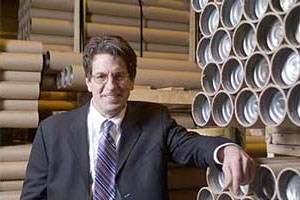
The only way to measure growth is to look at profits and losses, says Steve Peplin, co-founder and CEO of Cleveland-based Talan Products, a manufacturer specializing in metal stampings, tube forming and aluminum extrusions.
That’s why every week Peplin generates a real-time financial report to analyze every cent coming in and going out.
“Every week we meet with all managers, put all the numbers on the wall and anything that’s .1 percent over budget, we solve it,” Peplin says. “So at the end of the month, there are no surprises. We’ve known all along.”
For a company producing thousands of aluminum, copper and steel parts per hour, studying the numbers is critical for growth, and for Talan it has made the difference.
The company nearly doubled its revenue from $8.5 million in sales in 2002 to $19 million in 2005. Sales are expected to reach $23 million this year.
Likewise, Talan had 32 employees in 2002, which grew to 53 by 2005.
Such an expansion required Talan to move out of its 57,000-square-foot factory to a larger facility formerly owned by TRW Inc., where Peplin invested more than $1.5 million redesigning and adding equipment.
“We don’t do just one thing right, we do thousands of little things right every day,” Peplin says.
From Inside Business – May, 2006
PMA Zero Lost-Time Accidents Award Received by Talan Products for 6th Straight Year (April 2006)
April 23rd, 2006April, 2006
This spring, Talan Products was recognized by the Precision Metalforming Association for a continuation of a quality safety standard within the metal-working industry.
Talan Products, is an industry leading high volume metal stamper located in Cleveland, Ohio.
In addition to stamping metal parts, Talan Products produces finished, fabricated components from metal tube as well as finished cut-to-length and fabricated aluminum extrusion.
For the sixth consecutive year (2005), Talan Products was recognized by PMA’s Safety and Environment committee on “achieving zero incidents involving days away from work, days of restricted work activity or job transfer.”
With the United States, accidents involving workers in plants employing metal forming and metal working (including the Talan Products’ area of expertise – metal stamping), along with transportation equipment manufacturing and food manufacturing accounted for 42 percent of all injury and illness cases reported as by the Bureau of Labor Statistics (BLS) for 2004.
The Precision Metalforming Association has aligned itself with the Occupational Safety & Health Administration (OSHA) to promote worker safety and health in the metalforming industry. PMA and OSHA work together to reduce exposure to ergonomic hazards and address press-safety issues such as machine guarding and lockout/tagout to prevent injuries.
Meegan Moore, Talan Products director of Human Services, proudly noted that on January 19, 2006 Talan reached 2,100 consecutive days with zero lost-time accidents, a figure monitored by the Ohio Bureau of Worker’s Compensation.
Local Companies get State Tax Credits – The Plain Dealer (July 27, 2005)
July 27th, 2005July, 2005
Cleveland’s Talan Products Inc. and THI Holdings Inc. of Highland Hills are among nine companies to receive job creation tax credits from the Ohio Tax Credit Authority. Talan, a metal stamping company, will get an eight-year, 55 percent credit valued at $152,192 to expand its manufacturing operation – a project expected to create 45 jobs in three years. THI, a subsidiary of Nationwide Insurance Co., will receive a 10-year, 60 percent credit valued at $3 million to grow its headquarters by 250 employees in three years. 2 companies get development loans.
Two Northeast Ohio companies will receive loans from the state’s Development Financing Advisory Council, which allocates money to firms as an incentive to create and keep jobs in Ohio. Hudson’s QuaTech Inc., a maker of data communications products, will get an 8 percent, $2.5 million Innovation Ohio Loan to help acquire a wireless connectivity technology that will enable the company to grow into new markets and add 22 jobs in three years. Camaco LLC, a Michigan- based firm that produces seating frames for the auto industry, has received a 3 percent, $2 million direct loan to launch a tube and stampings operation at its Lorain campus. The Camaco project is expected to create 40 jobs in three years.
Copyright 2005 – The Plain Dealer and cleveland.com. Used by permission
Marketing Gives Balance to Talan – The Plain Dealer (January 31, 2005)
January 31st, 2005January, 2005
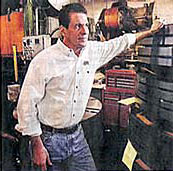
By Steve Peplin, as told to Plain Dealer reporter Marcia Pledger
Steve Peplin of Talan Products, Metal Stamping Company in Cleveland, OH
When you talk about manufacturing in America, you generally don’t use “high growth” in the same sentence. It’s a tough industry that is suffering from overcapacity, has low margins and is hyper-competitive. But we grew steadily and very quickly for many years, and we’re still having fun.
I started this company 19 years ago with two other guys. We each put in $2,100, and we clawed our way up the glass wall.
We are metal-forming specialists that make parts typically unseen in products – unless you’re a manufacturer. We’re in the metal stamping, tube-forming and aluminum-extrusion business. We make components for the fastener, appliance, building hardware and automotive industries. In the 1990s we got used to receiving awards for growth. We won Inc. 500 awards in 1993 and 1999 for being among the nation’s fastest-growing privately held companies.
We won the Manny award from Inside Business and CAMP for manufacturing excellence in 2000. We were named to the Weatherhead 100 list of fastest-growing private companies in Northeast Ohio from 1993 to 1997. That’s kind of unique, because by the fifth year, you’re not comparing such small sales numbers.
But that was the 1990s. Our sales stayed flat at around $10 million to $12 million for many years. My biggest mistake was not building a sales and marketing arm sooner. We were unbalanced. We concentrated on innovative tooling and processes of manufacturing, but I was the only one selling our manufacturing services.
After our high sales growth period settled down, we still grew at a rate of about 40 percent a year for a few years. And we made nice profits. We didn’t even have a brochure for a long, long time. When you’re growing fast, who needs one? We had built the business by networking and through our reputation. Our efforts were spent becoming a better manufacturer by working with an organizational development consultant.
We tried to just let growth happen. We never participated in trade shows or had reps doing work for us. Then, a few years ago, we finally decided to start marketing, and we fumbled. We hired someone, and it didn’t work out. Nothing was sold for a year. After we were burned by the experience, we got cold feet.
I was a little naive, though. It takes a few years to make it work. You have to have a formal process that includes a way to create leads, such as brochures and a Website. It took a while to get qualified leads. Then, once we did, we still didn’t have anyone in sales to chase them down. We ignored the sales process until we plateaued.
The good news is that in a four-year period when our sales were flat, we increased our productivity. Thanks to improved processes, 32 employees can do the same volume of business that 50 to 75 employees used to do.
Being more productive enabled me to spend more time landing a big job. After years of networking, we just closed a few deals that make us a $20 million company. Now I have breathing room to work with sales. Before, I was too busy doing what I call presidential crap.
About six months ago, we hired a known entity in our industry to be in charge of sales and marketing.
We’re successful in an industry that’s been hurt greatly by offshore purchasing. The industry is consolidating, too. Forecasters are saying that half the metal stampers will be out of business in just a few years. The ones that remain will be twice as big.
We’ve been fortunate. We still have the first, second, third and fourth accounts that we landed. Now that we’re generating leads, getting quotes and going after new business, I’m more excited than ever about our prospects.
It’s great to be high-growth again. Now, when I go to bed, I can’t wait to get back to work.
Copyright 2005 – The Plain Dealer and cleveland.com. Used by permission
Innovative Thinking – The Plain Dealer (November 12, 2004)
November 12th, 2004Innovative thinking is the key to surviving in a shifting market
November, 2004
By Thomas W. Gerdel
For six decades, the business model at Cleveland Wood Products was as plain as its name. From its plant on West 150th Street, the company designs and produces wood brush rollers for vacuum cleaners. The division of Scott Fetzer Co. supplies brush rollers to Kirby, a Clevelandbased sister company, and other vacuum cleaner makers. In its peak year in 2000, it turned out 7 million rollers and employed 200 people.
But since then, one large customer has gone offshore to Asia for its rollers, and now the business, whose workforce has fallen to 105, is reshaping its strategy. One of the company’s other products, a cloth vacuum cleaner bag, unexpectedly led to a new product – a pizza delivery bag.
So it has been learning all it can about the pizza delivery market so it can make and sell heated bags for delivering pizzas. After spending years working directly with large manufacturers, the company sales force now is learning how to reach small mom and-pop pizza stores through direct-mail promotions and trade show appearances In its quest for change, the manufacturer – now calling itself CWP Technologies Inc. – is getting encouragement from other local businesses that also seek ways to boost innovative thinking about products and markets.
Their group, called the Manufacturing Innovation for the Next Decade Learners Group, meets every month or so to share ideas and tour members’ plants.
“What the learner group really did was to challenge us as local manufacturers to abandon our paradigm,” said Russell Cooper, the West Side company’s manager of marketing and business development.
Many second- or third-generation manufacturers here tended to wait out a recession until business conditions got better, he said. But the last recession has not been like the past.
Robert Tucker, a California consultant who met with MIND last month on a trip to Cleveland, urges companies to take inventory of their competencies and ask who else might benefit from them.
Tucker likens innovation to a muscle that has been allowed to atrophy as manufacturers focused on cutting costs and making plant processes more efficient. Marketing and talking to new customer groups are “foreign to most of our manufacturing leaders,” he said. “The only time they do it is when they’re in a pinch.”
The MIND participants are trying to change that attitude. The group is a part of WIRE- Net, a nonprofit organization devoted to the advancement of manufacturing on the city’s West Side. The six firms in MIND have a combined work force of more than 450 people.
For Pete Accorti, an owner of Talan Products Inc., the group helps his metal-stamping firm learn to build innovation into its business structure and strategies, making it less accidental.
He said smaller firms often focus all their energies on squeezing costs “out of the middle of their business,” as opposed to seeing how they can grow their sales.
“You do have a tendency to get complacent,” said Gordon Barr, president of NewKor Inc., a maker of paper tubes and canisters that also is a MIND member. NewKor, which has lost some paint roller cover business to Asia, is trying to apply its know- how in precision cutting and highly engineered materials to new areas such as insulation jackets for rocket motors.
Another MIND member, E.C. Kitzel & Sons Inc., worked closely with jet engine maker Pratt & Whitney to develop a diamond indenting stylus for marking jet engine blades so they’re easier to identify.
Tom Schumann, general manager of the Cleveland cutting tool maker, said the new marker has potential applications in the automotive and other industries.
“You’ve got to be creative and come up with new products,” said Don Mottinger, an owner of Superior Products Inc. The Brooklyn manufacturer continues to increase its metal fittings business by developing new products and expanding into markets including the medical and beverage industries. In the last eight years, Superior has added five new patented products, and it recently expanded operations.
“You have to differentiate yourself from others,” said Mottinger, who is not a MIND member but recently talked to the group.
At Cleveland Wood Products, the leap from wood brush rollers to pizza delivery bags involved not just finding a new market but also a way to stand out. For the last 10 years, the firm has been making cloth bags for Kirby vacuum cleaners.
“We developed a capability to sew, join materials and to do ultrasonic welds,” said Brian Grabowski, product manager for CWP’s heated solutions group. That adds up to a pizza bag.
But he said the firm spent a year assessing the opportunities for making and marketing a new kind of bag that could hold heat longer than conventional insulated bags. “We gathered a lot of information about our competitors and felt that we could come up with a device that addressed all the negatives of what’s out there and attack them on price,” Grabowski said.
The result: a flat heating plate made from a special polymer that can be plugged into an electrical wall socket. Cooper said the bag, for which the firm has a patent pending, can keep a pizza hot up to 45 minutes. CWP also offers to put the customer’s own name on the bag, customizing it for thousands of pizza places.
“There are over 60,000 pizza shops in the United States, and over half of them deliver,” Cooper said. The company is exploring other markets as well, he said, including heated blankets, sleeping bags, catering trays, satellite dish covers and instrument insulation.
Copyright 2004 – The Plain Dealer and cleveland.com. Used by permission
The New Schneiderman – Socially Responsible Business (November 9, 2004)
November 9th, 2004The New Schneiderman – Socially Responsible Business Champion Nominees, Entrepreneurs for Sustainability
November, 2004
Champion: Peter J. Accorti – Talan Products
(Nominated by: John Colm – Westside Industrial Retention & Expansion Network, WIRE-Net)
Pete Accorti has been a champion of corporate social responsibility, environmental sustainability practice, systems thinking, experimentation and learning in many spheres, including education, design, and business.
I know of his work primarily in the business sector due to my involvement with him as a former Board president and current board member of the Westside Industrial Retention & Expansion Network or WIRE-Net, a Cleveland based non-profit organization devoted to a manufacturing-based economic development strategy. In that capacity, Pete was a founding and active member of WIRE-Net’s Employment & Training Committee, and our Manufacturing Assistance Program, which leveraged existing social capital among progressive manufacturing firms on Cleveland’s west side. Pete was a founding member of the NE Ohio Manufacturing Awareness Council, and is co-chair of the NE Ohio Campaign for American Manufacturing, which advocates for policies to strengthen and enhance domestic-based manufacturing.
Pete was instrumental in forming WIRE-Net’s Manufacturing Assistance Program, which brought together formerly isolated members of NE Ohio’s manufacturing world into a community to learn from and with each other about important strategies to maintain and improve their competitiveness. MAP explored ways to reduce employee turnover, improve hiring practices of Generation X, pursue manufacturing excellence and other topics. The program continues today, and a pilot Learners Group has just finished its first year of work on manufacturing innovation.
Pete was also a champion of a unique effort that resulted in WIRE-Net sending its director of Manufacturing for a internship at the Rocky Mountain Institute. That director was Holly Harlan. As a result of that experience, Holly formed a groundbreaking Manufacturing Sustainability Learners Group with several local manufacturing business leaders from industries that included a metal stamper, plumbing products company, a major dairy and a paint company. Several of these began implementing Natural Capitalism principles explored by the Learners, and one just completed construction of a major green-built, LEED certified distribution center, constructed on a former urban brownfield.
Pete was also a founding member of Entrepreneurs for Sustainability, and a major force behind E4S’ recycling design competition. In his own company, Talan Products, Pete was a central force to build a community of employees and managers, and implemented Open Book Management to engage employees more directly in efforts to improve the financial performance of the organization. Talan has won many awards due in large part to Pete’s leadership. Talan has been a multi-year winner of the Enterprise 100, and the Inc Inner City 100.
Pete is a strong believer that US companies can improve their commitment to and results from a concerted focus on the triple bottom line of profit, employees and community. His work has truly been catalytic, and best of all, many of us believe we did it…not Pete. This is the true mark of a “servant leader”, when your followers believe they did it without you.
Six Risky Things… – COSE Update (March, 2001)
March 23rd, 2001Six Risky Things They Did for Business That Actually Paid Off!
By Rosemary Rood-Tutt
From COSE Update – March 2001
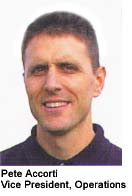
Knowing the Score
“Open-book management is not the end all,” says Peter Accorti, one of the owners of Talan Products, a metal stamping company on Cleveland’s near West Side. “It’s a tool. And if it’s implemented correctly, it gives you a very competitive advantage.”
In 1999, Accorti began sharing the company’s financial information with all 45 employees, even hourly line workers. Greeted with mild cynicism, doubts vanished when Talan paid out 11 percent of gross wages in year-end bonuses. ‘Any time people realize they’re playing a game and they’re winning, it has a very positive impact on the culture,” he explains.
Open-book management cuts to the quick. “It distills everything to the most basic level which is ‘What are we here for?’ “ Accorti explains. “It’s difficult to drill down to that level unless you go right to the basics.” Inspired by Jack Stack’s book called The Great Game of Business, Accorti agrees that business is indeed like a game. “You’ve got to keep score,” he says. “But generally, only a handful of people know the score. No one else knows whether we are winning or losing, or what they can improve upon.”
Stack bought a nearly bankrupt International Harvester plant in Missouri with a 90-to-1 equity ratio. He kept the doors open by developing key critical numbers to sustain the business and shared them with everyone in the company. Then he devised games around those numbers. “Make everyone aware of the score by communicating information every day,” Accorti advises. ‘And then share in the rewards.”
Talan’s managers gather weekly to review profits and flag variances, and the entire company comes together every month for an update. “Everybody knows from week to week what our production is, what our margins are and where the variances are,” says Accorti. “Get the whole company focused on improving areas like market share, efficiency or inventory turns. If you want to stay competitive in the marketplace, can you imagine any better way?”
Accorti cautions that open-book management is no magic bullet. There are other things you need to be doing simultaneously. “I don’t think you can implement open-book management to the exclusion of other issues like a good, solid approach to strategic planning,” he says. “To generate this kind of thing you need a solid financial strategy, sophisticated software and an infrastructure to support it.” And a good accountant to generate figures on a weekly basis.
Open For Business – COSE Update (January, 2001)
January 23rd, 2001Open for Business
By Sallie Hoelscher
From COSE Update – January 2001
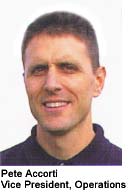
Although he knew the practice of “open-book management” was a bit unusual in smaller companies, Peter Accorti became intrigued with the idea 20 years ago when he read The Great Game of Business by Jack Stack. According to Stack’s Web site (www.greatgame.com), open-book management—the sharing of financial data with all employees—is a piece of the “great game” process, defined as “a total management system that encompasses the basic components of a game, applies them to the art of running a business and allows the players (employees) to understand and help control their destiny in the business.”
For Accorti, part-owner and vice president of operations for Talan Products, a metal-stamping company on Cleveland’s West Side, open-book management enables him to use financials as tools to set goals and educate employees. Sounds good in theory, so where is the “but” …
Open-book management, Accorti observes, does not come without its challenges, because you are, after all, sharing your financial information with your employees. He recommends that you have a solid business infrastructure already in place, along with strong lines of communication.
This year Talan Products enters its third year of open-book management, and Accorti admits they are still fleshing out the process. He says it has made a major impact in two ways.
Culturally, says Accorti, “open-book management gives us a competitive advantage, because we’re all focused on outcomes.” And operationally, he feels it forces him to be a better businessperson because of the constant accountability.
But he warns that the practice is not a panacea. “It will not solve all of your problems. But it does help employees understand what the drivers are. There is a greater sense of team.”
Talan Products, Inc., founded in 1987, has 50 employees and has been named to the Weatherhead 100 five times..
From School to Career – Catalyst Cleveland (December, 2000)
December 23rd, 2000Labor Pool Shrinking:
Act now, report urges educators and employers
By Sandra Clark
November / December 2000
From Catalyst Cleveland
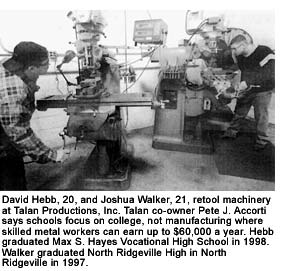
To stem the tide of unqualified workers, Cleveland schools, local businesses and community agencies are drawing up a plan to build a more sophisticated workforce. Together with the Greater Cleveland Growth Association, the district plans to assemble a School-to-Career Office, chiefly charged with translating business needs to schools. It also should see that skills and a rigorous curriculum are taught to students district wide.
“The business community is geeked up about the possibilities,” says George Coulter, director of the Growth Association’s Jobs and Workforce Initiative. “Now what?”
“I think things are going to change,” says local business owner Pete J. Accorti, owner of a local manufacturing firm and an advocate of the School-to-Career movement, “I’m more excited about what will happen in the future than I am about what’s happening now.”
The school district must act now, the report says. There is “a newfound optimism” and “a sense of urgency” among employers that schools can benefit from, it says.
Wired For Revitalization – Cleveland Enterprise (Summer 2000)
June 23rd, 2000Wired For Revitalization:WIRE-Net’s mission is to bring a much-neglected part of Cleveland a little TLC.
By Lori Ashyk
From Cleveland Enterprise – Summer 2000
When the Westside Industrial Retention Network (WIRE-Net) was launched in 1988, Cleveland’s manufacturers had been beaten up and bruised by a recession. WIRE-Net hoped to help them heal.
Twelve years later and looking much healthier, many of those same companies can credit WIRE-Net with offering them more than band-aids. The non-profit organization acts as an intermediary between businesses and the community by providing employment training and referrals; what it calls workforce development services; industrial real estate services, which includes a “brownfields” development project; and technology assistance to companies on Cleveland’s West Side.
“We didn’t know in 1988 there would be such a niche for this kind of work, says executive director John Colm. The niche was carved originally by three community development corporations: Cudell Improvement Inc., the Detroit-Shoreway Community Development organization, and the Stockyard Area Development Association. Those groups realized that in addition to neighborhood organizing around the issues of housing and commercial revitalization, the industrial employment base of their West Side communities needed to be stabilized and increased.
Today, WIRE-Net serves directly or indirectly some 700 manufacturing companies employing 30,000 people. It has 173 member companies. Within the past two years, it has added two more community development groups, Westown Community Development and Bellaire-Puritas Development Corp., which serve the city’s far west side, into its fold. Those groups now have more direct working relationships with WIRE-net and representatives on its board of directors.
“We have a much more diverse customer base now than when we started,” Mr. Colm says. He added that in its early days, WIRE-Net assisted many companies struggling to climb out of the recession. They often were older businesses founded on supplying the auto and durable goods industries. Some didn’t make it. Those that did now supply a much wider range of industries.
“They’re much stronger companies now; they’re innovators, they’ve proven they can survive,” Mr. Cohn says of WIRE-Net’s members.
WIRE-Net, which is funded by a combination of state and local grants, foundation grants, membership dues, and program revenues, has earned its stripes mainly in the area of workforce development. Its “Hire Locally” program matches the needs of employers with training programs at local schools such as Cleveland city schools, Polaris Career Center, and Cuyahoga Community College. It also coordinates a 30-week precision machining technology program with NASA Glenn Research Center.
At Destiny Academy, located within Max Hayes High School in Cleveland, students learn “work-readiness” skills such as workplace behavior and ethics, showing up on time, and, in general, meeting the expectations of employers. They also meet potential employers and have job – shadowing opportunities.
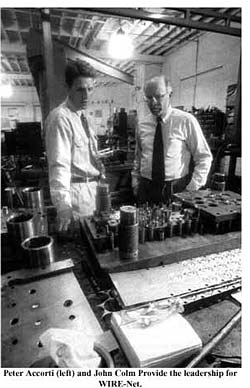
Peter Accorti, vice president of Talan Products, Inc. and president of the board of directors of WIRE-Net, says the group’s services have been invaluable to him as an employer at a time when labor shortages have made businesses “desperate for help.” He says students who work with WIRE-Net often show greater results from their training than do students from more traditional vocational programs. “The reality is that companies don’t have the luxury of on the-job training anymore,” he says. “We have to get people trained faster.” Five years ago, businesses on the West Side may have been growing about 5 percent a year, he says. Now they’re growing, in aggregate, 15 percent a year and need workers who are ready to work productively the day they’re hired. Mr. Accorti also notes that WIRE-Net helped Talan, a metal stamping company, set up its own apprenticeship program. Talan has hired students from Destiny Academy for its program.
“There’s a lot of value in a WIRE-Net membership,” says Mr. Accorti. He added that WIRE-Net’s small, “non-bureaucratic” staff Of 12 is easy for businesses to work with. The average WIRE-Net member company has only 40 employees, and often doesn’t have the resources or time to do extensive training.
The organization has been recognized for its effectiveness. Public/Private Ventures, a Philadelphia based non-profit group which studies the effectiveness of social programs on youth, evaluated WIRE-Net’s effectiveness in a 1998 study called “Working Close to Home.” It concluded that among WIRE-Net’s strengths are its ability to “target” employment areas such as metalworking and to hone in on the needs of businesses, as opposed to focusing solely on finding jobs for the unemployed. Thereby, it makes sure that those businesses can actually use the people it trains, the study says.
Although more than half of WIRE-Net’s budget is dedicated to its employment programs, another major area of growth in recent years has been its industrial real estate efforts. In the early 1990s WIRE-Net conducted a survey which found that one reason companies leave their West Side base is because they want to expand and simply don’t have the space. In order to fulfill its mission of retaining and expanding industry on the West Side, WIRE-Net decided to develop a 15-acre industrial park near West 65th and I-90.
“It turned out the land wasn’t green,” says Mr. Colin, referring to the need to clean up the property by digging up underground tanks, testing for groundwater contamination and digging out lots of dirt. WIRE-Net assembled the parcels and cleaned up the property with much assistance from the City of Cleveland and the State of Ohio. A coalition of state, city, community development groups, and WIRE-Net has been working since 1992 to bring the park to fruition. One of WIRE-Nees member companies, B&R Machine Co., has its headquarters under construction there, and more land is available.
Mr. Cohn sees the real estate development side of WIRE-Net’s operation growing rapidly in years to come, as healthy businesses on the West Side seek to expand.
MANNY Award – the CAMP CONNECTOR (May 2000)
May 23rd, 2000CAMP C-Hosts 3rd Annual MANNY Awards
May / June 2000
From The CAMP CONNECTION
More than 300 local manufacturers and business representatives gathered at the Renaissance Cleveland Hotel in May to honor the winners of the third annual MANNY Awards.
Hosted by Inside Business Magazine in partnership with CAMP, the MANNY Awards celebrate manufacturing excellence in Northeast Ohio.
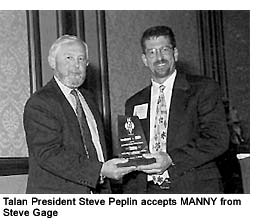
CAMP member winners this year included Osborn International, Parker Hannifin Corp. and Talan Products. Other winners included CAM-LEM Inc., EasiJet Inc., Lighting Products Inc. and MeriTool. CAMP member finalists included Haitek Solutions. Additional finalists were Advanced Technology Corp., ATC Nymold Corp. and VendorTech.
Winners were chosen on the basis of how each company solved various challenges showcasing invention, cooperation and excellence. Judges included Inside Business editor Steve Gleydura, moved from a bearings distribution company to a technology company, noting that “In addition to broadening our product lines, we needed to add value to our customer transactions by assisting them in applying ever-changing technologies.”
In offering useful insights and advice for the future, Dannemiller notes that “it’s important that you (companies) think in a manner that allows for developments that extend beyond our human ability to anticipate only what we now understand. Your company will be truly revolutionary when it learns faster than its competition!”
Open-Book Management – Cleveland Enterprise (Spring 2000)
April 23rd, 2000Open-Book Management:
After a bad year in 1998, Talan products adopted an open-book management philosophy that has turned the company around.
By David R. Wasserstrom
From Cleveland Enterprise
This is one of the first companies I’ve worked for that’s “That’s had open-book management, and I think it’s great,” says Eugene Sawyer, second-shift production supervisor at Talan Products. “If you could have been here in December and seen these guys leave with bonus checks – everyone had a smile on their face.”
Talan distributed $115,000 in bonus money in 1999, representing 12 percent of gross wages. And for the first time, Talan’s internal culture dubbed Team Talan – has begun to attract outside workers to its ranks.
It wasn’t always this way.
Not long ago, the owners of Talan Products realized that their company had become mired in mediocrity. As managers and floor workers passionlessly went about their daily routines, executives foresaw an inevitable slide in product quality and customer satisfaction. For this modest-sized metal stamping business at the heart of Cleveland’s blue-collar West Side, it was a potentially fatal situation that sent owners scurrying for answers.
“We had a bad year in 1998, and part of it was the culture that needed mending,” recalls president and founder Steve Peplin. “There wasn’t really a smoking gun … but we’re such a low-margin business that [you’re] looking at 50 items,” he explains, “and every one of them was a tenth of a point off because you spent a little more on shop rags, used more waste and were just a little less efficient. [Suddenly], there’s 5 percent missing, and that’s your profit margin.”
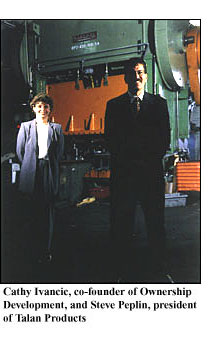
So Peplin began to ponder an idea his partner, Pete Accorti, had suggested a few years earlier: an open-book management style, whereby a company shares financial information with its employees, sets and measures goals and rewardsthose who achieve those goals – all in hopes of helping employees see how their work affects the entire company.
Peplin became especially intrigued by a well-known method of open-book management called The Great Game of Business, a phrase coined by the book’s author, Jack Stack, and now marketed to businesses nationwide. Its underlying premise is to track performance based on a company’s income statement.
In November 1998, Talan retained Cathy Ivancic, cofounder of Akron-based consulting group Ownership Development Inc., to help turn things around. Her first task: Identify what variables drive Talan’s business forward while enhancing employee performance.
“We worked on developing an incentive that was easy to communicate, under standable and one that would pay for itself,” Ivancic says. “That turned out to be a proportion of Talan’s operating profits.”
Ivancic and ownership agreed to set goals every six months and let departments create “minigames” to measure performance. The quality assurance department game, for example, was structured as a car race and measured quality against customer complaints during a three-month period. A large, graphic representation of the race was placed on a wall in the department and updated regularly. The result: Quality outpaced customer complaints.
The shipping department, meanwhile, focused on having each tow-motor operator complete a government-mandated safety checklist each morning without fail for one month. The reward: Leave work one hour early with pay.
A key step in this process involved teaching workers what financial indicators mean. Recalls Peplin, “At one class we held for the workers, an instructor held up a dollar bill and asked, ‘How much of it does the guy on top get to keep for every dollar we sell?’ They honestly thought that I put between 30 and 40 percent of it in my pocket. They’ve never had business classes before, and they don’t realize that I actually get a little comer of the white border on one side of the bill!”
A year after the program’s inception, Peplin still marvels at the results he sees throughout his company, whose dramatic turnaround has earned it a 2000 Manny Award.
Though Talan won’t release specific figures, it reports that profits rose from a five digit loss one year to a six-digit gain during the next as sales increased 12 percent. “It was like throwing a switch … you could feel the change,” he says. “Now I walk through the shop, and everybody cares.”
Talan Products Reaps Rewards of Inner-City Work Environment
May 24th, 1999May 24-30 1999
From Crain’s Cleveland Business
By David Prizinsky
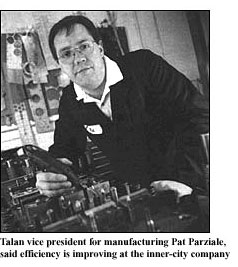
At a time when inner cities are losing manufacturers to the suburbs, the owners and employees of Talan Products Inc. say the metalworking company’s West Side location is one of the keys to improving its operations.
“We see the inner city as a competitive advantage,” said Peter J. Accorti, vice president of operations at Talan, a 13- year-old company at 1985 W. 68th St. that has gained a reputation for rapid growth in a traditional, low-growth industry.
Talan was one of 100 small, inner-city companies in the United States cited for rapid sales growth in April by the Initiative for a Competitive Inner City, a nonprofit group in Boston that is an advocate of locating businesses in the inner cities.
Five other companies in Cleveland that made the group’s list were Thermagon Inc., Complete Personnel Management Inc., Colormatrix Corp., Ullman Electric Co. and Even Cut Abrasive Co. The group said lower real estate costs, closeness to customers and the availability of workers are among the advantages enjoyed by inner-city companies.
Talan ranked 73rd on the list, with sales growth of 123% from 1993 and 1997, when Talan’s sales were $8.2 million. Sales last year were just over $8 million, but are expected to be $10 million in 1999, Mr. Accorti said. Mr. Accorti said the company’s location directly influences its success.
“There is access to a workforce,” he said. “There is the central location that is close to highways, the airport and vendors. There is the availability of lower priced real estate.”
Talan has 37,000 square feet of manufacturing space in several buildings on West 68th. The company operates stamping presses and tube forming machine tools. It also makes aluminum extrusions.
The company’s inner city location isn’t the only edge it is trying to exploit. Since the end of last year, Talan has been implementing an “open book management” style that includes daily reports to the employees on the rates of machinery utilization and monthly reports that analyze the company’s operating profits.
As part of the “open book” approach, a team of 12 workers was formed to define key production measurementsand to identify the major impediments to improved equipment utilization.
“In the last five month, we have improved efficiencies by 20%,” said Pat Parziale, Talan’s vice president of manufacturing, who, along with Mr. Accorti and president Steve Peplin, is one of Talan’s three owners.
Talan measures efficiency by comparing the standard number of hours needed to complete an order with the actual hours taken. The open book approach also includes a profit-sharing program that is expected to pay a bonus this year of between 10% and 15% of Talan’s total wages.
Holly Harlan, a program director for the Westside Industrial Retention and Expansion Network, said Talan is known for innovation and hard work. She said the company invests in worker training and education.
“They’ve created an environment where the employees motivate themselves to work smarter,” Ms. Harlan said.
Mike Wimberly, Talan’s production manager, agrees. He described employee morale as good and said employees, including himself, think of themselves as part of a team.
“They are sharing the gains with everyone,” said Mr. Wimberly, a tool and die maker who started at Talan three years ago. “If they make money, we make money. The owners are working as hard as we are.”
On the Cutting Edge of Low Technology – Cleveland Enterprise (Spring, 1994)
April 23rd, 1994From Crain’s Cleveland Business
Spring 1994
“OUR COMPANY MOTTO IS ‘Good parts, shipped on time, at the low bid,'” says Steve Peplin, president and CEO of TaIan Products, Inc., a Cleveland-based contract manufacturer specializing in long—run stampings and the fabrication and sale of aluminum extrusions.
Sales figures for the privately held manufacturing company were not disclosed, but were in the “under $5 million range” on the 1993 Weatherhead 100 list of northeast Ohio’s fastest growing companies. Talan placed #6 on this list, with sales growth of over 1,000 percent and employment growth of 400 percent in the last five years. From 1992-1993, says Peplin, sales increased 50 percent. In the last three years the company has outgrown its 15,000 square foot facility located on Cleveland’s west side. “We use off-site warehousing on an as-needed basis and plan to relocate when the right place comes along at the right price,” Peplin says.
Talan’s product mix is dominated by the appliance and building construction component industries, but it also includes fastener and retail display manufacturers; defense contractors; and electronics, container, and toy manufacturers among a growing list.
Peplin says that since 1986, Talan’s client base has increased tenfold. The complete client list includes American companies and US-based but Swiss, German, and Japanese-owned companies that range geographically from California to Massachusetts and Arkansas to Hawaii. “I think that savvy business people know that partnering is a good way to build long-term business relationships particularly in an already mature, over-capacity industry,” he says. “We are very used to partnering and being involved in projects from the design stage on.”
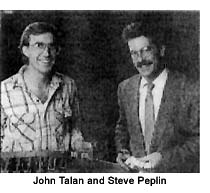
While Talan does a hefty amount of prototyping implicit in design, the company does try to distinguish its operation from high-volume manufacturers, “One of our biggest assets is to look at a part, come up with a redesign to ease manufacturing, and save the customer money,” Peplin says. “Our input saves a project time and money and helps us in the long run.”
Peplin says that he foresees a manufacturing renaissance in the Midwest and that the Cleveland infrastructure—its supplier base, labor pool, machinery support, and geographic location—make the Midwest a desirable location for Talan. The company was created with a $6,000 private initial investment.
Peplin; his brother Rich; John Talan, vice president of engineering; and Peter Accorti, director of operations, will pay off their first round note of capitalization in 1994. “We have an excellent relationship with Society Bank. This is a low margin business and therefore very capital—intensive,” Peplin says.
Successful as it is, this manufacturing company still has hurdles to leap. Peplin says that a 10 percent increase in Talan’s 1993 steel costs posed an immediate threat to its ability to make the low bid. “Without the low bid we’re lost,” Peplin says. To compensate for rising costs, he says, “We wear a lot of hats here and keep a minimal front office staff.” In fact, every day Peplin, wearing his chief-of-sales hat, uses his background in contract and manufacturing repping for Talan, which does without a staff of outside representatives.
“We’re on the cutting edge of low technology, and our biggest goal is to maintain a quality culture; it’s more efficient than reinventing it later,” he says.
Talan executives have also learned to use a contingency work force to accommodate the increased business during the company’s third and fourth quarters, which is due to an increase in summer construction. “Last time this year we had 25 employees. Today we have 35 employees, most of whom operate machinery and receive a competitive wage, benefits, and bonuses,” Peplin says. A temporary agency provides Talan with a workforce it can train and screen, and puts Talan executives in a position to make knowledgeable employment decisions. “Not one employee has quit this company, ever,” Peplin says.
Talan’s business may be low tech, but the company uses technological advances to increase its efficiency wherever possible. It has expanded its automation system to secure quality assurance and tie its information system together.
Implementation of Talan’s new network is expected to increase the company’s production capabilities and keep the growth rate up. “We hope to see another 30 to 50 percent growth in sales this year,” Peplin says, “without doing it at the expense of quality.”
Talan executives hope to introduce their own product to the market soon. (Until it’s ready, they naturally prefer to keep the specifics about it to themselves.) With a few ideas and prototypes already in the works, they plan to create an innovative product, realize production efficiencies, and fine-tune existing components of the business. “Our own product will allow us to fight the marketplace rather than other stamping companies,” Peplin say’s. “But we know that we are primarily a job shop, that we bid on a small number of jobs and close nearly one-third of them—an unusually high ratio,” he adds.
Talan is already capable of modem purchase orders and of exporting CAD drawings, and Peplin expects automation to add a new dimension to the company. “Our new automation system will expedite the entire work flow here from quotes all the way through to shipped products. In addition, we’re really concentrating on expanding our quality control department, and we’re doing more non-metallic stamping, including plastics,” he says.
For now it’s back to the grind in a small front office, attending to ringing telephones and new computers, designs, and clients. After all, a job shop has to stay focused on its core business. For a futurist like Peplin, it happens day by day, one customer at a time.
End of Year Party – Inside Business (May, 1993)
May 23rd, 1993Annual End-of-the-Year Party
From Corporate Cleveland
May 1993
Like many companies, Cleveland-based Talan Products, which manufacturers stamped metal parts, had always hosted a year-end celebration for its 45 employees and their significant others – usually a catered affair at the Cleveland Athletic Club.
“We have people with different religious beliefs, so we never liked to hammer home the fact that this is a Christmas party,” says Pete Accorti one of the company’s three partners. But the club sported traditional Christmas decorations that made some employees uncomfortable. And because Talan ascrIbes to the ‘open book’ theory of management and shares its monthly financial statements with employees, they knew what the outing cost. Although the company could afford the expense, Accorti says, employees believed the money could be better spent.
“We’re a pretty small company,” Accorti explains. “It’s not hard to get a sense of how people are feeling.”
So in 1999, company officials tried something different —they reduced the party’ budget to $2,500, then asked a shop-floor supervisor to assemble a committee of workers from all departments to decide what sort of year end event the company should have.
The result? An employee-only potluck luncheon prepared by the workers themselves, served up in Talan’s West 68th Street facility.
Everybody brought a dish, including president Steve Peplin, who deep-fried a turkey. Instead of spending the $2500 on a catered spread, the committee purchased prizes to raffle off after the meal, everything from TV’s and VCR’s to Blockbuster gift certificates.
“We’ve been in business since 1987 and having events since 1989” Accorti says. “This was probably the only event that had universal buy-in. Everybody felt a part of It.”
Guiding Principle: Employee participation. “We feel were going to be more effective as a company if everybody is focused on the primary goal of the company, which ultimately is earning a profit.” Accorti says. “As opposed to having a select group of people focused on that goal — and keeping score with regard to that goal —we have the whole company focused on that goal.”
Best Practice: Win-win raffle. In addition to the big-ticket items, the party-planning committee purchased enough small items so everyone could take home a prize.
Setting: Employees broke bread in the plant on a mid-December workday so everybody could attend.
Keeping it Clean – Corporate Cleveland (May, 1993)
May 23rd, 1993Keeping it Clean: Taking responsibility because it’s good business and it’s free
From Corporate Cleveland
May 1993
Recycling is the name and saving money is the game, says Steve Peplin, president of Talan Products Inc., a metal-stamping plant on Cleveland’s West Side that employs 25 people and produces goods ranging from electric products to armored parts for military vehicles.
Peplin believes you have to challenge preconceived notions about improving the environment in your own workplace.
In Talan’s case, that meant taking a look at the packaging of outbound products. At one time, Peplin says, each truck that left the plant carried up to 6,000 pounds of non-recyclable cardboard packing.
“We fiddled with this thing, worked on it and have just about arrived at a combination for repackaging” Peplin says. That effort will reduce the weight of packagIng by about 75 percent without, he emphasizes, putting the cargo at any additional risk.
Peplin says environmental issues have always been a concern at the seven-year-old company, but adds that they have taken on a new emphasis of late.
“We’re young guys In our 30’s and we want to be the corporate citizens with a conscience,” he explains. “We’re the good guys.”
“It’s not that difficult and can be done easily,” Peplin says, citing as an example the simple act of opening the mail. “After sorting through the mail, take the recyclable paper and drop it in one canister, and the shiny, non-recyclable junk mail in the other,” he says. “It’s easy.”
Peplin says such efforts throw another dart at the often-held belief that being environmentally conscious is a costly proposition. “We’re saving the envIronment and saving dollars,” he says.
View Brighter for Industry – Crain’s Cleveland Business (October, 1992)
October 23rd, 1992October 1992
From Crain’s Cleveland Business
By David Prizinsky
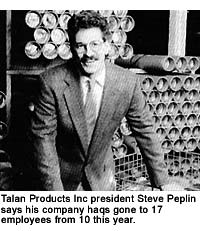
The city’s small manufacturers are upbeat about near-term spending and hiring plans, according to a survey 100 neighborhood manufacturers by the non-profit Westside Industrial Retention and Expansion Network.
“I was surprised by the large number of companies that said they were adding jobs and by the 70% who said they will be making capital investments,” said WIRE-Net director John CoIm.
According to the WIRE-Net survey, which was conducted in July and completed last week, 61% of the respondents said they would add an average of at least three jobs before the end of the year.
“This is almost a 5% expansion in the average work force size for responding companies,” Mr. CoIm said. In addition, 71% told Mr. Coim they had capital spending projects on the drawing boards; their planned investments total $8 million. About 40 member companies of WIRE-Net answered the questionnaire, Mr. CoIm said.
A rebounding auto industry and an aggressive cost-cutting strategy were cited by two of the WIRE-Net members as responsible for their good fortune this year.
“We figure out a way to do something at less cost,” said Steve Peplin, president of Talan Products Inc., a 6-year-old metal-stamping company at 1985 W. 68th St. “We’re lean; we’re efficient, and we work for slim profit margins.
Mr. Peplin said Talan started the year with 10 employees and now has 17.
“We are looking at a record year, with sales up 35% to 40% from last year,’ he said.
